


IT in Manufacturing


Get full value from data science

October 2020 IT in Manufacturing

Data is easily collected and stored, but in most cases the data pipeline stops here and there is hardly any value extracted from the data. The data pipeline is often not completed in a proper way so that the right person(s) can easily exploit the value inside the data. It is a challenge to extract the value from the huge stream of data and not to drown in the flood. Simply collecting and storing data is not enough to monetise any investments in Industry 4.0 and IIoT infrastructure.

Getting the maximum value out of the data and keeping an overview of data streams goes beyond standard statistical methods and tooling. Manual analysis and creation of dashboards and reports are not sufficient. The dashboards become too complicated and often do not show the right information at the right time, in the right way, to be able to see at a glance what is going on and be able to act. The routines implemented in a normal machine controller to observe the production process and to detect errors can detect present deviations and problems, but are not suitable to predict future problems. Machine controllers are not suitable to combine all available information and to perform advanced analytics on it.

IT vs OT

Most organisations understand the roles and functions of Information Technology (IT), but in the context of its relationship to Operational Technology (OT), it is probably worth expanding. In simple business terms, IT refers to the application of network, storage, and compute resources toward the generation, management, storage, and delivery of data throughout and between organisations.

Compared with IT, OT is unique in that related hardware and software is historically designed to do specific things, i.e., control heat, monitor mechanical performance, and trigger emergency shutoffs, to name a few. Typically, this is done through industrial control systems (ICS) and supervisory control and data acquisition (scada).

While IT and OT have historically made up separate aspects of modern organisations, a phenomenon known as IT-OT convergence is changing this. Since IIoT technology takes assets not typically connected to the Internet – such as assembly line machinery – and bringing them online, enterprises now have the opportunity to create new efficiencies by applying the intelligence of IT to the physical assets of OT systems.

Transforming data into information

The valuable information needs to be extracted from the data and presented to the right audience, at the right time, and in the right way. The key is to put enough effort into the transformation process of the data into useful information, which should be done in close collaboration between data scientists, who know how to tame the data, and domain experts of the manufacturing process, who know the story behind the data. Once data is transformed into information, a solution can be developed that brings value in the long run.

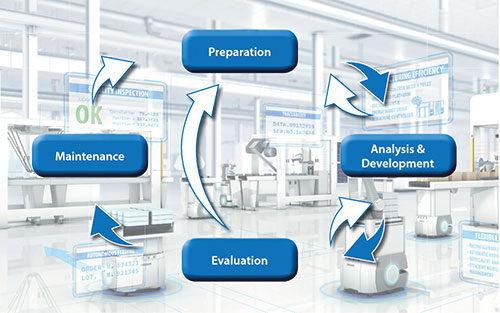
Industrial Data Science is a fairly new discipline and there is no one-size-fits-all solution as of yet. Each solution and application needs tailored data analysis and modelling to obtain the maximum result. Data scientists at Omron follow a standard approach to obtain the best project results and to manage the expectations. The approach is based on the CRISP-DM model. CRISP-DM is the acronym for Cross-Industry Standard Process for Data Mining and is widely used.

It is challenging to use the potential of big data. Just collecting it and displaying some graphs is not sufficient. The valuable information needs to be extracted from the data and presented to the right audience, at the right time and in the right way.


Credit(s)


Share this article:
Share via emailShare via LinkedInPrint this page

Further reading:

How digital infrastructure design choices will decide who wins in AI
Schneider Electric South Africa IT in Manufacturing
As AI drives continues to disrupt industries across the world, the race is no longer just about smarter models or better data. It’s about building infrastructure powerful enough to support innovation at scale.

Read more...
How quantum computing and AI are driving the next wave of cyber defence innovation
IT in Manufacturing
We are standing at the edge of a new cybersecurity frontier, shaped by quantum computing, AI and the ever-expanding IIoT. To stay ahead of increasingly sophisticated threats, organisations must embrace a new paradigm that is proactive, integrated and rooted in zero-trust architectures.

Read more...
2026: The Year of AI execution for South African businesses
IT in Manufacturing
As we start 2026, artificial intelligence in South Africa is entering a new era defined not by experimentation, but by execution. Across the region, the conversation is shifting from “how do we build AI?” to “how do we power, govern and scale it responsibly?”

Read more...
Five key insights we gained about AI in 2025
IT in Manufacturing
As 2025 draws to a close, African businesses can look back on one of the most pivotal years in AI adoption to date as organisations tested, deployed and learned from AI at pace. Some thrived and others stumbled. But the lessons that emerged are clear.

Read more...
South Africa’s AI development ranks 63rd in the world
IT in Manufacturing
The seventh edition of the Digital Quality of Life Index by cybersecurity company, Surfshark ranks South Africa 75th globally.

Read more...
Optimising MRO operations through artificial intelligence
RS South Africa IT in Manufacturing
AI is reshaping industrial operations at every level in the maintenance, repair and operations supply chain, where it is driving efficiency, predictive insight and smarter decision making.

Read more...
Data centres in an AI-driven future
Schneider Electric South Africa IT in Manufacturing
A profound transformation will begin to take hold in 2026 as AI becomes ever more ingrained in every aspect of life, and the focus shifts from LLMs to AI inferencing.

Read more...
Driving innovation in agricultural machinery
Siemens South Africa IT in Manufacturing
A leading Argentine agricultural machinery manufacturer, Crucianelli has adopted the Siemens Xcelerator portfolio of industry software to drive innovation and digital transformation of its business, from product ideation and development to production and to its extended dealer network.

Read more...
Don’t let the digital twin drift from reality
Schneider Electric South Africa IT in Manufacturing
The digital twins is a highly effective tool that offers real-world scenarios within a virtual environment. However, there is the danger of a disconnect stemming from a communication failure between the design, construction and operations phases of a project.

Read more...
Install and commissioning time cut by 50% thanks to digital twin insights
IT in Manufacturing
ECM Technologies, a world leader in the design and manufacture of innovative and modular low-pressure carburising industrial furnaces, has developed a solution that removes many of the installation and commissioning challenges relating to the development, testing and deployment of large-scale heat treatment plants.

Read more...


While every effort has been made to ensure the accuracy of the information contained herein, the publisher and its agents cannot be held responsible for any errors contained, or any loss incurred as a result. Articles published do not necessarily reflect the views of the publishers. The editor reserves the right to alter or cut copy. Articles submitted are deemed to have been cleared for publication. Advertisements and company contact details are published as provided by the advertiser. Technews Publishing (Pty) Ltd cannot be held responsible for the accuracy or veracity of supplied material.


© Technews Publishing (Pty) Ltd | All Rights Reserved

