Mines reduce fire hazards
August 2020
Electrical Power & Protection
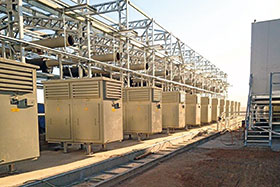
Underground mines in southern, central, and west Africa have been seeing the safety benefits of dry-type transformers from Johannesburg-based Trafo Power Solutions.
According to managing director David Claassen, this clientele even includes collieries, where the strictest safety regulations apply with regard to fire hazards.
“The high risk of fire in underground coal mining environments has led to a high demand for dry-type transformers,” adds Claassen. “Among the fire risks that coal mines face are transformer short-circuits as well as fires reaching the transformer.”
He notes that dry-type transformer technology is rated Class F1 in terms of fire protection, ensuring that transformers supplied by Trafo Power Solutions are flame-retardant. “Oil-cooled transformers, on the other hand, are a fire risk due to the oil they contain to cool the windings,” he outlines. “The risk is heightened by the harsh operating conditions in which many transformers must function on mines.”
These transformers also require regular attention and maintenance. Oil samples must be taken at prescribed intervals, and these must be tested at a laboratory with the appropriate accreditation. Testing must be conducted to ensure that oil purity is within bounds, and to check for gas levels and pressure build-up in the oil tank.
“This maintenance can present challenges and added costs if the equipment is located on a remote mine far from a source of expertise and the right equipment,” explains Claassen. “With dry-type transformers, it is really only the temperature that requires monitoring. The equipment comprises limited componentry, so generally requires servicing only twice a year.”
He highlights that these regular inspections are brief and simple, taking just a couple of hours. Key aspects to be checked are the physical termination connections – which must be tightened to the right torque – and any dust that has gathered around the core and windings must be cleaned away.
Trafo Power Solutions has in recent years supplied dry-type transformers – along with ancillary power equipment such as low and medium voltage switchgear – to mines in South Africa, Mozambique, Zambia, the Democratic Republic of Congo, Ghana and Sierra Leone. In addition to coal, there are gold and base metal producers included in this clientele.
Further reading:
Africa’s net-zero ambition must become operational
Schneider Electric South Africa
Electrical Power & Protection
Schneider Electric’s Rohit Chashta argues that the biggest gap in Africa’s green transition is not ambition but execution, and outlines how advisory services, bankable project roadmaps, digital visibility and SF6-free switchgear can turn sustainability commitments into measurable progress.
Read more...
High-efficiency half-brick DC-DC converters
Vepac Electronics
Electrical Power & Protection
The Supreme series half-brick DC-DC converters from Vepac Electronics use synchronous rectification for high conversion efficiency, in a six-sided metal case built to withstand harsh industrial and transportation environments.
Read more...
Zinc-based batteries power a more sustainable energy future
Electrical Power & Protection
Zinc-based batteries are gaining ground as a safe, recyclable and cost-effective energy storage option, from consumer electronics to grid-scale systems. The International Zinc Association’s Simon Norton explains why zinc is well placed to support the clean energy transition.
Read more...
Energas introduces lower-cost German gas genset for South African market
Electrical Power & Protection
Energas Technologies will supply R Schmitt Enertec’s new Energy Line genset to the South African market, offering German-engineered gas-to-power generation of 400 to 500 kW at a lower entry cost through focused standardisation and a simpler standalone architecture.
Read more...
ACTOM plays key role in large transmission substation project in Swellendam
ACTOM Electrical Machines
Electrical Power & Protection
ACTOM has been appointed to engineer, procure, construct and commission the 1000 MVA main transmission substation for the Overberg Wind Farm in Swellendam, one of the largest substations of its kind in South Africa.
Read more...
Reliable power conversion from high-voltage DC buses
Conical Technologies
Electrical Power & Protection
The MEAN WELL DDRH-240 from Conical Technologies is a high-reliability DIN-rail DC-DC converter with a wide 250 to 1500 V DC input range, deriving stable low-voltage power directly from high-voltage DC buses in renewable energy, storage, charging, railway and industrial installations.
Read more...
AES maintains a strong value and safety stance on boiler retrofits
Electrical Power & Protection
AES Commercial Director Dennis Williams explains when a boiler retrofit makes more sense than replacement, outlines the range of efficiency and emissions upgrades available, and draws the line at safety: a boiler not legally signed off is shut down, no exceptions.
Read more...
The grid needs to become more intelligent
Schneider Electric South Africa
Electrical Power & Protection
South Africa’s power grid is becoming bidirectional and far more dynamic as distributed energy resources proliferate. Schneider Electric’s Nishandra Bajinath explains why digitalisation, DERMS and aggregation are essential to keep this increasingly complex grid stable and efficient.
Read more...
ACTOM’s integrated electrical solutions reduce project risk and accelerate delivery
Electrical Power & Protection
ACTOM has secured multiple orders across four divisions for the Naos-1 hybrid solar and battery project in the Free State, demonstrating its integrated model for supplying the full electrical chain from high-voltage equipment to distribution transformers.
Read more...
Smarter energy management starts with intelligent electrification
ABB South Africa ABB Electrification Products
Electrical Power & Protection
ABB Electrification specialists Adeline Maleka and Nokulunga Dube explain how the convergence of electrification, digitalisation and automation is helping South African industries gain real-time visibility, reduce energy waste and build operational resilience.
Read more...










 printer friendly version