



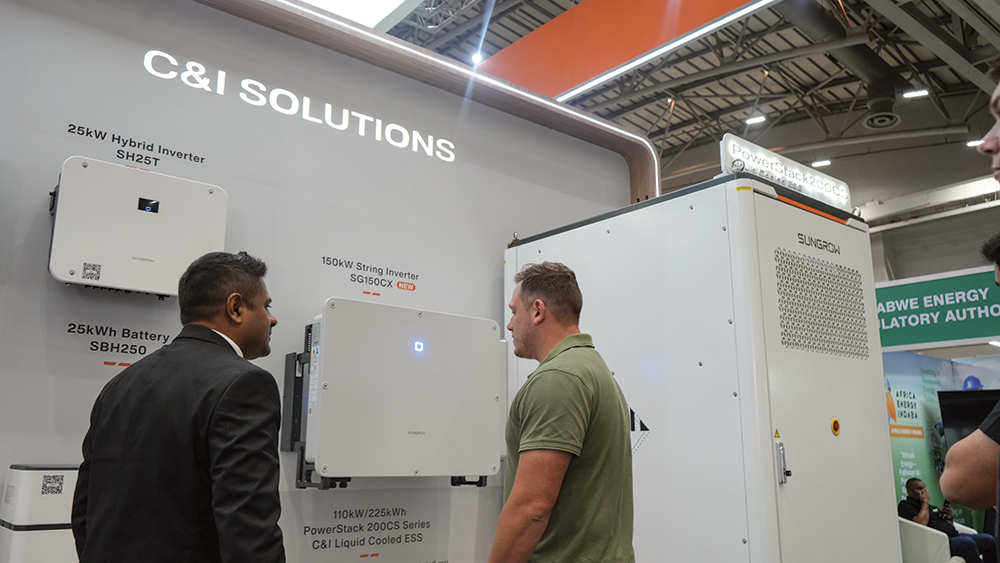
Energy storage is no longer an add-on but the foundation of a reliable, resilient and renewable energy system. “As South Africa accelerates towards a greener future, storage innovation could determine the difference between progress and paralysis,” says Ezzat Sankari, channels business director across Middle East, Africa and Central Asia at Sungrow.
South Africa’s energy system is at a crossroads, facing a worsening electricity crisis, rising demand and ambitious decarbonisation goals. While renewable energy is rightly heralded as a key solution, it is often misunderstood as the silver bullet to enable sustainable power generation. In truth, generation alone won’t solve the country’s energy woes. The real missing link in South Africa’s energy puzzle is storage.
Despite steady progress in solar and wind adoption, these clean energy sources are, by nature, intermittent. Solar panels don’t generate power at night and wind turbines are silent on still days. Yet, our demand for electricity doesn’t follow the weather but rather daily routines, industrial activity and seasonal fluctuations. This mismatch between supply and demand is at the heart of South Africa’s ongoing energy instability. While adding generation capacity is part of the solution, it is only effective if that energy can be stored and dispatched when needed. Without storage, surplus power generated during peak sunlight hours is wasted and the grid remains vulnerable to sudden demand spikes or generation failures.

Storage enables ‘load-shifting’: the ability to absorb excess energy and release it later during evening peaks or grid outages. This function is not merely a convenience but a critical buffer for grid reliability, especially as more variable renewables are added to the mix. For communities, businesses and municipalities alike, storage means fewer disruptions, lower reliance on diesel and greater autonomy in energy management.
Moreover, South Africa’s geography and grid layout present unique challenges. Rural and coastal regions often face infrastructure deficits, harsh environmental conditions or transmission bottlenecks that make traditional energy solutions difficult to deploy at scale. Storage offers a way to decentralise power, enabling localised microgrids that are more resilient to the national grid instability.
To unlock the full potential of renewables, South Africa must prioritise investment in energy storage across all levels - utility, commercial and residential; but that also requires robust, future-ready technology that is built for local conditions.
This is where Sungrow, a global leader in renewable energy solutions, can contribute to the conversation. The company has seen firsthand how purpose-built energy storage systems can transform unstable grids into resilient, clean energy ecosystems. Their technologies are specifically engineered to operate in the demanding South African climate with protective features that ensure consistent performance, even in high heat, humidity or dust.
Sungrow’s latest innovations include DC-coupled hybrid inverters which seamlessly integrate solar generation with storage, reducing energy loss and increasing self-consumption. Advanced AI-powered energy management systems forecast usage patterns, optimise charging based on grid conditions and tariffs, and reduce operational costs − all critical for both businesses and homes looking to maximise their solar investments.
Scalable, liquid-cooled energy storage systems such as the PowerTitan, which offer grid-forming capabilities, are enabling the rise of microgrids in areas where traditional infrastructure can’t keep up. These systems not only provide backup during outages but can also serve as independent power hubs in underserved or off-grid communities.
International case studies from Australia to Finland demonstrate what’s possible when storage is prioritised. In South Africa, a recent hybrid installation that combined 115 MW of solar with 96 MW of storage and wind using Sungrow 1+X SG6600UD-MV-20 and ST2752UX system represents one of the most advanced examples of integrated clean energy, showcasing what’s possible with the right mix of innovation and intention.
South Africa’s energy crisis cannot be solved with generation alone. Without the ability to store and strategically deploy clean energy, even the most ambitious renewable plans will fall short. Storage is the critical enabler that turns potential into performance and instability into resilience.
The message is clear: energy that isn’t stored, is energy lost. For South Africa to realise its clean energy ambitions, it must invest not only in generation but in retention, because only then can we move from crisis response to true energy transformation.






© Technews Publishing (Pty) Ltd | All Rights Reserved
 printer friendly version