



Steel consumers and competitive market conditions are driving steel mills to produce higher quality products more cost effectively. In order to meet these demands, steel mills must implement better controls to manage the temperatures and surface characteristics of the steel strip during the annealing process.
High strength steels for the automotive industry require tight temperature control in order to maintain material properties and keep scrap rates and coil reheats to a minimum.
Traditionally, single-wavelength and dual-wavelength infrared thermometers (ie ratio or two-colour) have been used for strip temperature control within an annealing line. As the graph in Figure 1 illustrates, the fundamental challenge with using these sensors is that their accuracy can vary greatly with the emissivity of the steel strip. Unfortunately in an annealing process, the emissivity of the steel strip can vary significantly and unpredictably due to:
* Changes in alloy, surface texture, surface oxidation, grain growth, and elemental migration.
* Abnormal operating conditions, such as a furnace leak, a bad roller, or a reheated coil.
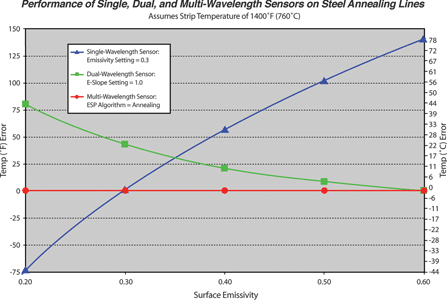
The best illustration that these temperature errors exist is when product properties do not correlate with the measured strip temperatures, or when a phantom temperature change occurs at the welded seam of the strip. With single- and dual-wavelength sensors, the approach to eliminating errors has been to make adjustments to the sensors for each product, but as Table 1 illustrates, this strategy has limits with being able to satisfy all of the annealing line requirements.
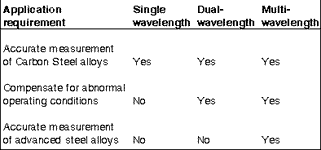
Williamson's multiwavelength sensor is specifically designed to meet the challenging requirements of annealing lines. Without the need to make any adjustments, this sensor provides more accurate and reliable temperature measurements across a wide range of steel alloys under a variety of operating conditions. With these high performance sensors, it is possible to obtain tighter control of physical properties, as well as reduce scrap rates, coil reheats, and costly coil downgrades.
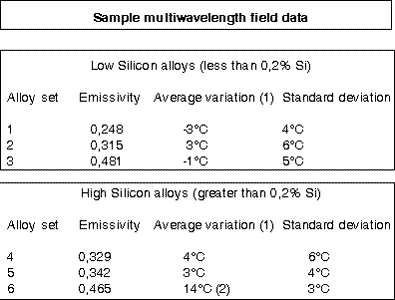
Williamson's PRO Series multiwavelength sensor was specifically developed to compensate for the challenging requirements of a steel mill annealing line. The sensor uses an ESP algorithm that considers infrared energy, emissivity, and the measured wavelengths to accurately calculate the strip temperature and the surface emissivity. The algorithm is a computer based empirical model that was developed from extensive data that was collected from off-line simulations and on-line tests. As the sample data in Table 2 illustrates, one ESP algorithm can be used for accurate measurements on most steel alloys including, carbon steels, tool steels, dual-phase steels, and high strength steels. Additional ESP algorithms exist for stainless steels, electrical steels, coated steels, and high temperature steels.
With the ability to provide realtime emissivity measurements, the PRO 110 can be used to verify measurement conditions, as well as optimise the radiant heat transfer and line speeds throughout the furnace. All combined, these capabilities help to produce better quality steel more consistently and more efficiently.
As the unit is able to make more accurate temperature measurements under a wide range of operating conditions, it offers the flexibility of installing sensors in more locations along the annealing line for greater control of process temperatures:
* For straight-pass furnaces, one or more sensors can be placed at the exit of the flame-heating section, the exit of the radiant-heating section and at the exit of the cooling zone.
* For serpentine-pass furnaces, multiple sensors can be placed within several heating and cooling zones.
* For hot dip lines, a sensor is placed at the snout.
* For galvaneal lines, sensors are placed at the exit of the heating zone (often an induction heating system) and just before the 'turn roll' where the coated strip must be below 650°F (350°C) before it contacts the roll and causes surface damage.
Features of multi-wavelength sensors
* Accurate temperature measurements without any adjustments to the sensor on carbon steels, tool steels, high strength steels, electrical steels, stainless steels, and high temperature steels.
* Automatic compensation for strip emissivity and e-slope variation.
* Realtime measurement of strip temperature and surface emissivity for process verification and optimisation.
* Dramatic reduction in sensitivity to warm furnace wall reflections.
Advantages of emissivity measurements
* High emissivity strip absorbs heat more efficiently, resulting in faster line speeds at lower zone temperatures.
* Low emissivity strip has a smoother surface texture resulting in a smoother finish.
* Stable and reasonable emissivity values validate operating conditions, surface texture, and crystal structure.
* Increasing emissivity values indicate oxide growth or surface defects that could be caused by changes in the hydrogen levels of the furnace.
Recommended locations for sensor
1. Direct flame and radiant tube heating zones: installation requires a cooled viewing tube to eliminate interference from reflections off the hot furnace walls.
2. Cooling zones: nNo special mounting provisions required.
3. Inter-connecting ductwork: for low-emissivity strips or advanced alloys, this location requires a cooled viewing tube. For high emissivity or carbon steels, no special mounting provisions are required because the multiwavelength sensor is less sensitive to hot background reflections.
4. Nip measurement technique: single-, dual-, or multiwavelength sensors may be used. Dual- and multiwavelength sensors tolerate misalignment to the roller nip.
For more information contact Andy Brown, Temperature Controls, +27 (0)11 791 6000, [email protected], www.tempcon.co.za
| Tel: | +27 11 791 6000 |
| Email: | [email protected] |
| www: | www.tempcon.co.za |
| Articles: | More information and articles about Temperature Controls |






© Technews Publishing (Pty) Ltd | All Rights Reserved
 printer friendly version