


Fieldbus & Industrial Networking


Wireless monitoring solution at Optimum Coal

Technews Industry Guide - Wireless 2014 Fieldbus & Industrial Networking Industrial Wireless

Optimum Coal – Koornfontein, is a coal processing plant in Mpumalanga situated between Emalahleni (Witbank) and Hendrina. The plant, spread over a wide geographic area as shown in the satellite photograph, needed to draw information from the remote pump stations located at the dams and bring it back to the central control room for processing. The distances involved (over 2 km) ruled out the possibility of a wired solution, which meant that a wireless telemetry network would be required. It was at this point that Allpronix was brought in to assist with the design architecture.
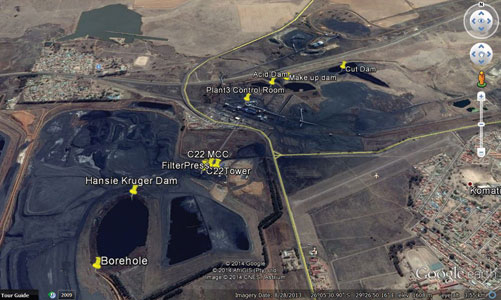
“What was initially required was to bring the water levels back to the central scada system for monitoring and control purposes,” says Allpronix field and instrument engineer, Jurie Weidemann. “But subsequently we found that there were other areas of the plant that could benefit from the wireless telemetry system we had in mind.

“There are currently a total of 8 main wireless links that are being used for plant monitoring, telemetry and PLC/scada diagnostics and troubleshooting. The network is a combination of 5 and 2,4 GHz components, the 5 GHz with its faster data rate is used as the backbone network to cut down on possible interference and the 2,4 GHz is used for the close proximity links. As the plant expands, more links will be added to the network with a total of 35 CPEs (customer premises equipment) expected to make up the final wireless network spread across the plant and surrounding pump stations.”

Equipment used in the network design so far includes:

* Airlive Outdoor wireless CPEs: 2,4 GHz – 802.11g compliant max 54 Mbit/s.

* Airlive Outdoor wireless CPEs: 5 GHz – 802.11a/n compliant with 1T1R technology max 150 Mbit/s.

* I/O over Ethernet: Acromag. Korenix JetNet 2005 – unmanaged 5-port switch.

The Airlive CPEs are powered using passive POE through 12 VDC POE injectors via the shielded CAT5 cable used to connect to the network through Allpronix supplied Korenix 2005, 5 port, as well as other unmanaged switches. The RJ45 connectors are wired as patch cables according to the T568B colour code as set out by the TIA/EIA-568 standard: http://en.wikipedia.org/wiki/TIA/EIA-568

Project progress: problems experienced, corrective action and fine tuning

In South Africa, there are 13 available channels for 2,4 GHz CPEs. Initially, the network was set up ad-hoc, with not much attention given to interference between channels or interference from power lines and other sources. The drawback using 2,4 GHz is that the frequency of the harmonics generated by heavy electrical machinery and power lines are often in this range and can therefore cause interference. Also, due to channel overlap, it is best practice to have five degrees of separation between the channels of neighbouring access points.

Figure 1. 802.11b/g channels in 2,4 GHz band.

As shown in Figure 1, channels 1, 6 and 11 do not interfere with each other at all. Figure 2 shows how the channels and access points can be arranged to avoid interference when the concentration of access points is high.
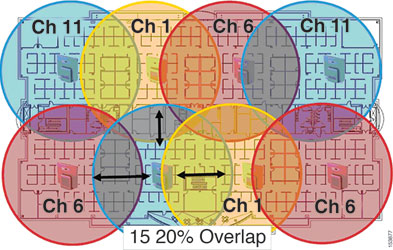
Figure 2. Channel separation.

“We encountered interference primarily on two of the wireless links, namely the link from ‘Plant 3 Control Room’ to ‘C22 Tower’ and the link from ‘C22 Conveyer’ to the ‘FilterPress’,” explains Weidemann. “These two links would work fine for intervals, but would then require a reboot to re-establish the network. The stability of these two links has subsequently been vastly improved by replacing the existing 2,4 GHz CPEs with Airlive’s AirMax5N-ESD, 5 GHz versions, while still keeping possible channel interference in mind. Each link is established by setting up one CPE as an access point and the other as a client. AirMax units are directional and the 16 dBi internal antenna provides the necessary transmitting power to establish reliable wireless communication on a stable 5 GHz frequency band.”

The table shows the current network layout.
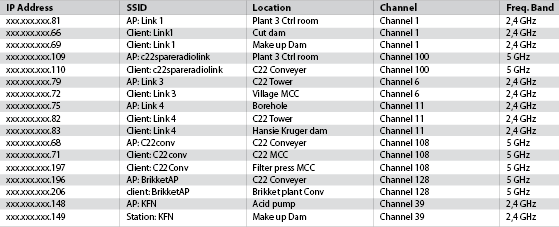
Figure 3 shows the network topology of the current links as well as the ‘project in progress’ links. It also shows where there are PLCs and switches that connect all the wireless units to the main network.
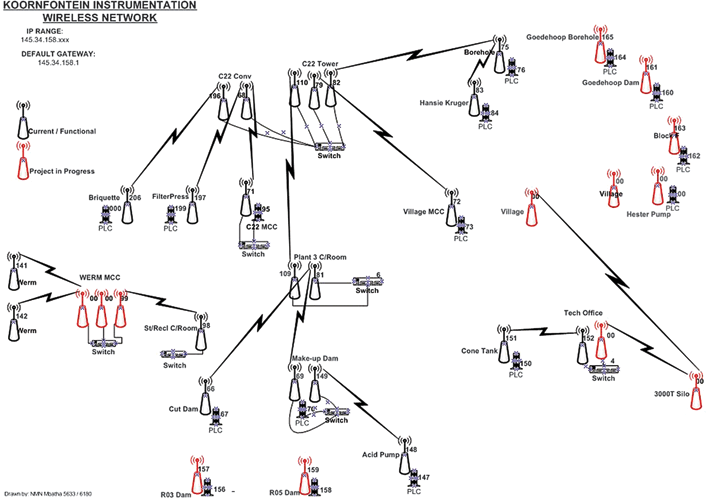
Figure 3. Topology diagram.

“As is evident from the diagram, this project is a work in progress and as there is still plenty of plant expansion in the pipeline, the telemetry network will have to grow as required in order to meet the increased demand,” concludes Weidemann.

For more information contact Jurie Weidemann, Allpronix, +27 (0) 11 795 9500, jurie@allpronix.com, www.allpronix.com


Credit(s)


Share this article:
Share via emailShare via LinkedInPrint this page

Further reading:

Why secure industrial communication depends on deployment as well
Fieldbus & Industrial Networking
The Industrial Security Harmonisation Group has released a joint industry perspective highlighting a critical truth in industrial cybersecurity: secure communication is not determined by protocols alone, but by how they are deployed and managed in real-world environments.

Read more...
A single platform for all automation functions
Beckhoff Automation Fieldbus & Industrial Networking
The introduction of TwinCAT in 1996 marked a decisive evolutionary step for PC-based control. Today, the TwinCAT platform combines all automation functions in a strictly deterministic real-time environment, from PLC and motion control through CNC and measurement technology and beyond, to vision, robotics and pioneering AI tools.

Read more...
Loop signature Part 2-4: Feedforward Control: Part 3
Michael Brown Control Engineering Editor's Choice Fieldbus & Industrial Networking
In the previous articles in this series, the basic theory behind feedforward control was discussed, and it was also shown how to apply feedforward in practice. In this article, it will be shown how well feedforward can work in practice by giving a couple of examples.

Read more...
Control Station and Dimension Software partner to connect control performance monitoring with enterprise operations intelligence
Fieldbus & Industrial Networking
Control Station has entered into a strategic technology partnership with Dimension Software, a leading provider of industrial operations management platforms. The collaboration connects Control Station’s PlantESP control loop performance monitoring platform with Dimension Software’s Asset Intellect operations intelligence environment, enabling manufacturers to operationalise control performance insights across their organisations.

Read more...
PCIe digitiser cards for optimal GHz signal acquisition and analysis
Vepac Electronics Fieldbus & Industrial Networking
The addition of two new PCIe Digitiser cards from Spectrum Instrumentation extends the company’s flagship M5i series to deliver optimal GHz signal acquisition and analysis capabilities.

Read more...
Precise, synchronised control for automated steel mesh handling system
Fieldbus & Industrial Networking
Automation specialist Hambi Maschinenbau has developed a world-first system that automates the cutting, handling and stacking of heavy reinforcing steel mesh – a task that previously required up to six human operators.

Read more...
Loop signature Part 2-3: Feedforward Control: Part 2
Michael Brown Control Engineering Editor's Choice Fieldbus & Industrial Networking
Feedforward control tuning is not nearly as critical as feedback tuning, and fairly simple models are usually fine for the purpose in hand.

Read more...
Upgrading radiological surveillance systems in nuclear facilities
Omniflex Remote Monitoring Specialists Fieldbus & Industrial Networking
Nuclear plant operators face an uncomfortable reality. Many of the control and monitoring systems still in use today were never designed to support the full operational lifespan of the facilities they serve.

Read more...
Next-level CAN Software enables easy access to CAN XL
Industrial Data Xchange (IDX) Fieldbus & Industrial Networking
With the release of its PCAN-Explorer 7, PEAK delivers a major update that adds full support for CAN XL, multiple symbol files per connection, Python scripting and flexible licensing including floating licenses.

Read more...
Loop signature Part 2-2: Feedforward Control: Part 1
Michael Brown Control Engineering Fieldbus & Industrial Networking
Feedforward control is a powerful technique that can dramatically improve control variance in cases where load changes cause big deviations from setpoint and the actual process dynamics are too slow to allow the feedback controller to operate fast enough to catch these disturbances.

Read more...


While every effort has been made to ensure the accuracy of the information contained herein, the publisher and its agents cannot be held responsible for any errors contained, or any loss incurred as a result. Articles published do not necessarily reflect the views of the publishers. The editor reserves the right to alter or cut copy. Articles submitted are deemed to have been cleared for publication. Advertisements and company contact details are published as provided by the advertiser. Technews Publishing (Pty) Ltd cannot be held responsible for the accuracy or veracity of supplied material.


© Technews Publishing (Pty) Ltd | All Rights Reserved

