



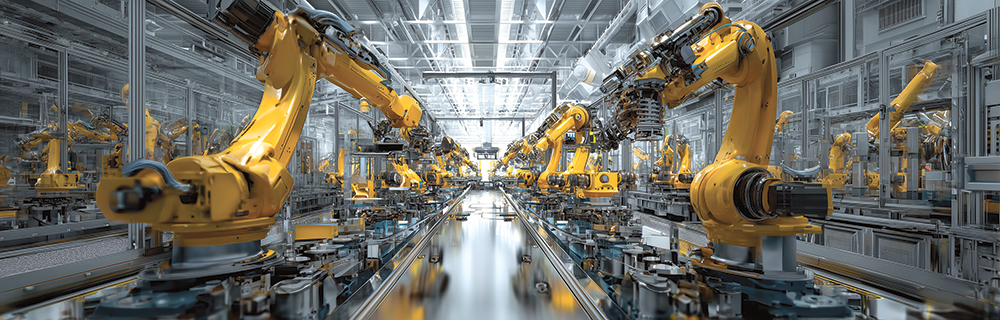
Imagine walking into a factory where machines can think ahead, predict problems before they happen and automatically make adjustments to realise peak performance. This isn’t science fiction, it’s happening right now as AI continues to transform how we run industrial operations.
But as all who have been on this journey know, not all AI is created equal. Today’s factories mainly rely on narrow AI, which are systems designed to perform specific tasks such as detecting product defects or predicting equipment failures.
The next step would be general AI that will allow machines to apply knowledge across different areas, more like a human operator. Further down the line lies artificial superintelligence, where machines outperform humans in every respect. This is still distant and even a bit daunting, but is part of the conversation about industrial futures.
Put into practice we need to look at the levels of AI containment and its expected evolution with industrial operators:
• Level 1: Monitored systems where human operators approve every decision
• Level 2: Semi-autonomous systems where AI manages routine tasks, flagging complex issues for humans
• Level 3: Autonomous systems where AI controls entire processes with minimal oversight
• Level 4: Networked intelligence where systems across facilities coordinate and share learning
• Level 5: A theoretical stage of unrestricted AI where it continuously redesigns itself, raising governance and safety questions

The engine behind the growth
Machine learning (ML) is the engine behind this transformation, with applications in three broad areas:
• Supervised learning: Predicting process behaviour. Classification algorithms spot abnormal conditions, regression models forecast values such as temperature or pressure, and time-series models anticipate demand or equipment wear.
• Unsupervised learning: Finding hidden patterns. Clustering reveals operational modes, anomaly detection flags subtle faults, and dimensionality reduction identifies key performance drivers.
• Reinforcement learning: The frontier of adaptive control. These algorithms learn optimal strategies through trial and error, balancing competing goals like energy efficiency, throughput and product quality.
Smarter control systems and predictive maintenance
Unlike rigid rule-based controllers, AI-enabled systems evolve with experience. For example, Google cut data centre cooling costs by 40% using AI-driven optimisation. Key technologies include:
• Neural network controllers that handle non-linear processes by learning input-output relationships.
• Fuzzy logic with ML that are self-adjusting rules based on real-time performance.
• Adaptive predictive control that continuously updates models as conditions or equipment change.
Arguably the most visible industrial AI success is predictive maintenance. By spotting small changes before they escalate, downtime is minimised. Techniques include:
• Vibration analysis: Detects wear, imbalance or misalignment
• Thermal imaging: Identifies overheating components
• Oil analysis: Spots contamination or early-stage degradation
• Acoustic monitoring: Picks up subtle sound changes linked to faults
Hurdles and the way forward
While AI continues to transform industrial operations, its rise is not without significant challenges. One of the most persistent hurdles is data quality. Industrial AI systems rely heavily on sensor inputs and poor calibration, noise or missing data can severely undermine model accuracy and reliability.
Equally critical is explainability. Operators and engineers must be able to trust and understand the decisions made by AI systems, especially in high-stakes environments. Without transparency, adoption stalls and human oversight becomes compromised. Security also remains a major consideration. As systems become more autonomous, they present expanded attack surfaces, making robust cybersecurity protocols essential to prevent breaches or sabotage.
Then there’s the issue of integration. Blending multiple AI tools, legacy systems and operational workflows without disrupting production is a complex and delicate task, often requiring bespoke solutions and cross-disciplinary coordination.
Looking ahead, several emerging innovations promise to extend AI’s industrial impact. Quantum-enhanced optimisation could unlock solutions to problems that are currently computationally intractable like real-time supply chain reconfiguration or molecular design.
Furthermore, neuromorphic chips, inspired by the architecture of the human brain, offer energy-efficient processing for edge AI applications, enabling smarter, faster decision-making directly on devices. Also, swarm intelligence introduces a paradigm where multiple AI agents coordinate like ant colonies, offering resilience and adaptability in distributed systems such as logistics or autonomous fleets.
Finally, cross-domain learning allows insights gained in one sector, for example predictive maintenance in aviation, to be transferred and adapted to another such as mining or manufacturing, fostering a more agile and interconnected industrial ecosystem.
| Tel: | +27 11 254 6400 |
| Email: | za-ccc@se.com |
| www: | www.se.com/za/en/ |
| Articles: | More information and articles about Schneider Electric South Africa |






© Technews Publishing (Pty) Ltd | All Rights Reserved
 printer friendly version