


Electrical Power & Protection


Battery energy storage system for microgrids

June 2024 Electrical Power & Protection

Schneider Electric has launched its latest battery energy storage system (BESS), designed and engineered to be a part of a flexible and scalable architecture. BESS is the foundation for a fully integrated microgrid solution that is driven by Schneider Electric’s controls, optimisation, electrical distribution, digital and field services

The climate crisis and geopolitical tension means energy security is not guaranteed today. Resilience can be improved by ensuring access and storage of various onsite energy sources quickly, efficiently and safely. As an integral part of a microgrid system, BESS captures energy from different sources, accumulates this energy, and stores it in rechargeable batteries for later use. Battery energy storage is a distributed energy resource (DER) that enables a wide range of energy use cases, including resiliency, demand-charge reduction, renewable self-consumption, decarbonisation of electrical energy, and variable generation smoothing.

“Reliable energy supply cannot be taken for granted. With over two decades of expertise in power conversion and batteries, storage is at the core of Schneider Electric’s proposition. Now, we are proud to introduce a solution that has been thoroughly designed and tested,” said Bala Vinayagam, Schneider Electric’s senior vice president of microgrids. “Our aim is to deliver this cornerstone technology to the market that enables multiple use cases for resilience, sustainability, and energy cost savings. We are providing greater demand-side flexibility at scale to the microgrid sector by enabling our local expert partners to deliver a safe and compatible system.”
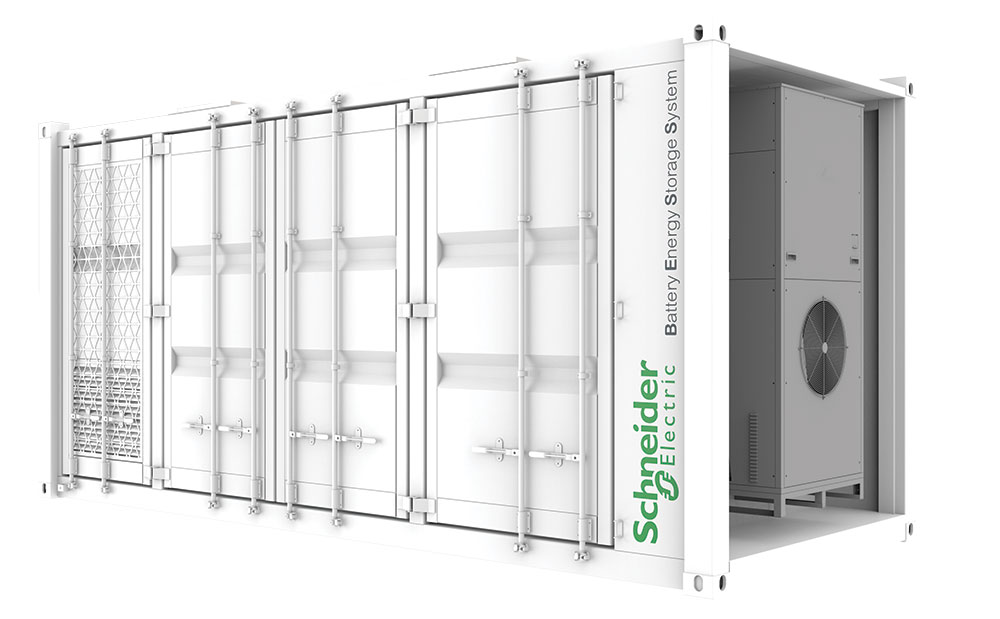
Comprised of battery modules, battery racks, a battery management system, power conversion unit and controller, BESS has been tested and validated to work as an integral component with Schneider Electric’s microgrid systems. It is also fully integrated into the software suite, which includes EcoStruxure Microgrid Operation and EcoStruxure Microgrid Advisor. With defined commercial references and options, selections include configuration and advanced safety controls. BESS minimises energy costs and delivers the following features:

• Full integration capabilities: The all-in-one enclosure seamlessly incorporates pre-integrated components that streamline site engineering, construction and installation processes, while minimising labour and material expenses. The paralleling capability enables multiple BESS units to function as a unified entity. This comprehensive integration encompasses inverters, batteries, cooling systems, transformers, safety features and controls, ensuring optimal performance and efficiency.

• Easy installation and maintenance: The system is ready to deploy, and features tested, validated and documented architecture (TVDA). It also facilitates installation processes, delivering efficiency compared to traditional custom-engineered designs. The solution also seamlessly integrates with Schneider Electric’s energy management systems (EMS), significantly reducing integration time and minimising field errors.

• Safety compliant: The solution is fully certified and compliant using ANSI/UL standards for deployment across multiple geographies, and has a cutting-edge fire safety system design.

• Resilience: The system offers bidirectional connectivity to the grid, providing the flexibility to operate as either grid-connected or off-grid. With the capacity to store energy for immediate access during outages, BESS can deliver up to 2 MW of power when needed.

• Peace of mind: Comprehensive services and support are available throughout the lifecycle of the project, together with warranty execution for optimal maintenance and care.

The BESS is available as a 6 metre NEMA 3R Enclosure that is AC coupled and available from 250 kW to 2 MW in 2h and 4h configurations.

“Our new battery energy storage system marks a significant step forward in enabling storage and connection with distributed energy resources, and is flexible enough to meet future energy demand,” Vinayagam said. “Amidst the global pursuit of net-zero objectives and the imperative for an enhanced grid, we are working closely with our trusted network of partners to deliver the technology required to unlock fully the potential of simplified battery storage and power conversion.”


Credit(s)


Share this article:
Share via emailShare via LinkedInPrint this page

Further reading:

Turning system integrators into trusted technology partners
Schneider Electric South Africa IT in Manufacturing System Integration & Control Systems Design
Schneider Electric’s Alliance Partner Programme is repositioning system integrators from hardware suppliers into lifecycle-value partners. Oriel Soupen explains the competency framework, certification model and real-world results that are already helping African system integrators win higher-value, longer-term engagements.

Read more...
Schneider Electric introduces next-generation BlokSeT switchboard
Schneider Electric South Africa Electrical Power & Protection
Schneider Electric has launched its next-generation BlokSeT low-voltage switchboard in West Africa, offering high reliability, predictive maintenance capability and digital integration for critical infrastructure and industrial applications.

Read more...
Powering South Africa’s renewable energy expansion
Electrical Power & Protection
ACTOM Distribution Transformers, the sole NECRT contract holder for Eskom, is powering South Africa’s renewable energy expansion through robust neutral earthing transformer solutions deployed across solar and wind projects in southern Africa.

Read more...
How a digital foundation can overcome the LNG trilemma
Schneider Electric South Africa IT in Manufacturing SCADA/HMI
The LNG sector is racing to add capacity, but without a digital backbone, growth creates complexity rather than capability. Christophe Begat of Schneider Electric explains how connecting data, systems and analytics across the LNG value chain can resolve the trilemma of secure supply, lower emissions and tighter costs.

Read more...
You can’t digitise a blackout
Schneider Electric South Africa Electrical Power & Protection
Across East Africa, smart meters and AI promise cleaner, more reliable power, but digital tools cannot optimise a grid too weak to carry the load. Schneider Electric’s Symphrose Ochieng sets out why operators should strengthen physical infrastructure first, then add digital capability in phases.

Read more...
Battery energy storage is key to powering South Africa’s manufacturing sector
Electrical Power & Protection
South Africa’s shift to renewables is creating a significant opportunity in battery energy storage, but local manufacturers face an uphill battle against cheap imports and stop-start demand. Richard van Moltke of ACTOM Static Power examines what it will take to build a sustainable local battery storage industry.

Read more...
Decarbonisation is reshaping mining strategy in Africa
Schneider Electric South Africa IT in Manufacturing Electrical Power & Protection
Mining companies across Africa are embedding decarbonisation into operational strategy, driven by investor, regulatory and customer pressure to reduce emissions while improving resilience.

Read more...
How to tell whether your mini-substation is new or refurbished
Electrical Power & Protection
Cosmetically refurbished mini-substations are being misrepresented as new equipment and sold back into the market, posing serious reliability and safety risks for mining, industrial and commercial operations. Trafo Power Solutions explains what to look for and what questions to ask before purchasing.

Read more...
Africa on the edge of a digital future
Schneider Electric South Africa IT in Manufacturing
Edge computing promises lower latency, stronger reliability and real-time responsiveness across Africa, yet its rollout keeps colliding with one stubborn obstacle, power. Steven Santini explores how renewable microgrids, smart energy management and the right partnerships could turn the continent’s energy gap into its biggest edge opportunity.

Read more...
How the DCS can step off the hardware obsolescence treadmill
Schneider Electric South Africa PLCs, DCSs & Controllers
Ageing servers and unsupported operating systems are quietly eroding the stability of process plants that rely on distributed control systems. Kobus Vermeulen of Schneider Electric explains how virtualising the DCS environment can break the hardware obsolescence cycle without disrupting operations.

Read more...


While every effort has been made to ensure the accuracy of the information contained herein, the publisher and its agents cannot be held responsible for any errors contained, or any loss incurred as a result. Articles published do not necessarily reflect the views of the publishers. The editor reserves the right to alter or cut copy. Articles submitted are deemed to have been cleared for publication. Advertisements and company contact details are published as provided by the advertiser. Technews Publishing (Pty) Ltd cannot be held responsible for the accuracy or veracity of supplied material.


© Technews Publishing (Pty) Ltd | All Rights Reserved

