Hydraulic connectors with residual pressure
February 2024
Pneumatics & Hydraulics
Hydraulic connections are vital in both outdoor industrial machinery, for example in agriculture and earthmoving, and in indoor industrial machinery for presses and moulding. Examples include farm tractors attaching to various implements, or excavators using tools like hydraulic hammers or buckets. The goal is to enable quick, easy swaps to enhance machine flexibility and productivity.
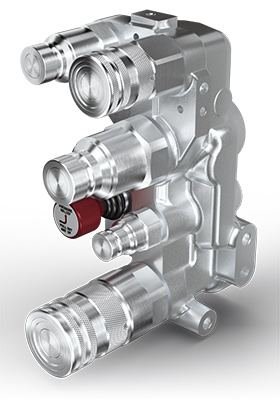
In the past, connecting hydraulic lines involved manually unscrewing couplings on oil-filled hoses, leading to significant oil spillage and environmental pollution. With their occlusion valves, modern quick couplings have largely addressed this by retaining fluid post-disconnection on both the hose and machine side. However, challenges arise when machines or hoses heat up in the sun, causing oil expansion and creating high residual pressure in the lines, up to 100 bar. While certain machines have circuits to mitigate this, and hoses can act as accumulators, the residual pressure often makes connecting quick couplings difficult. Under pressure, the occlusion valves become like rigid hydraulic cylinders, which are hard to connect manually. For instance a common 1,3 cm hose coupling valve has a hydraulic pushing area of 1,5 cm2, translating to a theoretical hydraulic force of 150 kg at 100 bar pressure.
Operators use various methods to overcome this challenge. Some apply excessive force, risking damage to seals and valves. Others strike occlusion valves against hard surfaces to release oil and reduce pressure, leading to environmental pollution and equipment damage. Loosening pipe fittings to drain oil is another method, although it poses safety risks like high-speed oil spray.
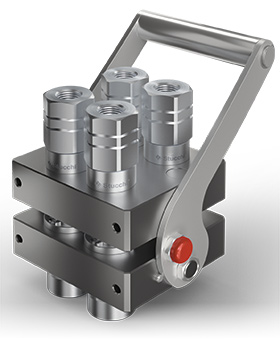
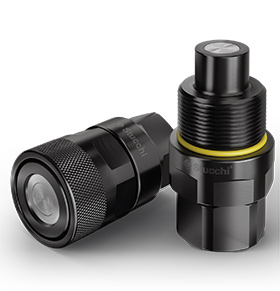
The residual pressure problem incurs costs like wasted time, reduced lifespan of quick valves, machine downtime and potential damage to the brand image. Thanks to the 60 years of field experience of Stucchi Italy, Stucchi South Africa offers various technical solutions to these issues. Innovations include a double internal valve system in the APM series, and A-HD and FAP couplings for manual connection without fluid loss. The screw-to-connect system used in the VP, VEP and VEP-HD series allows easier connection against internal pressure. Stucchi’s latest technology also features a manual knob on the Saturn cast iron block, activating an internal valve to drain excess oil for safe, effortless connections.
For more information contact Stucchi South Africa, +27 11 458 1202, [email protected], www.stucchigroup.com
Further reading:
Electrically operated, energy-efficient double diaphragm pumps
Bearing Man Group t/a BMG
Pneumatics & Hydraulics
BMG has introduced the EVO series 210 electric double diaphragm pump range from ARO, offering lower energy consumption and quieter operation than air-operated alternatives, with access from one side for both diaphragms, and optional electronic leak detection for critical applications.
Read more...
Integrated Air Solutions opens KwaZulu-Natal branch
Pneumatics & Hydraulics
Integrated Air Solutions has opened a KwaZulu-Natal branch in Pinetown, establishing a local turnkey compressed air partner for the province with equipment, installation, servicing, rapid emergency response and rental offerings under one roof.
Read more...
Precision and durability in metal manufacturing and injection moulding
Parker Hannifin - Sales Company South Africa
Pneumatics & Hydraulics
From 800 bar hydraulic circuits in metal presses to low-pressure cooling systems in injection moulding machines, Parker Hannifin’s fluid connector systems are engineered for the contrasting demands of high-pressure sealing, thermal resistance and rapid serviceability.
Read more...
BMG expands fluid technology portfolio with Boston by Danfoss industrial hose
Bearing Man Group t/a BMG
Pneumatics & Hydraulics
BMG has added the Boston by Danfoss Industrial Hose range to its fluid technology portfolio, giving customers a single source for both hydraulic and industrial hose requirements across Africa.
Read more...
Pneumatic solutions for versatility, operational safety and efficiency
Pneumatics & Hydraulics
As an authorised partner of Festo, BMG combines access to globally recognised pneumatic technologies with local application expertise and technical support.
Read more...
Turning compressed air into a strategic energy advantage
Pneumatics & Hydraulics
Compressed air accounts for up to 80% of a system’s lifecycle costs, yet often remains overlooked in energy strategies. CompAir’s Energy Check provides a data-driven analysis of the complete compressed air network to identify energy savings of 20 to 30% or more.
Read more...
Air compressor secures premium meat company’s legacy
Pneumatics & Hydraulics
A tailored ELGi compressed air solution from Integrated Air Solutions is helping Tulisa Meat Market protect six decades of quality and consistency in its premium meat production.
Read more...
How laser cladding delivers 33% more life and maximum ROI in hydraulic cylinders
Pneumatics & Hydraulics
By utilising advanced laser cladding, Honingcraft can help clients achieve a 33% longer life from their components, ensuring they secure the maximum return on their investment.
Read more...
Identifying signs of hydraulic cylinder wear and tear
CT Hydraulics (Nqoba)
Pneumatics & Hydraulics
Recognising the early warning signs of hydraulic cylinder degradation is crucial for preventing costly downtime, ensuring operator safety and maximising the lifespan of your hydraulic systems.
Read more...
Integrated Air Solutions opens Pinetown branch
Pneumatics & Hydraulics
Integrated Air Solutions has opened a branch in Pinetown, bringing world-class diesel and electric air compressor services closer to customers in KwaZulu-Natal.
Read more...










 printer friendly version