



Product safety remains a vital topic for achieving food security across the globe. To date, many manufacturers still question whether digitalisation can help reduce the effort involved in process optimisation, production monitoring and system installation.
The number of food product recalls increases year on year, with the most frequent instances involving products tainted with microbiological contamination and foreign objects. This problem is nevertheless no cause for concern because instead of product quality decreasing, the number of precautionary recalls has risen as manufacturers become more sensitive and react accordingly.
The 2018 DLG trend monitor for investments and trends in the food industry indicates that 65% of the surveyed companies consider food safety a very important factor when making investments in plants and equipment. This contrasts to 15% of the respondents who indicated that digitalisation has a similar priority.
Endress+Hauser furthermore came to the realisation that 97% of the data currently captured by field instruments during the manufacturing process is not utilised. This is tied to a lack of connectivity, which is required to transmit the data from the devices, plus the fact that a higher engineering effort is needed to interpret this information.
Technology from Endress+Hauser makes it possible to unleash this potential
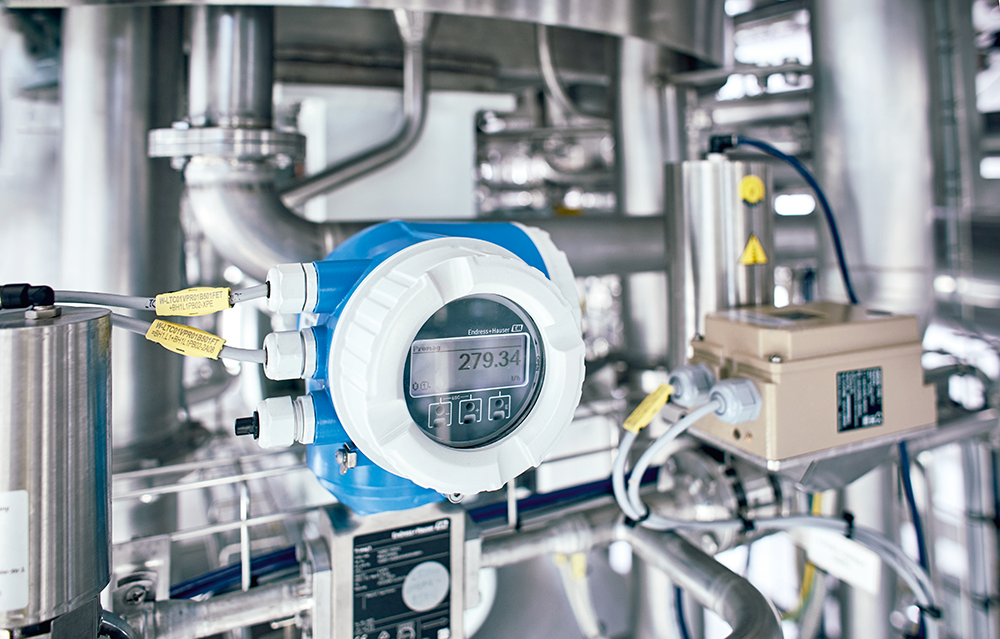
“Smart sensors are the key to digitalisation,” says Dhiren Naidoo, industry manager, Food & Beverage, Endress+Hauser South Africa. “For instance, the Proline 300/500 family of flow meters features an integrated web server, Wi-Fi and self-diagnostics systems.”
Advanced mass flow measurement systems such as the Proline Promass family measure the density and concentration of the medium, in addition to the mass flow. To date, however, key information such as exciter current and vibration frequency and amplitude, as well as 700 other parameters captured by the sensor system, are hardly used.
Conclusions can be drawn from this process data, such as whether the medium contains gas bubbles or if deposits are forming in the process. Level sensors such as Levelflex and Micropilot can detect unexpected foam build-up by analysing this data. These instruments also use the data to perform continuous self-diagnostics, thus enabling instrument verification without interrupting the process. This type of monitoring can also be used as a form of documented verification for processes that require precise dosing of the recipe ingredients essential for product safety.
One field of application is baby food manufacturing. Production continues to run only after the instrument has completed the self-verification. Endress+Hauser merges all these new features into the Heartbeat technology concept.
Data mining and self-learning systems
By collecting measurement data and comparing current and historical information, food industry plant operators can detect quality and process issues at an early stage. The oversized, inefficient cleaning systems still in use today are designed to operate at the highest degree of residue and contamination. In addition, there is limited capability to monitor inline cleaning and automatically document the outcome of the cleaning process.
Digitalisation of production systems
Instruments and production systems generate valuable information during installation, commissioning, utilisation and maintenance across the entire life cycle. Today, this data is mainly available only on a local basis from its creator. This begins with engineering and procurement data and stretches to technical documentation and parameters, then finally ends with the spare parts lists, inspection reports and material certificates.
In case of unwanted downtime or an audit, plant operators need immediate access to this information. A QR code generated by Endress+Hauser thus enables access to instrument-specific documents with the assistance of an operations app. Other information can be supplied in real-time via the Endress+Hauser Netilion IIoT ecosystem, such as the current status of the installed base of process control instruments.
The only thing that is required for the system to access this live data is the installation of an edge device with Internet access. A manufacturer-independent list of all installed instruments is then automatically supplied. The only requirement is that the instruments have a Profibus or HART communications interface.
Endress+Hauser offers edge devices for automatic monitoring of the installed instrument base. Netilion services help to manage and maintain the instruments in an online environment. If the user wishes to access this information directly within the production environment, the installation of an industrial Wi-Fi network is required. One result of this is that smartphones and tablets are increasingly becoming part of the work environment.
Conclusion
When it comes to food product safety during the manufacturing process, the benefits of digitalisation will be indirect for the most part. Process optimisation, production monitoring and maintenance can reduce the effort required to maintain a high level of safety. The food industry is still in the early stages of an evolution in which paths leading to the upgrade of legacy solutions will increasingly become the norm.
Parallel to these efforts, the industry must be able to meet the challenges of IT security, uniform standards for connectivity and hardware, the legal aspects of data privacy and the training and education of qualified specialists.
“While digitalisation can help companies gain mastery of an increasingly complex industrial environment, it must not become a driver of complexity itself,” concludes Naidoo.
| Tel: | +27 11 262 8000 |
| Email: | info.za.sc@endress.com |
| www: | www.endress.com |
| Articles: | More information and articles about Endress+Hauser South Africa |






© Technews Publishing (Pty) Ltd | All Rights Reserved
 printer friendly version