



As power grids continue to scale, key components in the energy sector are growing larger, and this makes their lifting and transportation increasingly challenging. Mammoet is a specialist in getting the world’s biggest and heaviest items to where they need to be. For this reason, it was approached by Maersk Project Logistics to support the inland transportation of a large, heavy transformer from Hitachi Energy’s factory in Ludvika, Sweden.
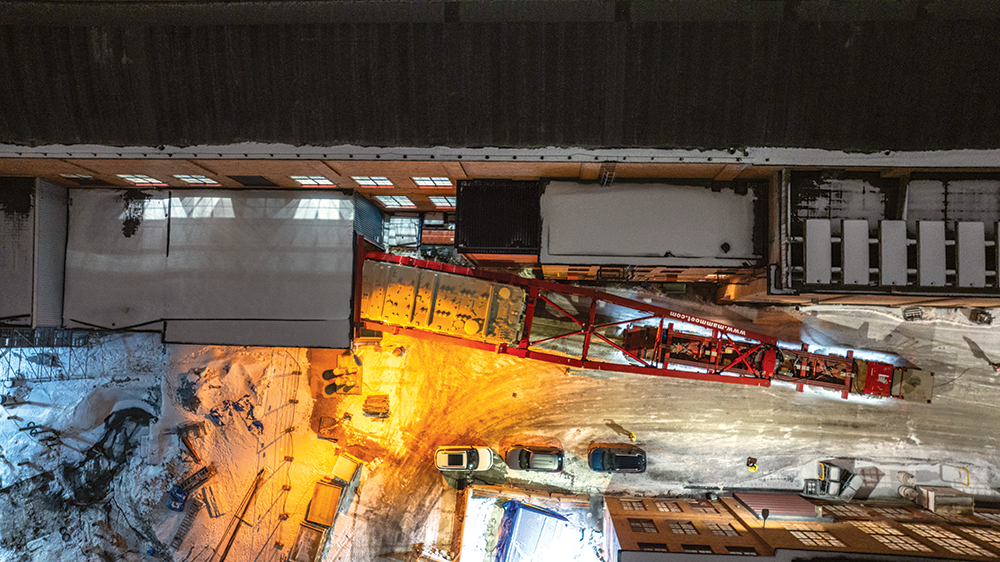
Typically, these components are transported by rail. However, this new, larger-capacity transformer was too heavy for rail, and an alternative solution had to be found. Collaborating with Maersk Project Logistics and Hitachi Energy, Mammoet proposed using its high-capacity AL600 girder frame trailer to move the transformer from factory to port. The frame spread the load over a greater distance, safeguarding road surfaces, and reduced the overall height of the transport to minimise disruption and civil work along the route.
Close collaboration from the start
Because the large transformer exceeded the weight limit for rail transport in Sweden, road was the only viable option. Mammoet engineers proposed a configuration of conventional trailers combined with its high-capacity AL600 girder frame trailer.
The AL600 allows extremely heavy cargoes to be transported close to the ground, making it well suited to overcoming overhead obstructions such as low bridges and power lines. It was more than powerful enough to perform the job, but needed slight modification to meet the stringent lashing requirements of Hitachi Energy. This resulted in the design and fabrication of a specialist adapter for the frame, with Mammoet designing the adapter and Hitachi adjusting the transformer design to ensure a smooth interface.
Maersk Project Logistics managed overall project management, ocean transport routing and road preparation, with Mammoet providing supporting data for the required permits.
100 metres over 130 kilometres
As space inside the facility was limited, the girder frame was driven into the loading area on two 14-line sets of Self-Propelled Modular Transporters (SPMTs), which offered greater manoeuvrability. The transformer was then lifted into the frame using a 500 ton crane. Once outside, the SPMTs were swapped for two 19-line sets of conventional trailers.
These conventional trailers were pulled by two prime movers and a hydraulic drive system which gave extra power to the front six trailer axles, preventing the need for additional trucks. The convoy stretched nearly 100 m in length and weighed more than 800 tons. Over two nights, it made the 130 km journey from Ludvika to Köping Port.
One of the biggest challenges on the route was at the very start. Near the Hitachi factory are two railway lines with no road crossing. To pass the tracks, a temporary passage had to be created to connect the two roads on either side. “This was also one of the biggest challenges for the schedule,” explains William Soeters, project manager at Mammoet. “We had a time window of just three hours to get everything prepared, for the convoy to pass the tracks, and then remove all the materials to allow access for the trains. Had this been missed, it would have caused significant disruption.”
When the convoy arrived at Köping Port, the AL600 was partly dismantled and several conventional trailers were decoupled. The remaining trailers loaded the transformer onto the vessel via a roll-on/roll-off operation, and remained onboard for a one-day sailing to the larger Swedish port of Norrköping.
At Norrköping Port, the transformer was offloaded and driven to a laydown area until it was collected by a heavy-lift vessel bound for China. For this second load-out operation, the transformer was driven to the quayside, allowing the heavy-lift vessel to lift it on board using its crane.
This project demonstrates how Mammoet’s engineers can solve problems and create solutions to achieve results that were not previously possible.
For more information contact Mammoet Global,






© Technews Publishing (Pty) Ltd | All Rights Reserved
 printer friendly version