


Motion Control & Drives


Trends and outlook for actuators in humanoid motion

September 2026 Motion Control & Drives

The humanoid robotics industry is transitioning from prototype development toward structured pilot deployments and early commercial adoption. IDTechEx’s report ‘Materials for Humanoid Robots 2026–2036: Technologies, Players, Forecasts’ expects 2026–2027 to represent key transition years, with more players moving from pilot testing toward production readiness and early-scale rollout.

A major component at the heart of humanoid hardware is the actuator, which drives the physical motion of the robot, allowing humanoids to walk, lift objects, handle tools and interact with the environment. With a 47% compound annual growth rate for humanoid unit sales expected over the next decade, materials manufacturers and component suppliers have emerging opportunities to enter the supply chain of this rapidly growing market.
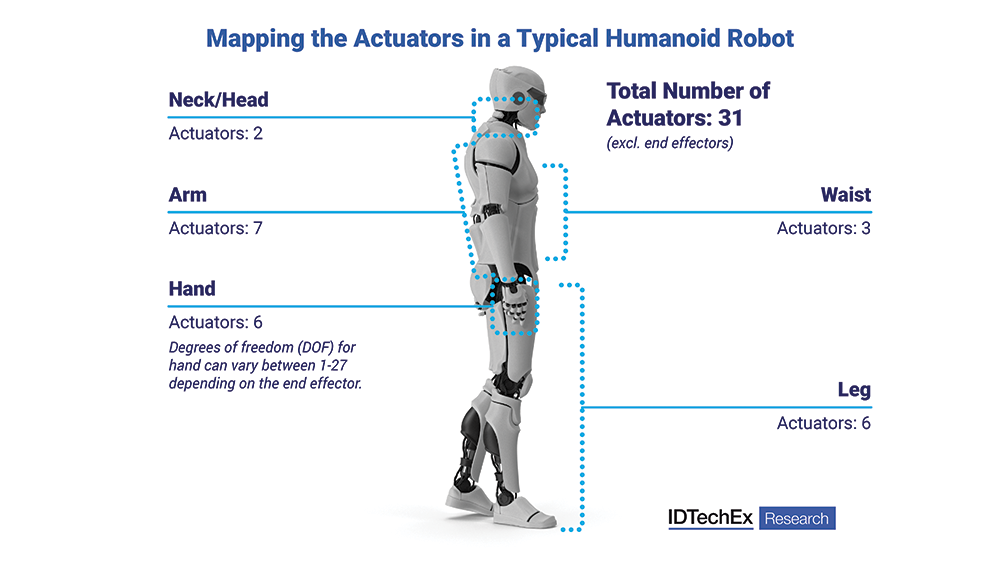
Current state of humanoid actuators

Actuators can be linear and rotary, and use pneumatic, electric or hydraulic power to generate movement, with electric actuators being the most popular among current humanoid robots. IDTechEx analysis of more than 50 humanoid robots and prototypes finds there are typically 31 actuators in a humanoid robot, excluding end-effectors such as grippers or dexterous hands. The actuators vary depending on the requirements of the joint: wrists and ankles typically use smaller actuators, while load-bearing joints like hips and knees require larger, heavy-duty actuators.

IDTechEx estimates that around 56% of the humanoid’s weight comes from actuators alone. These systems rely on rigid, heavy-duty materials such as metal alloys, steel, aluminium and similar metals for key structural components. Rare-earth permanent magnets, such as NdFeB, are critical for actuator motors in humanoid robots, providing high torque density, power density and smoother torque curves. IDTechEx’s report provides detailed insights into material requirements, challenges and 10-year demand forecasts for key materials, including metals and rare-earth permanent magnets.

A future for soft actuators?

Rigid actuators are particularly suitable for heavy-duty movements and loads with high precision often required by humanoid joints. Limitations include poor adaptability to unstructured environments, vulnerability to impact, mechanical wear and fatigue. These systems also use heavy materials such as steel and aluminium alloys which add to the weight and bulk of the humanoid, reduce movement, and battery efficiency.

Compared to rigid actuators, soft actuators based on flexible materials can have biomimetic functions and behave like artificial muscles. Typical materials used for soft actuators include electroactive polymers, shape memory alloys and piezoelectric materials. These materials respond to an external stimulus such as current, voltage, temperature, pressure or magnetic field to generate movement. However, these technologies are still at developmental stage with several challenges to address.

Although the vast majority of current humanoid designs use rigid actuators, IDTechEx considers this likely to continue as the mainstay. Soft actuators do have potential to play a role in the future, for instance, in hybrid designs, deployed in areas where human-like movement has a greater priority while retaining rigid actuators for high-loadbearing areas.

Outlook

The current focus of the humanoid industry is on standardising components, optimising designs for manufacturability and building supply chains. This is giving rise to partnerships between humanoid OEMs and actuator suppliers that traditionally serve the automotive industry, leveraging existing expertise and supply chains. Lightweighting without compromising structural integrity is also a key challenge. In the long term, materials innovations will be central to underpinning next-generation humanoid hardware.

IDTechEx’s report ‘Materials for Humanoid Robots: Technologies, Players, Forecasts’ provides timely market insights into humanoid robotics, identifying key trends and emerging opportunities for materials and component suppliers. It examines material requirements, roadmaps, challenges, bottlenecks, supply chains and industry players across major robot components, including actuators, structural elements, thermal management systems and tactile sensors, and includes 10-year demand forecasts by material type.

For more information contact IDTechEx, +44 122 381 2300, [email protected], www.idtechex.com


Share this article:
Share via emailShare via LinkedInPrint this page

Further reading:

Smarter motor technology for high-performance industrial automation
Adroit Technologies Motion Control & Drives
Adroit Technologies is bringing Mitsubishi Electric’s EM-A series permanent magnet motors to Africa, offering servo-like speed and position control at a lower cost by combining patented sensorless control with the FR-E800 inverter to eliminate encoders while achieving IE5 efficiency.

Read more...
A smarter approach to simplifying motion architecture
Motion Control & Drives
n motion system design, the wiring and drive placement between motor and drive are often decided by default, yet they shape a machine’s cost, footprint and adaptability. Kollmorgen sets out how single-cable and decentralised architectures simplify the cabinet.

Read more...
Robotic case packer achieves 99% uptime
Rockwell Automation Motion Control & Drives
DCC Automation designed a new robotic case packer for a nutrition supplement manufacturer using delta robots and a unified Rockwell Automation control platform, cutting changeover time from 45 minutes to 5 minutes, and achieving 99 to 99,5% uptime against the previous 10% per-shift downtime.

Read more...
igus puts 3D-printed wear materials to the test
igus Motion Control & Drives
A new igus white paper compares its tribological iglidur 3D-printing materials directly with conventional POM, reporting lower wear, more stable friction and up to ten times longer service life in gear testing for customised, low-volume and replacement components.

Read more...
SEW-EURODRIVE’s expanded local engineering capability
SEW-EURODRIVE Editor's Choice Motion Control & Drives
At Electra Mining Africa, SEW-EURODRIVE demonstrated how its expanded local engineering capability, digital technologies and lifecycle support strategy help customers improve reliability, energy efficiency and total cost of ownership across the full life of their drive assets.

Read more...
Latest Danfoss automation drive
Bearing Man Group t/a BMG Motion Control & Drives
BMG has launched the Danfoss iC7-Automation enclosed variable speed drive range in South Africa, backed by significant local stockholding of 400 V models up to 710 kW, approved warranty workshops, and DrivePro digital asset management support.

Read more...
Severe-duty workhorses powering mining
Motion Control & Drives
Mining machines such as rock crushers, pumps and conveyors need motors that combine high torque with robust enclosures, seals and cooling. WEG Africa explains how severe-duty motors deliver more than a decade of reliable performance in harsh conditions while meeting modern energy-efficiency standards.

Read more...
Looking beyond the spec sheet when choosing motion architecture
Motion Control & Drives
When machine builders focus only on torque, speed and price, engineering time, integration effort and long-term maintainability get overlooked. Kollmorgen explains how thinking at the system level, not the component level, leads to better motion architecture choices.

Read more...
Economy drive system closes the drive gap in the entry-level segment
Beckhoff Automation Editor's Choice Motion Control & Drives
Beckhoff has launched an economy drive system pairing its new AX1000 servo drive and AM1000 servomotor with the AF1000 dual-axis variable frequency drive on a shared EtherCAT platform, targeting series machines and price-sensitive markets without sacrificing TwinCAT integration or functional safety.

Read more...
SEW-EURODRIVE showcases modernisation and lifecycle support at Electra Mining Africa 2026
SEW-EURODRIVE Motion Control & Drives
At Electra Mining Africa 2026, SEW-EURODRIVE showed how it has expanded beyond equipment supply into integrated engineering solutions, plant modernisation and long-term lifecycle support for mining and industrial operators across Africa.

Read more...


While every effort has been made to ensure the accuracy of the information contained herein, the publisher and its agents cannot be held responsible for any errors contained, or any loss incurred as a result. Articles published do not necessarily reflect the views of the publishers. The editor reserves the right to alter or cut copy. Articles submitted are deemed to have been cleared for publication. Advertisements and company contact details are published as provided by the advertiser. Technews Publishing (Pty) Ltd cannot be held responsible for the accuracy or veracity of supplied material.


© Technews Publishing (Pty) Ltd | All Rights Reserved

