



A South African scientific initiative linking agriculture and space research has officially launched with the Rooibos in Space programme. In a first for the country, Rooibos seeds will be sent to the International Space Station (ISS), combining space-based plant science with hands-on STEM education. The launch took place at Parklands College’s Innovation Centre in Cape Town and brought together representatives from government, academia, education, agriculture and the emerging space economy.
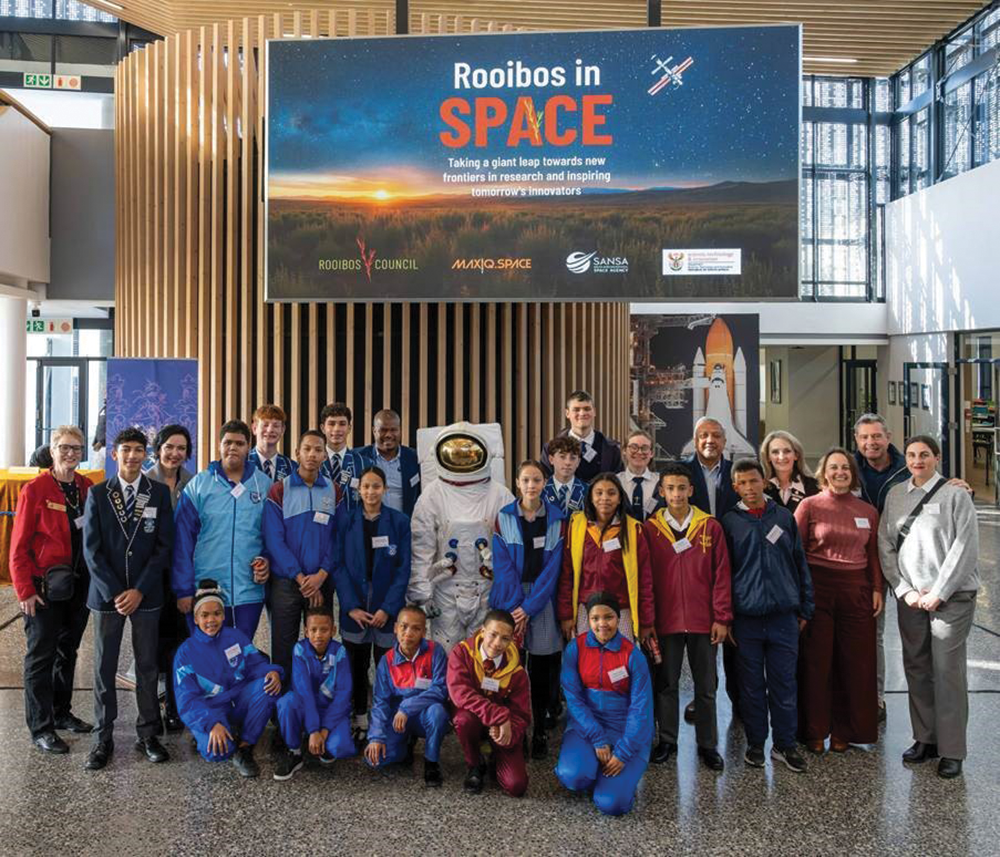
The initiative was conceptualised by the South African Rooibos Council (SARC) and is delivered in collaboration with MaxIQ Space, with support from the South African National Space Agency (SANSA). It connects Rooibos to a growing international focus on plant biology in space and the development of sustainable agricultural systems beyond Earth. Using Rooibos, a unique indigenous South African plant, the project engages learners in cutting-edge space science while exploring the potential role of plants in future exploration and off-Earth living systems.
As part of the programme, Rooibos seeds will be launched to the ISS in October 2026 where they will be exposed to microgravity and space radiation for several weeks before returning to Earth. On their return, they will be planted alongside control seeds in a comparative study examining germination, growth, resilience and yield. The experiment will be carried out by learners from seven schools in the Cederberg region, the birthplace of Rooibos. Working with local Rooibos farms, learners will collect and analyse data as part of a structured scientific investigation. A parallel experiment at Parklands College will provide additional comparative data.
Recent years have seen a renewed global emphasis on plant research in space, driven by upcoming long-duration exploration missions. International space agencies are increasingly prioritising the development of self-sustaining life-support systems for future deep space travel, including crops capable of producing food, supporting oxygen generation and contributing to crew wellbeing on extended missions. Rooibos joins a growing body of plant research conducted in space.
According to Dawie de Villiers, director of the South African Rooibos Council, the project reflects the industry’s focus on innovation, education and applied research. “Rooibos has long been part of South Africa’s agricultural heritage. This project places it within a broader scientific context, where plant biology, space research and education intersect. It also reflects the importance of investing in scientific literacy and skills development for the next generation of researchers and innovators.”
Beyond the scientific component, participating schools will engage in an extended STEM education programme introducing learners to space science, plant biology and sustainable agriculture. The programme is aligned with curriculum outcomes and designed to connect classroom learning with practical scientific application. Judi Sandrock of MaxIQ Space says the initiative aims to strengthen access to authentic scientific learning experiences. “The value of this project lies in giving learners exposure to real research processes linked to space science. It provides a structured opportunity to develop scientific thinking, data analysis skills and an understanding of how experimentation works in practice.”
The project aligns with South Africa’s growing involvement in space science and innovation. Deputy Director-General for Curriculum and Assessment Management in the Western Cape Education Department, Bertram Loriston, noted the importance of cross-sector partnerships in expanding access to STEM opportunities, highlighting the role of initiatives that connect education, agriculture and emerging scientific fields in making science more accessible.
The scientific credibility of the project is further supported by SANSA. Thandile Vuntu, who leads SANSA’s Science Engagement Unit in Hermanus, says space science is increasingly integrated into everyday applications and continues to expand opportunities for young people entering STEM fields. “Space science is becoming more integrated into areas that affect daily life, from communications to environmental monitoring. Initiatives such as this help build awareness of the skills required for future participation in the sector, and align with national priorities around skills development, innovation capacity and strengthening South Africa’s position in emerging scientific fields. They further highlight the importance of collaboration between industry, government, academia and the science sector in building a strong pipeline of future scientists, engineers and researchers.”
Dr Kelebogile Gasealahwe, a South African Radio Astronomy Observatory postdoctoral fellow at the University of Cape Town whose research focuses on X-ray binaries, highlighted the role of facilities such as MeerKAT in advancing South Africa’s contribution to global astronomy research and encouraged learners to remain open to diverse pathways within STEM fields. The project is delivered in partnership with the South African Rooibos Council, MaxIQ Space and SANSA.
For more information contact Meropa,






© Technews Publishing (Pty) Ltd | All Rights Reserved
 printer friendly version