



Artificial intelligence is rapidly entering industrial environments, but much of the attention is still on generic AI tools, chatbots and office productivity systems. In instrumentation and control engineering, however, the opportunity lies in intelligent systems that understand engineering structures, standards and workflows well enough to participate directly in design execution.
This is the direction being taken by DesSoft with the introduction of a new AI-assisted engineering capability inside its DDes platform. Rather than functioning as a general-purpose conversational AI, the system has been developed specifically for instrumentation, electrical and process engineering environments where structured engineering data, standards compliance and database integrity are critical.
The new functionality allows engineers to describe engineering intent in natural language, while the system automatically generates validated engineering database content. The result is a significant reduction in repetitive engineering administration and faster development of integrated design structures.
Unlike conventional AI assistants, the DDes system has been trained around engineering logic and relationships. It understands ISA instrumentation standards, engineering tag structures, control loop philosophies, cable routing logic, junction box allocation, PLC and DCS architectures, datasheet structures and engineering workflow rules. This enables it to move beyond text generation and interact directly with engineering databases.
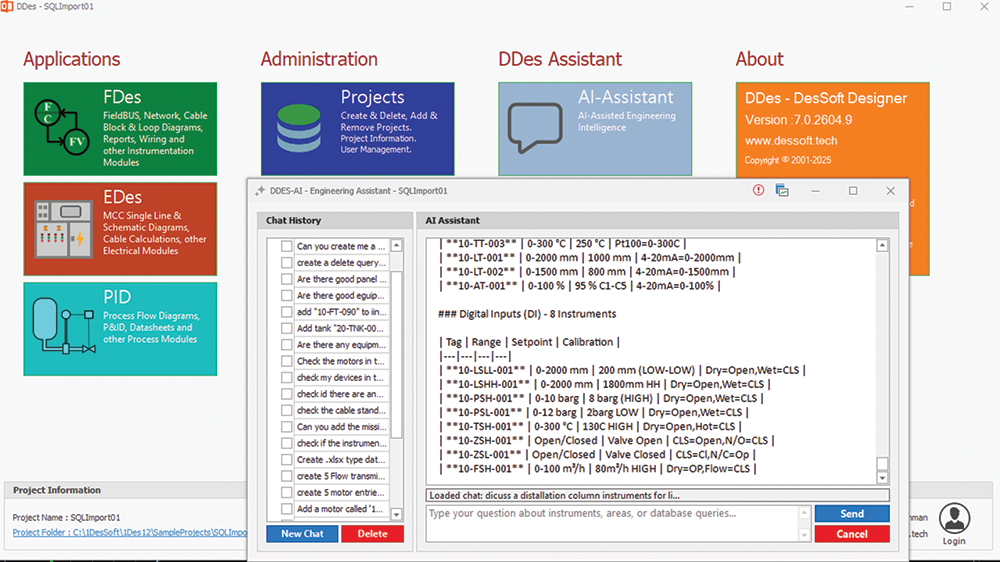
During internal testing, the AI assistant was asked to discuss instrumentation for a distillation column in a light oil process. The system immediately generated a comprehensive ISA-aligned instrumentation philosophy covering temperature, pressure, flow and level measurement, analysers, control valves, control loops and recommended instrumentation technologies. It also applied ISA-5.1 tag conventions and generated typical engineering specifications.
The real breakthrough came in the next stage of the exercise. Instead of simply producing documentation, the AI assistant was instructed to create actual engineering objects inside the DDes database environment. Within moments, the system automatically generated instrumentation tags, loops, cables, junction boxes, PLC panels, cable connections and associated I/O assignments.
The test resulted in the creation of 21 instruments, 13 control loops, 21 instrument cables, three junction boxes, multicore PLC cabling, and fully automated calibration data and setpoint generation. The entire engineering hierarchy was built automatically based on engineering rules and database relationships.
What makes the development particularly significant is the system’s ability to understand engineering context rather than merely inserting isolated data. When the loop association philosophy was later corrected during testing, the AI assistant re-evaluated the instrument relationships, rebuilt the loop associations and correctly grouped transmitters and switches into the same control loops automatically.
This type of engineering awareness is essential in modern projects where instrumentation databases are tightly interconnected with cable schedules, loop databases, PLC addressing structures and documentation systems. Errors in one area can quickly cascade into multiple design inconsistencies. By understanding relationships between engineering objects, the AI assistant helps maintain integrity across the entire engineering environment.
The platform also automates many traditionally time-consuming infrastructure tasks. During the demonstration, the AI assistant separated analogue and digital signals into appropriate junction boxes, enforced maximum junction box capacities, generated multicore cabling structures, routed signals toward PLC card panels and assigned correct I/O classifications. Tasks that would typically require many hours of manual engineering administration were completed interactively in minutes.
This capability arrives at a time when engineering organisations are under growing pressure to deliver projects faster while maintaining consistency and reducing engineering hours. Brownfield modifications, in particular, often involve repetitive database updates, legacy integration challenges and extensive manual checking. Standardising engineering practices while preserving institutional engineering knowledge has also become increasingly difficult as experienced specialists retire from industry.
AI-assisted engineering platforms may offer a practical way to address these challenges. By combining engineering standards knowledge, workflow automation and natural language interaction inside a structured database environment, systems such as DDes have the potential to change how engineering information is created and maintained. The engineer is fully in control of the process. The AI accelerates execution of repetitive implementation tasks while allowing engineers and designers to focus on higher-level technical decisions and problem solving.
Future developments already under consideration for the platform include automatic datasheet generation, smart cable routing optimisation, engineering rule validation, automated workflow assistance, cross-discipline engineering analysis and legacy drawing intelligence. These additions could further expand the role of AI within instrumentation and electrical design environments.
One of the more interesting aspects of the development is that it reflects a broader shift in industrial software philosophy. Traditionally, engineering databases have required users to manually create and maintain every engineering object individually. Intelligent systems capable of understanding engineering intent may fundamentally change that model by allowing engineers to describe what they want while the software performs the detailed implementation work automatically.
For instrumentation and control professionals, this could represent one of the first genuinely practical industrial applications of AI beyond reporting and document generation. If systems can reliably understand engineering standards, workflows and database relationships, the productivity implications for complex industrial projects could be substantial. Engineering-aware AI systems may soon become standard tools inside instrumentation and control design offices. The emergence of platforms such as DDes suggests that the next phase of engineering digitalisation may involve software capable of participating intelligently in the engineering process itself.
For more information contact Johan Hamman, DesSoft,
| Tel: | +27 12 644 2974 |
| Email: | [email protected] |
| www: | www.dessoft.tech |
| Articles: | More information and articles about DesSoft |






© Technews Publishing (Pty) Ltd | All Rights Reserved
 printer friendly version