Haddy scales AI-enabled adaptive microfactories with Siemens Xcelerator
July 2026
IT in Manufacturing
Haddy, a USA based additive manufacturing company, has adopted the Siemens Xcelerator open digital business platform to scale local additive manufacturing using circular materials across industries including furniture, marine and defence.
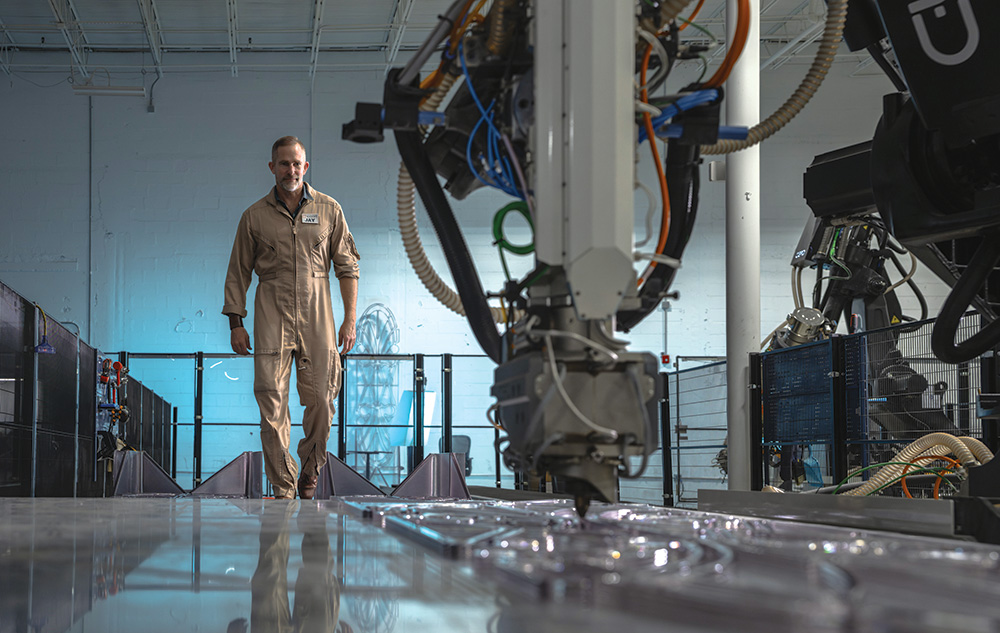
Founded around the idea that additive manufacturing can support both local production and circular material use, Haddy produces large-format components using robotic additive manufacturing processes and recyclable and biodegradable materials designed to stay in use. Products are made to be taken back at end of life, reprocessed into feedstock and returned to production, helping reduce waste and keep materials out of landfill. Materials are sourced domestically in the USA to help reduce transportation-related emissions while supporting local supply chains.
“Our goal is to keep materials in use and production close to where products are needed,” says Jay Rodgers, chief executive officer at Haddy. “Adopting Siemens Xcelerator helps us connect design, automation and manufacturing in a way that supports circularity, local sourcing and rapid iteration while using data and AI to continuously improve how our microfactories operate.”
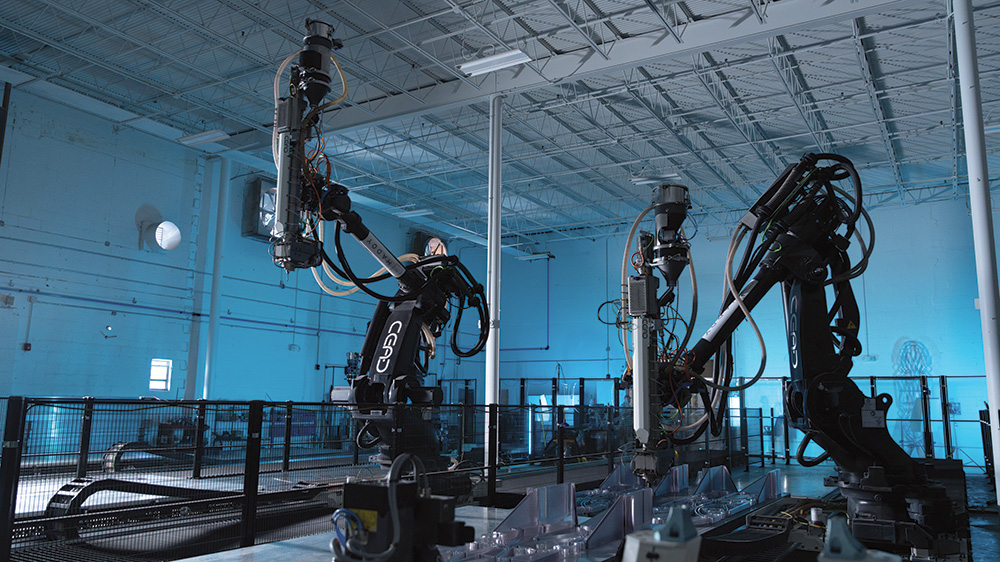
Haddy delivers this model through a network of digitally standardised, AI-enabled microfactories. By producing closer to where products are needed and relying on data and software to maintain consistency across sites, the company aims to reduce supply chain complexity while supporting more resilient, low-waste production.
To support this approach, Haddy uses Siemens Xcelerator to connect product design, manufacturing planning and automation through a consistent digital thread. Siemens’ Designcenter software is used to design large-format parts produced through additive manufacturing and prepare designs for robotic production. Teamcenter software manages product data and configuration across sites, while SINUMERIK, Siemens’ computer numerical control (CNC) platform primarily for machine tools, provides high-precision motion control and execution on the shop floor, including the integration of industrial robots. In Haddy’s microfactories, SINUMERIK orchestrates robotic additive manufacturing systems, combining CNC-based path control with industrial robot kinematics.
Haddy is also expanding its use of Siemens’ software as it scales its distributed production model. It has adopted Simcenter Optistruct software to assist with product optimisation and validation of its large-scale products. Alongside this, Haddy is leveraging NX X Manufacturing, a cloud-enabled manufacturing solution, to define build strategies, support computer-aided machining part programming, simulation and verification, and execute complex large-format robotic additive manufacturing processes.
“Haddy is showing how manufacturers can rethink production by combining the power of the AI-enabled digital twin and local manufacturing with circular material strategies,” says Tony Hemmelgarn, president and chief executive officer at Siemens Digital Industries Software. “By building a digitally connected, software-defined manufacturing model, Haddy is creating a scalable approach that helps maintain consistency across sites while supporting more resilient and sustainable production.”
For more information contact Siemens South Africa, [email protected], www.siemens.co.za
Further reading:
How sustainability unlocks real business impact
Rockwell Automation
IT in Manufacturing
Sustainability has moved from a compliance obligation to a strategic driver of resilience and value for manufacturers. Rockwell Automation explains how its Triple A framework and connected-data approach help producers cut energy, water and waste while improving productivity.
Read more...
Mining’s AI future will depend on people as well as technology
IT in Manufacturing
South Africa’s mining industry is embracing digitalisation and AI, but AvenirHoldings chief executive officer, Tshidi Mndzebele says the real test is whether the people behind the industry are equipped to move forward with it, and outlines five things mining needs to get right.
Read more...
How BIC overcame operational silos to integrate technology and people
Rockwell Automation
IT in Manufacturing
Manufacturing giant BIC deployed Plex MES from Rockwell Automation at its Bizerte plant in Tunisia, replacing fragmented, partly in-house software with a single cloud-based execution system that broke operational silos and improved shop-floor visibility.
Read more...
AI in industry is an early warning system, not a guarantee
Schneider Electric South Africa
IT in Manufacturing
Schneider Electric’s Paul Steyn argues that AI in industrial maintenance is only as good as the infrastructure and people behind it, and explains the three layers a facility needs before predictive maintenance can deliver on its promise.
Read more...
SA’s mining industry must put people at the heart of its digital future
IT in Manufacturing
South Africa’s mining industry employs around 470 000 people while its digital transition accelerates. Avenir’s chied executive officer, Tshidi Mndzebele argues that technology should enable and upskill the workforce rather than replace it, setting out five ways mining can make technology work for its people.
Read more...
Quality control supports efficient tissue production
Valmet South Africa
IT in Manufacturing
Valmet’s advanced quality control technology is helping tissue producers improve product consistency while reducing energy and raw material consumption. Its latest installation at KORO Paper in Vietnam combines real-time measurement, process optimisation and non-contact, nuclear-free quality control.
Read more...
Patented algorithm maximises operator efficiency
Rockwell Automation
IT in Manufacturing
Rockwell Automation piloted a patented anomaly detection algorithm and FactoryTalk DataMosaix at its Twinsburg electronics plant, giving operators 30 to 60 days’ advance warning of stencil failure, improving fail rates by 22% and achieving a 200% return on investment.
Read more...
Cybersecurity must become part of the next era of industrial automation
Adroit Technologies
IT in Manufacturing
The EU’s Cyber Resilience Act is setting a global benchmark for connected products, making cybersecurity a core engineering requirement in industrial automation. Adroit Technologies and Mitsubishi Electric explain how building security into controllers, PLCs and drives from the outset helps South African manufacturers protect production and meet international expectations.
Read more...
The next generation of engineers is building living labs of innovation
Schneider Electric South Africa
IT in Manufacturing
Graduate engineers at Schneider Electric East Africa designed, integrated and commissioned the smart building systems in the company’s new Nairobi head office, demonstrating how practical, real-world project experience accelerates engineering capability and confidence.
Read more...
Innodisk launches APEX series edge AI systems for industrial deployment
Vepac Electronics
IT in Manufacturing
Innodisk has launched its APEX series edge AI systems, combining hardware, software and system design to simplify industrial AI deployment. The APEX-A100, powered by Qualcomm’s Dragonwing IQ9 processor, delivers up to 100 TOPS with guaranteed availability through 2038.
Read more...










 printer friendly version