



Mammoet was approached by Qingdao McDermott Wuchuan to perform the weighing, jacking and load-out of the 33 000 t floating production unit (FPU) for Woodside Energy’s Scarborough Project at its fabrication yard in China. The FPU comprised two modules, the deck support frame and the topsides itself, which would sit on top of it.
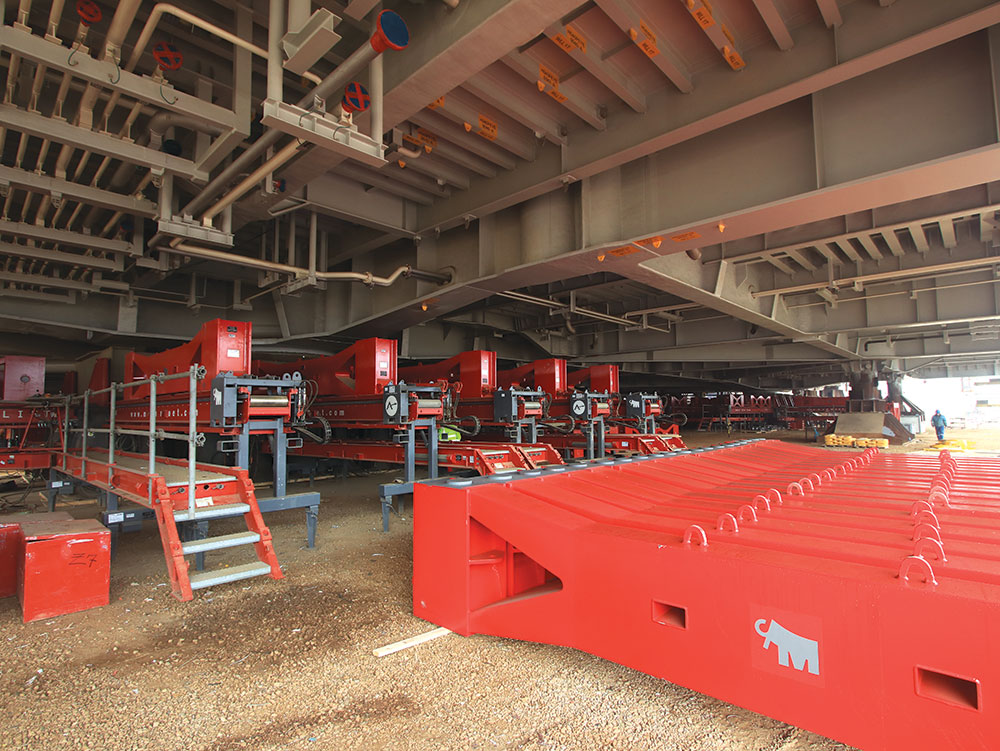
Mammoet’s first involvement was a full eight years prior when it was asked by the design team to participate in meetings to discuss different build methods for the topsides. From that discussion evolved a solution: including an integrated weighing and jacking solution and fabrication of a specialist starter beam that between them brought significant time and cost-saving benefits to the project.
Reducing the wait through integrated weighing and jacking
Engineers at Mammoet explained that they could save time by combining weighing and lifting operations. Weighing operations would take place using Mammoet’s Mega Jack system. The Mega Jack is a large jacking system that uses beams loaded at ground level to lift some of the world’s heaviest loads with minimum working at height.
This project marked the debut of Mammoet’s new Mega Jack 10000 system, designed to handle the heaviest loads from a lower starting height than ever before This particular mobilisation connected many jacking bases together in a modular fashion, multiplying the lift capacity of each combination by spreading the load across many bases.
The Mega Jack system was set up in a configuration of four towers, each positioned underneath the corners of the load, beneath its strongest point. A total of 80 load cells, each with up to 750 t measurement capacity, were inserted into the Mega Jack system to both lift and weigh the load at the same time.
“The alternative method would have been to use load cells with hydraulic cylinders incorporated underneath, positioned at different locations around the topsides,” explains Richard Verhoeff, sales director at Mammoet. “We explained that we could perform the weighing of the topsides with the same system we use for the jacking. This makes things far more efficient between the two project phases.”
Fully loaded from the start
A standard Mega Jack tower is supported by four jacking bases, one at each corner. Thanks to specialised lifting beams, ten bases could be combined into one lifting system, resulting in a high capacity relative to its footprint.
An integrated load-spreading beam was also especially designed for the project, with engineers at Mammoet performing the detailed engineering to make it fully compatible with the Mega Jack system. Taking these specifications, the customer was able to fabricate and incorporate the beam into the underside of the topsides. This meant that when it came to the jacking operation, the topsides were already standing on four points.
The beam also doubled up as a build support to assist operators during the construction process. Once the final weight of the topsides had been verified, it was jacked up to a height of 16 metres using the four towers. This allowed space for the deck support frame to be positioned underneath and connected to the underside.
The towers were then slowly lowered until their total weight was fully transferred onto the deck support frame. The topsides were next pulled onto the installation barge in incremental steps of 500 mm, using eight SJ850 strand jacks and a skidway. Mammoet also supported the ballasting of the barge, to ensure it stayed level as the huge weight of the topsides structure was transferred from the front to the middle of the vessel.
Building low to save high
Using Mammoet’s Mega Jack 10000 system resulted in the need for less lifting equipment to be mobilised, saving time and cost. It also reduced the surface area of the contact points, which meant less ground needed to be reinforced.
Also, if standard jacking towers were to perform the same work, additional load-spreading beams would have been needed. With the integrated beam, this steel was also not required. This allowed the topsides to be constructed closer to the ground, improving the safety of operations and greatly improving construction uptime.
The alternative approach would have been to fabricate the topsides on top of its support frame. This method would have meant waiting for the module to be constructed first and the topsides being fabricated 16 metres in the air.
“This would have increased the cost,” adds Verhoeff, “with the supports around the structure needing to reach that height, as well as bigger cranes needed to lift components to the higher elevation. It would have also increased the time taken for operators to access and leave the topsides each day.”
Building the topsides directly on its sea foundation would have impacted the project significantly, adding further height and also preventing work on the topsides before the foundation was fabricated. Therefore, this lifting solution allowed more of the project to take place in parallel.
Thanks to decisions taken eight years previously, construction could be performed simultaneously and closer to the ground. This resulted in the project being completed safely and efficiently.
For more information contact Mammoet Global,






© Technews Publishing (Pty) Ltd | All Rights Reserved
 printer friendly version