



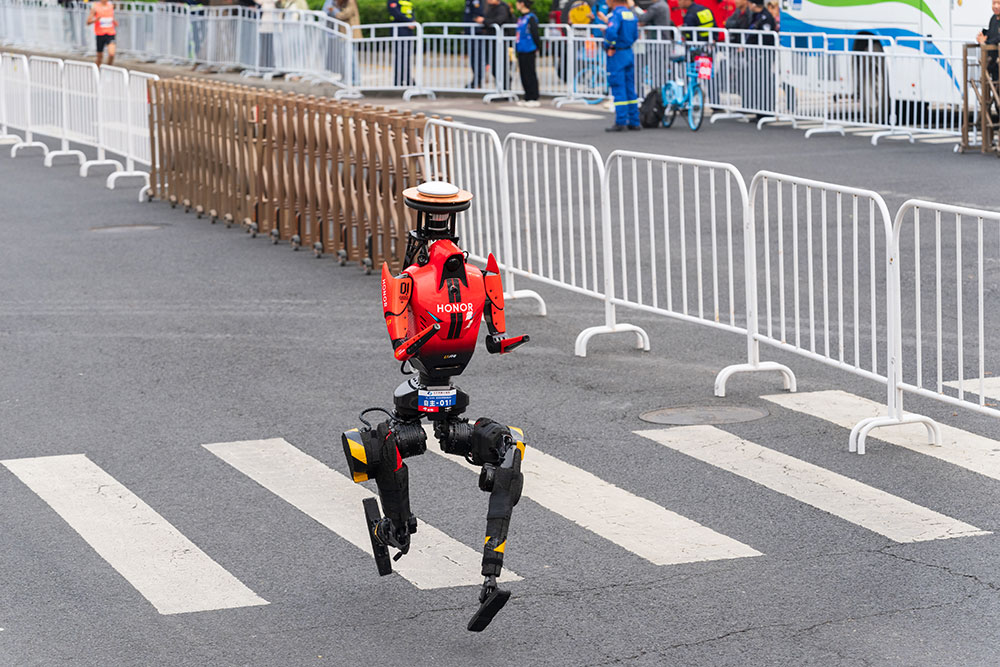
At the 2026 Beijing Humanoid Robot Half Marathon, a bipedal robot named Lightning, developed by Chinese technology company Honor, completed the 21,1 km course in 50 minutes and 26 seconds, nearly seven minutes faster than the standing human world record of 57:20 set by Ugandan runner Jacob Kiplimo.
Engineers are viewing the achievement as evidence of how rapidly humanoid robotic platforms are maturing.
From public spectacle to engineering test bench
The Beijing event, now in its second year, featured more than 100 robotic entrants competing alongside 12 000 human runners. Roughly 40% of the robotic field operated fully autonomously, while the remainder were remotely controlled. The race was organised as a public demonstration of China’s accelerating humanoid robotics sector, but a serious engineering proving ground was behind the event.
Unlike laboratory demonstrations on flat indoor surfaces, the half marathon required robots to navigate corners, uneven terrain, changing gradients and outdoor environmental variables. This placed demands on locomotion systems, thermal management, battery endurance, structural fatigue resistance, and real-time control algorithms.
There was a marked improvement over the inaugural 2025 event. Last year’s winning robot took more than two and a half hours to finish, and only six of 21 entrants completed the course. In contrast, this year’s event saw record pace, vastly improved reliability and far fewer of the collapses, collisions and control failures that characterised the earlier race.
The engineering behind the performance
Lightning’s performance was enabled by a package of design features aimed at high-speed endurance locomotion. The robot stands 1,65 metres tall and incorporates 95 cm long legs, proportions optimised to emulate elite human distance runners. Longer stride geometry reduces the cadence requirement at speed, improving running efficiency and lowering peak actuator demand.
Equally critical was the robot’s advanced dynamic stabilisation system, combining inertial measurement units, force sensors, joint encoders and AI-based gait control to maintain balance while adapting to changing terrain in real time.
The most notable engineering feature was its active liquid-cooling system, adapted from thermal management technologies commonly used in smartphones. The cooling circuit regulates actuator and joint temperatures, maintaining critical components near 60°C during sustained operation. This is essential in endurance robotics where heat buildup in motors and gearboxes can quickly degrade performance or trigger shutdowns.
Battery technology and power management also showed major advancements. Battery swaps were completed in roughly 10 seconds without requiring a system reboot, a significant improvement over the lengthy replacement procedures seen in 2025.
Beyond the race
To some people, building a robot that runs fast may appear to have limited practical relevance. Engineers disagree. According to members of the winning development team, high-speed endurance running pushes robotic systems into performances that directly benefit industrial applications. Structural fatigue, thermal dissipation, actuator durability, vibration management and control-loop responsiveness all become more demanding at race pace.
Faster running translates into advances in structural reliability and cooling that can later transfer into commercial robotics platforms. These same technical gains are relevant to industrial and service robots expected to operate for long periods in warehouses, logistics centres, factories, hazardous environments or disaster zones. In particular, endurance locomotion research improves:
• Joint actuator longevity under repeated load cycles
• Real-time motion planning in unstructured environments
• Thermal performance of compact electromechanical systems
• Battery energy density and swap systems
• Mechanical shock tolerance and impact recovery
• Progress, but not general intelligence.
Despite this impressive performance, robotics specialists caution against overstating the broader significance of the record. The racecourse was pre-mapped and controlled, meaning the robots were not required to interpret a highly unpredictable environment. Moreover, even the winning robot was followed by a support team monitoring telemetry, supervising operation and intervening when required. Lightning itself reportedly required assistance after veering into a barrier near the end of the race.
Basically, locomotion has advanced faster than cognition. Today’s humanoid robots can increasingly demonstrate impressive physical capability, but many still lack the perception, dexterity and contextual reasoning required for the real world. Running efficiently in a straight line is far simpler than performing non-repetitive industrial tasks such as handling delicate components, making contextual decisions, navigating cluttered spaces or interacting naturally with people.
More symbol than threat − for now
Humanoid robots are becoming faster, more stable and more energy efficient, but practical deployment is some distance away. They are still highly specialised machines operating under constrained conditions. The Beijing half marathon may not herald the arrival of robot domination, but it does indicate that humanoid robotics is moving out of the laboratory and into a new phase where the core technologies are improving fast.
To view a video visit www.tinyurl.com/42t5k9b8






© Technews Publishing (Pty) Ltd | All Rights Reserved
 printer friendly version