


Motion Control & Drives


Replacing roof-mounted façade cranes in the heart of The Hague

April 2026 Motion Control & Drives

Cities cannot stop, and so every effort must be made to perform heavy lifts safely while causing minimal disruption. Buildings and other immovable obstacles must be carefully considered, as must the safety of those living in, working in, and visiting busy urban areas.
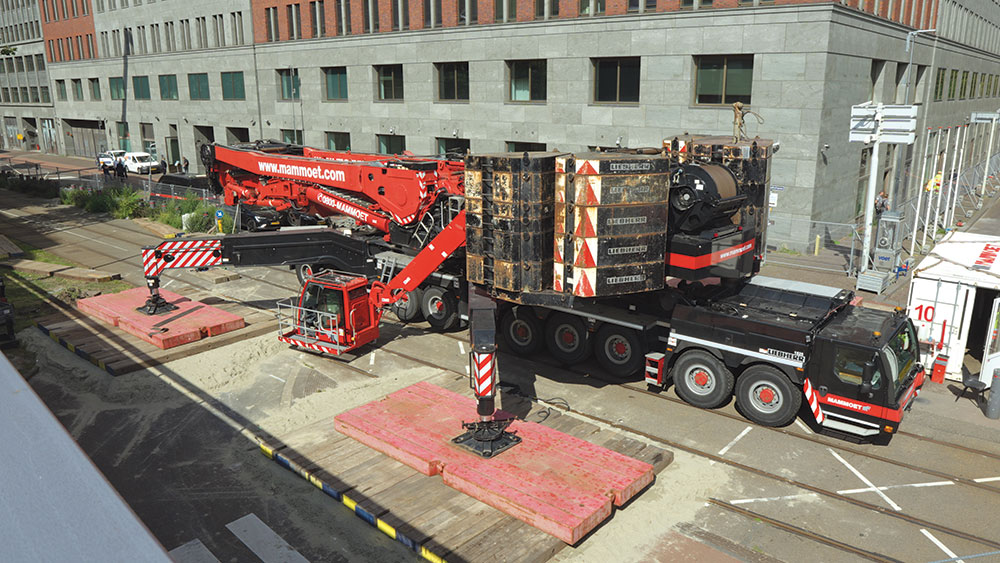
Mammoet was approached by Façade Access Solutions to support with the replacement of roof-mounted building maintenance units (BMUs) on two neighbouring Dutch government buildings in The Hague. Each new Manntech BMU consisted of sixteen separate components that had to be lifted individually, with weights varying from 200 kg winches up to a 3500 kg column and undercarriage.

Mammoet worked with Façade Access Solutions to determine the safest and most efficient method to support the removal of the old cranes and installation of the new ones. There were several challenges, including the extremely limited ground space that was available to assemble and operate a crane capable of doing the job.

Mammoet was successful in finding the optimum crane and setup position, and completed the project safely and with minimal disruption to the seat of Dutch political life.

Determining the best crane for the job

Key to the solving this puzzle was selecting the correct type of crane, as it needed to achieve a 180 metre lifting height and work within a very limited space at street level. A crawler crane was considered initially but rejected due to concerns that its counterweight could collide with a nearby viaduct.

After further analysis, a mobile crane was chosen instead: an LTM 11200, with 1200 ton maximum load capacity, fitted with a Y Frame on its main boom for added strength.

Mobilising this crane with the world’s largest telescopic boom to the heart of the city would be no mean feat. The engineering team also determined that there was just one setup location that would make it possible for the crane’s boom to reach both buildings.

“This was due to the Y Frame,” explains Stefan Plugge, project manager at Mammoet. “We had to find a position that allowed us to stay clear of the buildings and the viaduct. From the one position we identified, the crane could service both buildings, avoiding the need to demobilise it to a different location, saving time and unnecessary disruption.”

When it came to setting up the mobile crane, the team only used the space it needed, which minimised disruption further. For the first two days, a smaller assembly area was created. Only on the third day, when the boom had to be assembled on the ground, was this area temporarily extended. This allowed a key road to be closed for one day instead of three.

Tall lifts in a complex city

The existing façade cranes were disassembled, lifted down and transported away. The components for the new cranes were lifted onto the roof of the buildings in a specific order, allowing assembly to happen simultaneously, again saving on time. An adjacent street was used to store the old crane sections. It also served as a laydown area for the new components, which were delivered using a self-loading crane.

The team set up two lifting zones with different boundaries. This included an area for small parts, anything up to three metres, and another for larger items of up to 10,5 metres in length.

Working within these zones enabled only the short-term closure of a nearby canal and its neighbouring road during the lifting phase. Additional safety measures were also adhered to.

“We discussed with the client that all items be attached using fixed lifting points,” adds Plugge. “Nothing would be lifted using slings or other lifting approaches. We also agreed that the maximum allowable wind speed would be low.”

It was also determined that the roofs wouldn’t be strong enough to take the impact of the heavier components if one were to fall. Therefore, a crash deck was assembled on each roof before anything was lifted off or onto the buildings.

As would be the case in any seat of government, The Hague is a complex city to perform heavy lifts at height, requiring detailed permitting, lifting and safety plans. Mammoet provided this information in a timely manner to keep everything on schedule. The team’s work kept disruption to a minimum, while successfully accomplishing these high lifts safely and efficiently in this challenging urban environment.

For more information contact Mammoet Global, +31 622 63 5062, [email protected], www.mammoet.com


Share this article:
Share via emailShare via LinkedInPrint this page

Further reading:

A smarter approach to simplifying motion architecture
Motion Control & Drives
n motion system design, the wiring and drive placement between motor and drive are often decided by default, yet they shape a machine’s cost, footprint and adaptability. Kollmorgen sets out how single-cable and decentralised architectures simplify the cabinet.

Read more...
Robotic case packer achieves 99% uptime
Rockwell Automation Motion Control & Drives
DCC Automation designed a new robotic case packer for a nutrition supplement manufacturer using delta robots and a unified Rockwell Automation control platform, cutting changeover time from 45 minutes to 5 minutes, and achieving 99 to 99,5% uptime against the previous 10% per-shift downtime.

Read more...
igus puts 3D-printed wear materials to the test
igus Motion Control & Drives
A new igus white paper compares its tribological iglidur 3D-printing materials directly with conventional POM, reporting lower wear, more stable friction and up to ten times longer service life in gear testing for customised, low-volume and replacement components.

Read more...
SEW-EURODRIVE’s expanded local engineering capability
SEW-EURODRIVE Editor's Choice Motion Control & Drives
At Electra Mining Africa, SEW-EURODRIVE demonstrated how its expanded local engineering capability, digital technologies and lifecycle support strategy help customers improve reliability, energy efficiency and total cost of ownership across the full life of their drive assets.

Read more...
Latest Danfoss automation drive
Bearing Man Group t/a BMG Motion Control & Drives
BMG has launched the Danfoss iC7-Automation enclosed variable speed drive range in South Africa, backed by significant local stockholding of 400 V models up to 710 kW, approved warranty workshops, and DrivePro digital asset management support.

Read more...
Severe-duty workhorses powering mining
Motion Control & Drives
Mining machines such as rock crushers, pumps and conveyors need motors that combine high torque with robust enclosures, seals and cooling. WEG Africa explains how severe-duty motors deliver more than a decade of reliable performance in harsh conditions while meeting modern energy-efficiency standards.

Read more...
Looking beyond the spec sheet when choosing motion architecture
Motion Control & Drives
When machine builders focus only on torque, speed and price, engineering time, integration effort and long-term maintainability get overlooked. Kollmorgen explains how thinking at the system level, not the component level, leads to better motion architecture choices.

Read more...
Economy drive system closes the drive gap in the entry-level segment
Beckhoff Automation Editor's Choice Motion Control & Drives
Beckhoff has launched an economy drive system pairing its new AX1000 servo drive and AM1000 servomotor with the AF1000 dual-axis variable frequency drive on a shared EtherCAT platform, targeting series machines and price-sensitive markets without sacrificing TwinCAT integration or functional safety.

Read more...
SEW-EURODRIVE showcases modernisation and lifecycle support at Electra Mining Africa 2026
SEW-EURODRIVE Motion Control & Drives
At Electra Mining Africa 2026, SEW-EURODRIVE showed how it has expanded beyond equipment supply into integrated engineering solutions, plant modernisation and long-term lifecycle support for mining and industrial operators across Africa.

Read more...
Mammoet supports critical heavy lift and marine activities for topsides
Motion Control & Drives
Mammoet provided specialised heavy lift and marine logistics support for the Munin topsides on Aker BP’s Yggdrasil North Sea development, including a complex transshipment operation and a tidal-window load-out classified as a Class 1 operation.

Read more...


While every effort has been made to ensure the accuracy of the information contained herein, the publisher and its agents cannot be held responsible for any errors contained, or any loss incurred as a result. Articles published do not necessarily reflect the views of the publishers. The editor reserves the right to alter or cut copy. Articles submitted are deemed to have been cleared for publication. Advertisements and company contact details are published as provided by the advertiser. Technews Publishing (Pty) Ltd cannot be held responsible for the accuracy or veracity of supplied material.


© Technews Publishing (Pty) Ltd | All Rights Reserved

