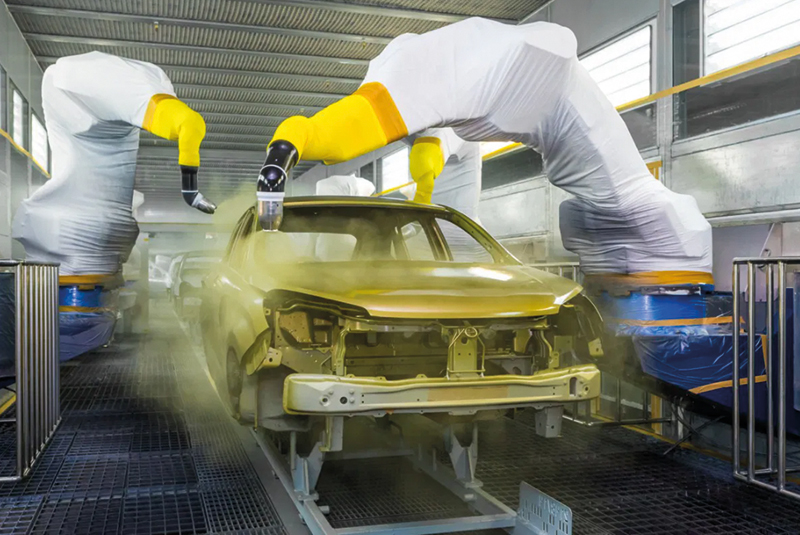
Painting the bodywork is an integral component of vehicle manufacturing. During the early period of car manufacturing, high-gloss bodywork finishes were associated with high costs and time expenditures. The first electrostatic rotary atomisers were developed in the 1980s. Rotary atomisers, also known as paint robots, are advantageous because they use material economically. Thanks to the high-voltage paint charge, 90 percent of the paint is applied directly onto the bodywork and is no longer wasted.
Rotary atomisers of this kind merely require a rotating disc. The paint to be atomised forms a film on the disc that becomes increasingly thin towards the edges and dissolves into droplets whose size is controlled via the speed of rotation. A nozzle ring is required around the atomiser to direct and shape the paint jet. The atomiser can therefore be operated in any position and used for external and internal finishings. This type of rotary atomiser is ideal for the car industry.
Intrinsically safe pressure transmitter for the spray head
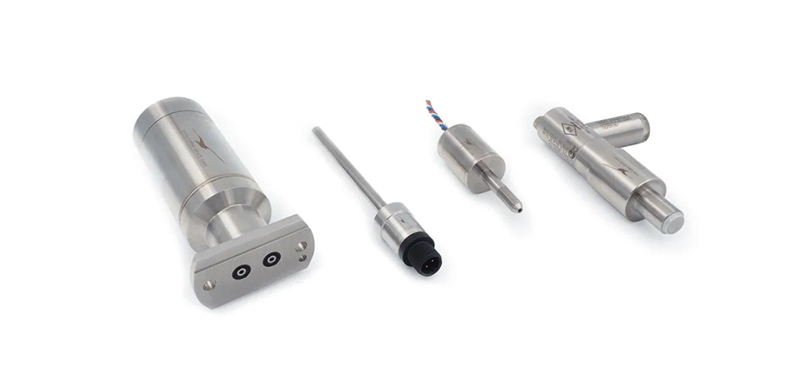
Keller supplied intrinsically safe pressure transmitters and intrinsically safe temperature sensors to a client producing paint robots for the car industry.
Even though non-flammable water-based paint is usually used on bodywork parts, the mist created during atomisation can take on a flammable state. Although hazards only occur in the rarest case during paint spraying, rotary atomisers must be equipped with explosion-proof technology.
Some pressure transmitters are fitted in the robot’s spray head. They measure the spray pressure in the paint spray system and detect quick pressure changes caused by placing hoses, for example. The pressure transmitters are located in a high-voltage field and communicate with the robot control mechanism via a fibre-optic cable. Additional pressure transmitters and temperature sensors monitor the dosing system and the pumps of the axes. These communicate with the control system through conventional via copper conductors.
Keller’s equipment manufacturing team develops automation solutions that are tailor-made for the requirements of its production department and that meet its high standards of quality and precision. This has allowed the company to improve its products, process stability and efficiency continuously over the last 50 years.
Market opportunity for sensors in humanoid robots
Sensors & Transducers
A new IDTechEx report forecasts the market for sensors in humanoid robots will exceed $6,59 billion by 2037, driven by perception sensors, force/torque sensors, encoders and inertial measurement units across a growing range of commercial robot platforms.
Read more...The wireless route to safer, more efficient mining operations Emerson Automation Solutions
Editor's Choice Sensors & Transducers
Modern wireless level measurement technologies are helping mining operations improve process control, increase safety and reduce installation costs. Emerson’s Rosemount 3408 wireless non-contacting radar level transmitter uses 80 GHz frequency-modulated continuous wave radar with HART communication to reach remote assets where cabling is impractical.
Read more...Telco sensors for harsh environments
Sensors & Transducers
Telco sensors are designed to operate where moisture, particulate contamination and surface fouling would disable conventional sensors, with a range including an adjustable five-metre infrared proximity sensor for harsh industrial environments.
Read more...The data-driven path to sustainable manufacturing ifm - South Africa
Editor's Choice Sensors & Transducers
Smart automation is closing the gap between operational efficiency and environmental responsibility, and the data to do it is already inside the plant. With ifm’s sensing and digitalisation technologies, manufacturers can turn machine intelligence into measurable sustainability gains.
Read more...Expanding visibility in mining operations Emerson Automation Solutions
Editor's Choice Sensors & Transducers
Advances in wireless communications, condition monitoring and sensing technologies are helping mining operators extend measurement into previously under-monitored areas, improving equipment reliability, process performance and water stewardship.
Read more...Fiber-optic amplifiers for precise object detection ifm - South Africa
Sensors & Transducers
The OCF fibre-optic amplifier detects even the smallest or most transparent objects in confined spaces, making proven fibre-optic technology easier and more user-friendly than before.
Read more...Distance sensor for confined spaces ifm - South Africa
Sensors & Transducers
The O6D100 from ifm has been designed as a powerful all-rounder for typical applications in object detection, distance measurement and positioning.
Read more...Optimise sludge treatment and reduce operational costs Endress+Hauser South Africa
Sensors & Transducers
Endress+Hauser’s inline measuring devices, the Proline Teqwave MW 300 and the Proline Teqwave MW 500, determine the total solids content of wastewater directly through microwave transmission.
Read more...Inclination sensors for motion control ifm - South Africa
Sensors & Transducers Motion Control & Drives
The JBC dynamic inclination sensor from ifm offers accurate angle measurement in the most demanding conditions, filtering out motion disturbances such as vibrations, shocks and vehicle dynamics to deliver reliable inclination values via IO-Link or programmable switch outputs.
While every effort has been made to ensure the accuracy of the information contained herein, the publisher and its agents cannot be held responsible for any errors contained, or any loss incurred as a result. Articles published do not necessarily reflect the views of the publishers. The editor reserves the right to alter or cut copy. Articles submitted are deemed to have been cleared for publication. Advertisements and company contact details are published as provided by the advertiser. Technews Publishing (Pty) Ltd cannot be held responsible for the accuracy or veracity of supplied material.










 printer friendly version