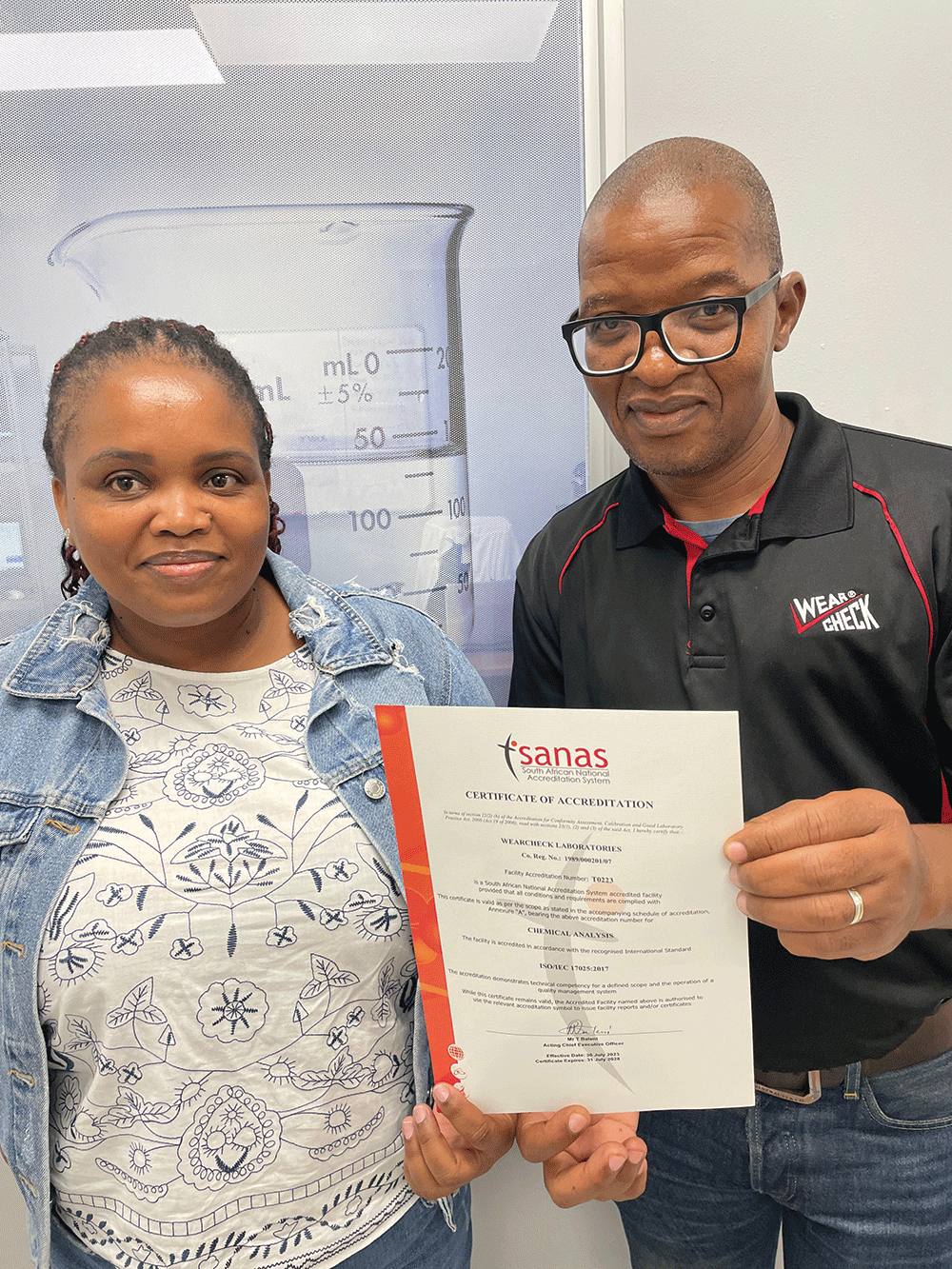
WearCheck Water earns AdBlue/DEF analysis accreditation
February 2025Analytical Instrumentation & Environmental Monitoring
WearCheck Water, a division of condition monitoring specialist, Wearcheck recently became the first laboratory in Africa to be officially ISO17025 accredited to test AdBlue diesel exhaust fluid (DEF) by the South African National Accreditation System (SANAS). This latest achievement adds to WearCheck Water’s other accreditations. The company already has ISO17025:2017 accreditation for chemical and microbiological water analysis.
WearCheck Water’s AdBlue/DEF analysis accreditation means that the company can test AdBlue/DEF solutions to ensure that Adblue manufacturers meet the required ISO 22241 standards. This analysis service will assist AdBlue/DEF manufacturers and users, OEMs, fuel depots and large-scale truckers and fleet managers.
SANAS is the only national body in South Africa responsible for carrying out accreditation of entities- including laboratory testing- the relevant section regulating WearCheck’s laboratory services.
General manager of WearCheck Water, Thelma Horsfield, is proud of the company’s ISO17025 achievements. AdBlue, a form of diesel exhaust fluid (DEF), helps to reduce harmful Nox emissions and is added to diesel engines. It is not a fuel additive and is not added to the fuel tank of a vehicle. AdBlue is a colourless, non-toxic liquid that converts pollutants into gases which do not harm the environment.
AdBlue is used in vehicles with selective catalytic reduction (SCR) technology. It is a 32,5% solution of high-purity, synthetically manufactured urea in demineralised water, and is safe to use. Vehicles with SCR technology have a separate tank filled with AdBlue/DEF, which is injected into the exhaust pipe in front of the SCR catalyst, downstream of the engine. Heated in the exhaust, it decomposes into ammonia and CO2. When the NOx from the engine exhaust reacts with the ammonia, the harmful NOx molecules in the exhaust are converted to harmless nitrogen and water, which are released from the exhaust pipe as steam.
Adblue/DEF solutions are made up to ISO 22241 standards to ensure that the mixtures are created correctly and do not harm engines. Moses Lelaka, technical manager for WearCheck Water was instrumental in setting up and implementing the testing process, along with the company’s quality manager, Lorato Hotane.
Lelaka says, “We offer an analysis service that includes testing alkalinity, insoluble matter, biuret, aldehydes and metals. After investing in a refractometer for our laboratory, we are already conducting the tests in our Johannesburg laboratory, and will be extending this service to our Cape Town laboratory soon.”
The hidden role of motion systems in electronic pipetting
Analytical Instrumentation & Environmental Monitoring
Portescap explains how motor selection defines the precision and accuracy of electronic pipettes, comparing brushed DC motors and stepper linear actuators across force, speed, positional fidelity and system complexity for laboratory liquid handling applications.
Read more...Matching HVAC to the real demands of buildings and processes
Analytical Instrumentation & Environmental Monitoring
Industrial Climate Engineering director, Alin Gomes explains why effective HVAC goes beyond specifying equipment on capacity, covering load profiling, ventilation requirements, heat recovery and turnkey delivery for specialised manufacturing and processing environments.
Read more...Electrostatic spark discharge – when static strikes back Wearcheck
Maintenance, Test & Measurement, Calibration
WearCheck technical manager, Steven Lumley explains how static electricity accumulates in modern low-conductivity lubricants, why compact system designs and fine filtration make ESD more likely, and how to recognise the degradation it leaves behind.
Read more...How SCE approaches sensor selection for critical environments Specialised Climate Engineering
Analytical Instrumentation & Environmental Monitoring
Specifying the right sensor for a critical climate involves far more than matching a datasheet accuracy figure. As an authorised Vaisala HVAC partner, SCE explains how understanding the environment, the measurement purpose and sensor placement determines effective climate control.
Read more...When maintenance-system compliance starts replacing plant reliability Wearcheck
Maintenance, Test & Measurement, Calibration
WearCheck ARC division manager, Annemie Willer argues that the greatest threat to effective maintenance is no longer a lack of technology, but the gradual replacement of technical judgement by CMMS compliance, leaving no one owning the machine.
Read more...Changing gas quality calls for smarter combustion control
Analytical Instrumentation & Environmental Monitoring
As South Africa prepares for a transition from declining Mozambican natural gas to a proposed methane-rich bridge, LNG, industrial users can no longer assume a constant Wobbe Index and calorific value. The compact RMG RGQ 5 provides fast, plant-level gas-quality data to support approved burner and engine settings.
Read more...Nitration: the acid you didn’t see coming Wearcheck
Maintenance, Test & Measurement, Calibration
Nitration is as destructive as oxidation in many engines but far less understood. WearCheck technical manager, Steven Lumley explains how nitrogen oxide gases degrade lubricants, why the process is difficult to detect, and what oil analysis can reveal before damage occurs.
Read more...Getting the chemistry right
Analytical Instrumentation & Environmental Monitoring
Grace’s European production site has relied on analogue compression load cells from Minebea Intec for decades, with the long-proven measurement concept now serving as the reference for new silo projects as the company expands its capacity.
Read more...Why measurement matters in smelting Endress+Hauser South Africa
Analytical Instrumentation & Environmental Monitoring
South African smelters returning to operation after energy constraints face new demands for tighter control, better visibility and environmental compliance. Endress+Hauser explains how modern measurement technology supports safer, more efficient furnace operation and local beneficiation.
Read more...Sun tracking with pinpoint precision Senseca
Analytical Instrumentation & Environmental Monitoring
Senseca has introduced the SEMS-2000 solar energy measurement system, a 2-axis solar tracker with pinpoint sun-pointing accuracy that automatically monitors direct, global and diffuse irradiance for unattended outdoor solar installations.
While every effort has been made to ensure the accuracy of the information contained herein, the publisher and its agents cannot be held responsible for any errors contained, or any loss incurred as a result. Articles published do not necessarily reflect the views of the publishers. The editor reserves the right to alter or cut copy. Articles submitted are deemed to have been cleared for publication. Advertisements and company contact details are published as provided by the advertiser. Technews Publishing (Pty) Ltd cannot be held responsible for the accuracy or veracity of supplied material.










 printer friendly version