



Unscheduled downtime and maintenance on machines is often a source of frustration for many companies active in industrial manufacturing as it results in loss of process and productivity, which in turn equates to loss of revenue.

While most machinery vibrates, the presence of excess vibration in equipment can lead to these machines malfunctioning or failing, as vibration can cause premature wear of components, shortening the lifespan of equipment and resulting in safety issues. An imbalance or misalignment of machinery may also cause components to crack or break.
An online vibration monitoring system is one of the most effective ways to maintain machine health, predict potential issues and give early warnings of machine failure, translating into numerous operational advantages. By continuously assessing the health of machinery, organisations can implement online condition monitoring maintenance strategies, therefore reducing downtime and extending equipment life.
Advancing with smart online IO-Link vibration monitoring sensors
Using smart vibration monitoring sensors, companies can leverage time domain vibration monitoring to measure and monitor parameters, such as vibration velocity and acceleration, to provide an overview of overall machine health.
These smart sensors can be used to measure and trend vibration against the ISO 10816 standards, which provide vibration guidelines for vibration velocity in mm/s for different classes of industrial machines. Vibration in the time domain represents the overall vibration of the machine and what operators feel when they put their hands on a machine. It is the combination of all components of vibration.
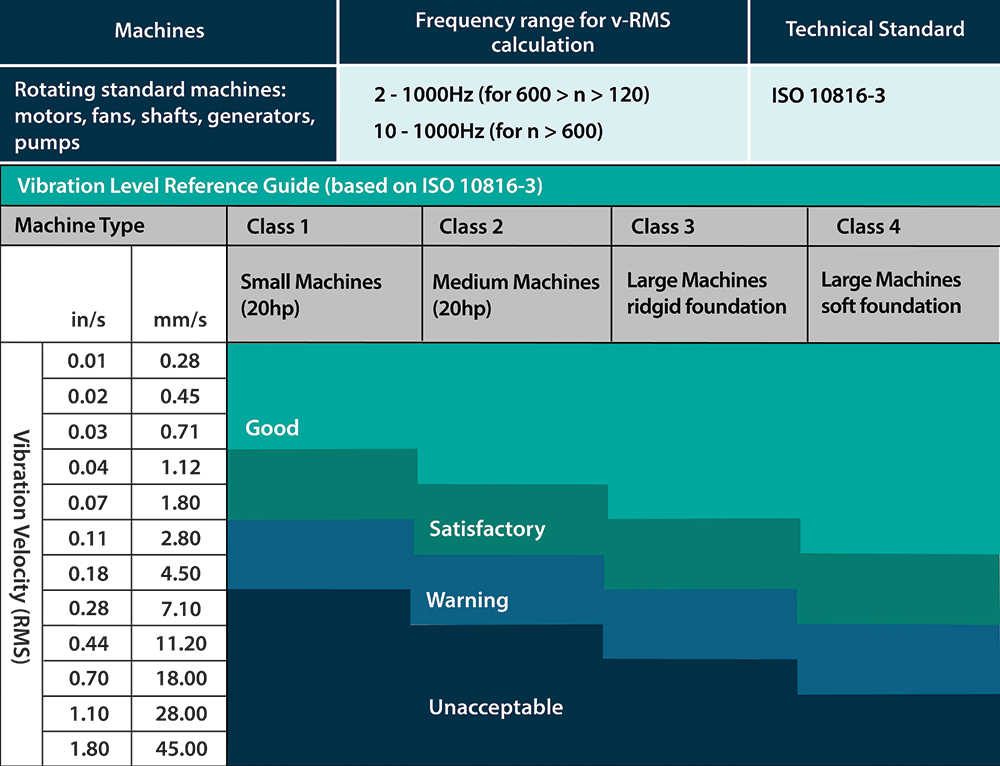
Smart IO-Link vibration sensors are available that offer multiple measurements, including vibration velocity, acceleration, crest factor and temperature, all within a single device. These metrics are measured to provide insights into machine performance, while the sensors are adept at identifying faults like misalignment, unbalance, looseness, bearing failure, cavitation and gear damage.
Measurements of vibration in the time domain that monitor both low- and high-frequency vibration are essential for this type of vibration monitoring. Low frequency vibration in the range of 10 to 1000 Hz can result from defects such as unbalance, misalignment, looseness and more, and is normally measured as velocity. Frequencies of more than 1 kHz are an indication of vibration related to natural frequencies, and are measured as acceleration resulting from defects such as gear faults, bearing failure or cavitation. The crest factor is the peak acceleration divided by the average acceleration and is a quick indication of the impact that is occurring.
Companies further benefit from smart IO-Link sensors that enable compatibility with multiple communication protocols such as Modbus TCP, Profinet and EtherCAT among others. These sensors can easily be integrated into existing control and automation systems. This plug-and-play configuration simplifies installation and accelerates deployment.
Advanced vibration monitoring in the frequency domain
For companies seeking even deeper insight into machine performance, the advanced vibration monitoring solution is the go-to option, combining time and frequency domain analysis. This dual approach allows for enhanced fault detection capabilities. The advanced 3-axis vibration sensor exemplifies this advanced monitoring capability, offering detailed diagnostics across three axes paired with special diagnostic modules for comprehensive system analysis. Collecting data across the three axes provides a holistic view of machine health.
Fast Fourier Transformation of time domain vibration data into the frequency domain enables detailed frequency analysis capable of identify specific issues, and this is used to break up the overall vibration signal into its individual frequency components. This type of vibration analysis can be used to monitor specific bearing faults such as outer race, rolling element or inner race damage, by configuring the specific bearing number in the diagnostic module.
Implementing preventative steps to ensure that your machinery and equipment works optimally and lasts longer is essential to achieving operational success. With tools such as vibration monitoring systems, operations are able to measure any irregularities and have the advantage of early warning of potential failures.
| Tel: | +27 12 349 2919 |
| Email: | [email protected] |
| www: | www.iritron.co.za |
| Articles: | More information and articles about Iritron |






© Technews Publishing (Pty) Ltd | All Rights Reserved
 printer friendly version