With any air dryer, the removal of liquid condensates before the inlet to the dryer is vital. With refrigeration dryers, liquids entering the dryer impose an extra heat load on the dryer’s refrigeration system. This wastes energy, as the freon system is designed to condense water vapour into a liquid. If we allow liquid condensates into the dryer at its inlet, the system is now working to condense water vapour into a liquid, and also cooling down actual liquid water to a temperature of 3°C.
This creates a problem in the main air-to-freon exchanger, and also in the condensate drain system. They are being forced to handle more actual liquid content than the dryer and its drain were designed for. This can lead to liquids being entrained in the air flow and pushed into the compressed air system. This automatically leads to a higher dewpoint, resulting in wet compressed air in the plant’s distribution system.
What is an aftercooler?
An air compressor’s aftercooler is the integral first stage in the air treatment system. It is essentially a radiator with hot compressed air inside the tube stack. This has a fan to push colder atmospheric air over the radiator to cool the hot compressed air in the radiator. This cooling process can condense up to 70% of the water vapour that is pulled in by the air compressor from atmosphere, and compress it to 7 bar for your factory. The aftercooler is supposed to eject this condensed liquid to waste via an attached water separator and autodrain system.
This partially dried air leaving the aftercooler can be now allowed to enter the prefilter and air dryer for further treatment. If the aftercooler is not fitted, or a water separator is missing (or not supplied by the OEM) or the drain has malfunctioned, there will be a liquid water overload in the air dryer, leading to wet compressed air.
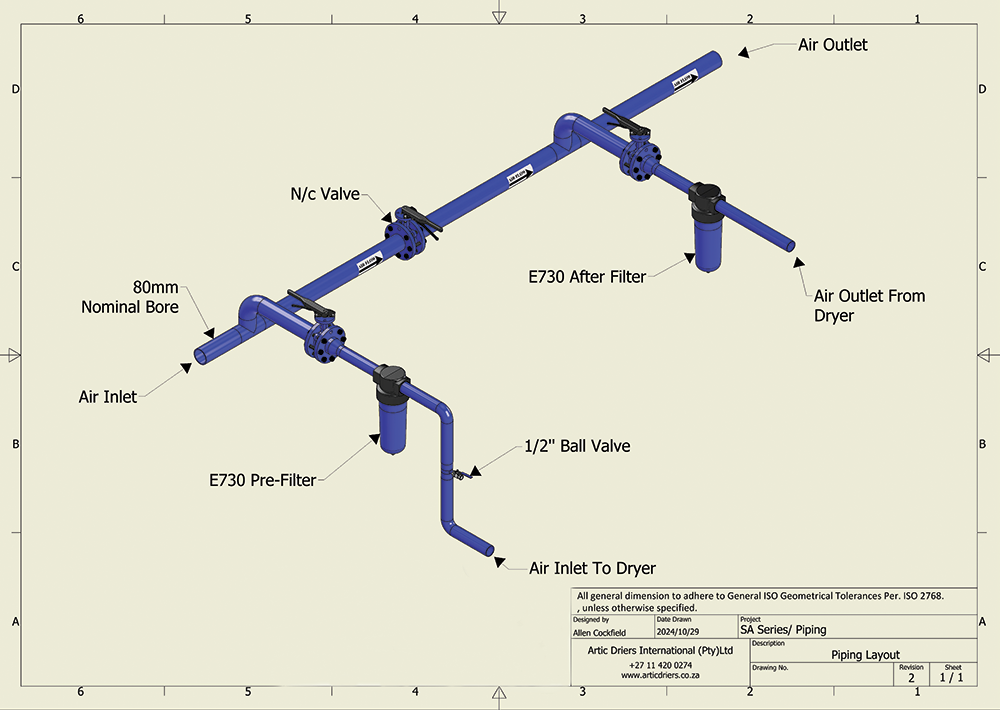
Inline air filters are not designed for bulk liquid removal; they are installed to coalesce compressor oils and trap airborne particles and debris. Poor piping installations can also add to bulk liquid contamination. The correct layout is shown below. Inlet and outlets, valves and filters should be located at the highest points.
Compressor aftercooler and filter drains must be function checked daily. The installation of a low-cost dewpoint monitor S305 from Artic’s Suto iTEC range is a good protection against compressed air system contamination. A high dewpoint alarm tells operators that a fault on a drain valve, a failure, or a trip condition of a dryer has occurred.
The same issues of bulk water contamination, aftercooler, and piping issues can also be applied to heatless twin tower chemical air dryers.
igus puts 3D-printed wear materials to the test igus
Motion Control & Drives
A new igus white paper compares its tribological iglidur 3D-printing materials directly with conventional POM, reporting lower wear, more stable friction and up to ten times longer service life in gear testing for customised, low-volume and replacement components.
Read more...SEW-EURODRIVE’s expanded local engineering capability SEW-EURODRIVE
Editor's Choice Motion Control & Drives
At Electra Mining Africa, SEW-EURODRIVE demonstrated how its expanded local engineering capability, digital technologies and lifecycle support strategy help customers improve reliability, energy efficiency and total cost of ownership across the full life of their drive assets.
Read more...Latest Danfoss automation drive Bearing Man Group t/a BMG
Motion Control & Drives
BMG has launched the Danfoss iC7-Automation enclosed variable speed drive range in South Africa, backed by significant local stockholding of 400 V models up to 710 kW, approved warranty workshops, and DrivePro digital asset management support.
Read more...Severe-duty workhorses powering mining
Motion Control & Drives
Mining machines such as rock crushers, pumps and conveyors need motors that combine high torque with robust enclosures, seals and cooling. WEG Africa explains how severe-duty motors deliver more than a decade of reliable performance in harsh conditions while meeting modern energy-efficiency standards.
Read more...Looking beyond the spec sheet when choosing motion architecture
Motion Control & Drives
When machine builders focus only on torque, speed and price, engineering time, integration effort and long-term maintainability get overlooked. Kollmorgen explains how thinking at the system level, not the component level, leads to better motion architecture choices.
Read more...Economy drive system closes the drive gap in the entry-level segment Beckhoff Automation
Editor's Choice Motion Control & Drives
Beckhoff has launched an economy drive system pairing its new AX1000 servo drive and AM1000 servomotor with the AF1000 dual-axis variable frequency drive on a shared EtherCAT platform, targeting series machines and price-sensitive markets without sacrificing TwinCAT integration or functional safety.
Read more...Mammoet supports critical heavy lift and marine activities for topsides
Motion Control & Drives
Mammoet provided specialised heavy lift and marine logistics support for the Munin topsides on Aker BP’s Yggdrasil North Sea development, including a complex transshipment operation and a tidal-window load-out classified as a Class 1 operation.
Read more...High voltage need not mean high complexity
Motion Control & Drives
Kollmorgen has extended its Essentials motion platform into 400 to 480 V high-voltage applications, allowing machine builders to right-size their motion systems without stepping up to unnecessarily complex or over-specified solutions.
Read more...Sinamics G200 frequency converter for general applications Siemens South Africa
Motion Control & Drives
Siemens has expanded its Sinamics portfolio with the G200, a compact general-purpose frequency converter that supports Profinet, TIA Portal integration and built-in safety and cybersecurity functions for a wide range of industrial drive applications.
While every effort has been made to ensure the accuracy of the information contained herein, the publisher and its agents cannot be held responsible for any errors contained, or any loss incurred as a result. Articles published do not necessarily reflect the views of the publishers. The editor reserves the right to alter or cut copy. Articles submitted are deemed to have been cleared for publication. Advertisements and company contact details are published as provided by the advertiser. Technews Publishing (Pty) Ltd cannot be held responsible for the accuracy or veracity of supplied material.










 printer friendly version