



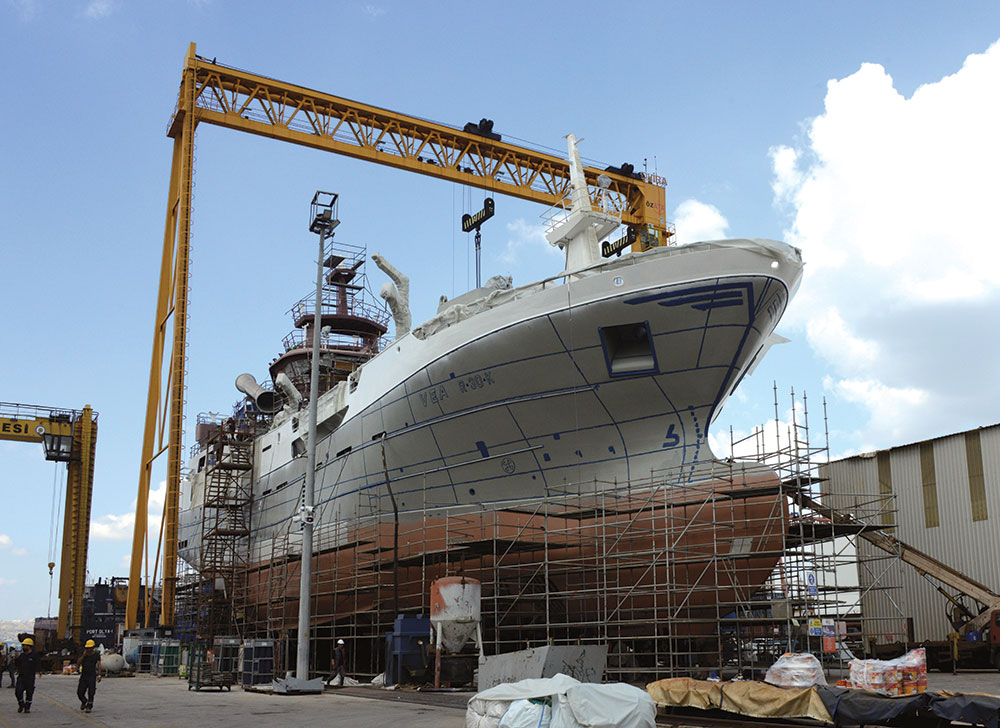
Hidroser, a Parker Premier Distributor in Turkey, has started using F37 non-welded flange technology for hydraulic operated systems on board its vessels. The Turkish firm established its partnership with Parker’s High Pressure Connectors division in the past few years, and started to explore the potential of using non-welded tube connections in shipyards.
The F37 non-welded flange technology is known for its ability to reduce the installation time and cost of hydraulic systems compared to traditional welded flanges. It offers greater flexibility during installation and maintenance, as it can be easily disassembled and reassembled without damaging the system. This technology is also known for its high reliability and resistance to leaks, which are both important factors in the marine industry, where hydraulic systems are subjected to harsh conditions.
Hidroser and Parker’s Complete Piping Solutions (CPS) teams have collaborated to bring this technology to the shipbuilding market in Turkey. With the successful completion of more than 15 projects, many clients have recognised the benefits of F37 non-welded tube connections, and are willing to adopt this technology in their hydraulic systems.
A solution to shipbuilding challenges
Hidroser has focused mainly on industrial hydraulics since 1991. It also works as a system integrator, manufacturing power units, manifolds and cylinders in its facility in Corlu. In recent years, Hidroser has expanded its business to include Parker’s F37 non-welded flange technology, which has a range of advantages over traditional welding technology. This technology has been used to build vessels that need to be highly reliable and efficient in order to withstand the harsh conditions in which they operate.
Shipbuilding is a market that differs significantly from those in which Hidroser has traditionally worked. In this market, the vessels are typically used for maintenance of fish or wind farms, fishing vessels or ferries. This requires high security standards and maximum reliability. In addition, approval from a third-party company such as DNV or ABS is always necessary. The vessels operate in open seas under harsh conditions, so reliability of the components and the service around them is critical.
According to Ramiz Selimbasic, project manager at Parker Hannifin, the cost of stopping and repairing a vessel is much higher than building it with high-quality components from the start.
Growing in the market together
Parker supported the growth of Hidroser in the tube fittings market in the early stages, with piping machine leasing options and the provision of demo machines to create non-welded connections for the vessels, in contrast to the welded connections traditionally used.
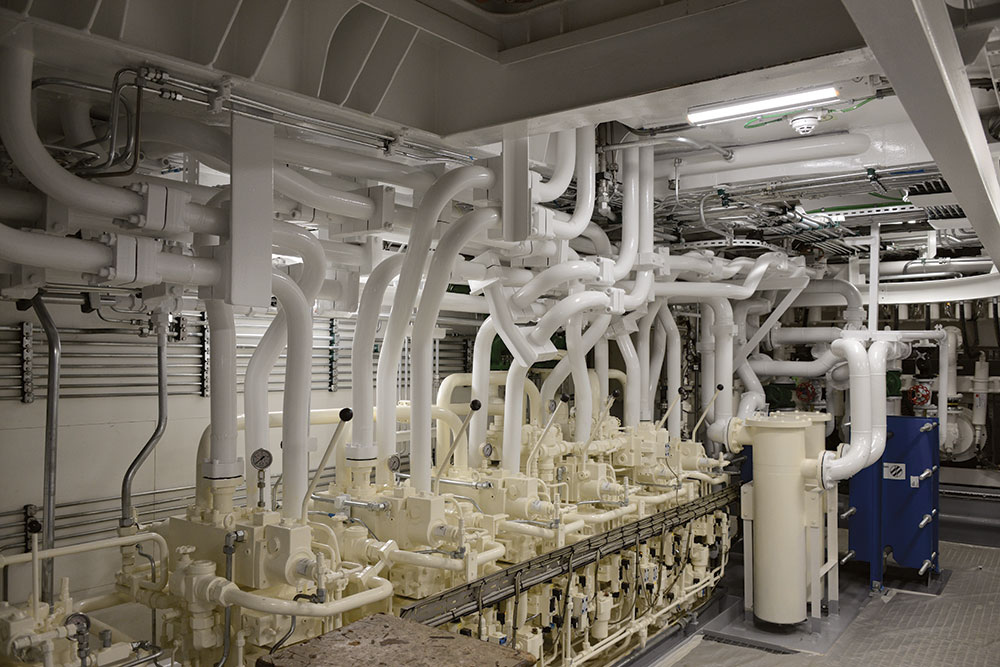
The projects involved the use of hydraulic systems in the vessel, which are critical as the pipeline runs through the whole vessel. In general, hydraulic power consumption is growing, so larger pipelines are needed. For these larger diameters, it is more difficult to build non-leaking connections than it is with smaller diameters. With large diameters and high-pressure requirements, there are only two options to connect them: with either welded or non-welded connections. Most manufacturers today use welded connections; there are only a few non-welded connection suppliers, and the technology is not yet known across all markets.
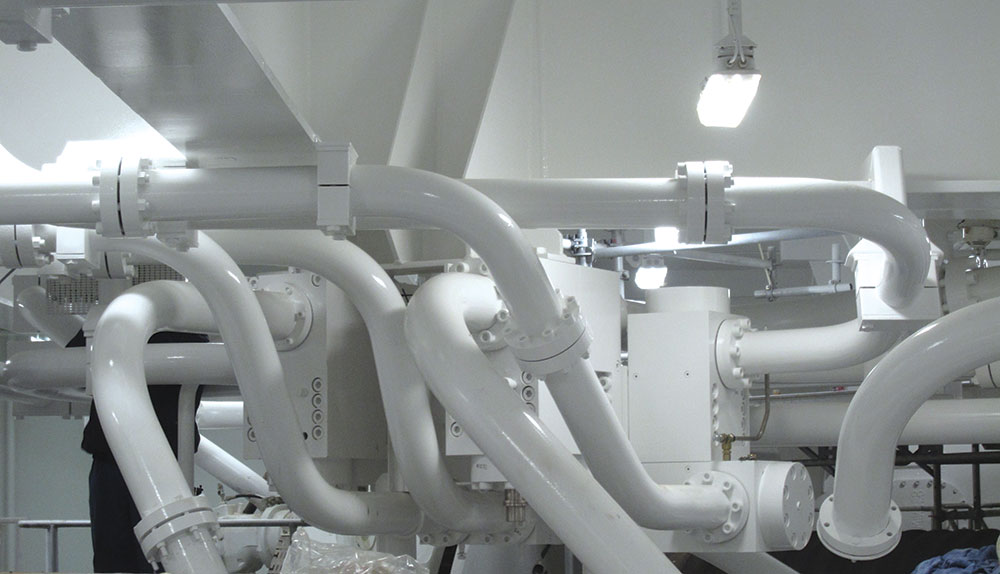
According to Hidroser, welding is a very easy option for the customer. But in the projects, it was found that non-welded connections are more reliable and also easier and much faster to install on site. So, as welding is still more recognised in the market, the company needed to convince customers to use non-welded connections in their projects. Non-welded connections are more reliable and offer a longer lifetime. The time saved with the efficient installation translates into big cost savings across the life of the project. Within the hydraulic systems on the vessels, the flanges represent an important component, as they connect the different tubes and can minimise leakages and therefore define the uptime of the whole vessel.
In addition to the challenges of building vessels that can withstand harsh ocean conditions, there are also several regulatory and safety requirements that must be met for a vessel to be approved for use. Parker has a broad range of non-welded technologies with its F37 and High Performance Flange (HPF) ranges, now also certified by third-parties for the marine market. These meet customers’ demanding requirements for large pipe diameters and high-pressure ranges.
Managing projects as turnkey solution provider
However, components alone are not enough. Engineering, servicing and consulting are also key to these projects. Onsite services require trained employees. Every stage needs to run smoothly, and for Hidroser it is key to deliver the best quality at every stage throughout the project.
The cost savings associated with non-welded connections can be significant, as repairs to hydraulic systems can be both time consuming and expensive. In contrast, non-welded connections offer a longer lifetime and faster, more efficient installation. However, there is still a need to convince customers of the benefits of
non-welded connections over more traditional welding methods, which remain more widely used in the market. A project can take one to two years, and Hidroser needs to support the customer through all stages.
“One of the main challenges in winning those projects is to convince the customer that investing a bit more now into non-welded connections will reduce the costs both in building the connections now and having more reliable, leak-free connections in the working life of the vessel later,” said Hidroser business development manager, Evren Cakil.
One way in which Hidroser worked to address this challenge was by offering onsite services, including engineering, consulting and project management. By providing turnkey solutions that take a project from design to delivery, Hidroser and Parker can ensure that the non-welded flange technology is installed correctly and operates reliably over the long term.
A win-win partnership for Hidroser and Parker
Hidroser profits from Parker being a global brand, successful in applying new technologies. Many of the vessels produced in Turkey are destined for the Nordic countries. Complete Piping Solutions also has a good reputation in northern Europe, where customers already have experience with non-welded connections.
With Parker CPS as a major supplier and expert in building reliable tube connections, the flanges and fittings used in these vessel projects are fully certified for the marine industry, and product tracing and test approvals are also in place.
Parker’s High Pressure Connectors division and the CPS team supported Hidroser during the projects with their product and market knowledge and engineering services. “There is no other match on the market when it comes to product knowledge and consulting services at the same time,” said Cakil. “Parker’s CPS team thinks more like a partner than like a pure manufacturer of components.” Many project meetings took place with customers of Hidroser and Parker. “The presence of Parker with the customers is helping us to show them the benefits of the products, but also of the partnership we have,” he added.
In this way, end users and ship owners also see a wealth of experience coming into these projects. This builds trust and helps to overcome doubts when it comes to using a more expensive technology with the flanges rather than welded connections, which pays off later when the vessel is in use.
Furthermore, the brand reputation of Parker is important in the market, and Hidroser as a long-term partner knows exactly how best to represent Parker best. The brand reputation needs to be supported by trust on the customer side. Here the consultation with Parker’s CPS team again comes into play to show the customers that they are receiving the best solution. Finally, in contrast to other suppliers in this market, Hidroser can deliver the whole project with high-quality full service.
Winning new projects together
To date, Hidroser and Parker have completed more than 15 shipbuilding projects together, which has allowed them to refine their approach, and improve the efficiency and effectiveness of their services. However, the market for non-welded flange technology is still relatively small, and there is a need for further education and outreach to present the benefits of this approach to customers.
To this end, Hidroser and Parker are continuing to invest in research and development to further improve the performance and reliability of the non-welded flange technology. They are also working to expand their reach into new markets, including offshore wind energy, and oil and gas exploration.
The common goal is to optimise the change of delivery, and construct more pipes on site. Moreover, Hidroser would like to add more technologies to its portfolio to meet customer requirements with greater flexibility. Aside from the EO2-FORM fitting series and F37 non-welded flange technologies, the High Performance Flange (HPF) system should also be implemented in the near future to complete the non-welded connection range, especially in the marine business.
“We have EO2-FORM and F37 technologies right now. We’d like to invest in HPF and develop more business with Parker’s CPS team,” concluded Cakil.
| Tel: | +27 11 961 0700 |
| Email: | [email protected] |
| www: | www.parker.com/za |
| Articles: | More information and articles about Parker Hannifin - Sales Company South Africa |






© Technews Publishing (Pty) Ltd | All Rights Reserved
 printer friendly version