



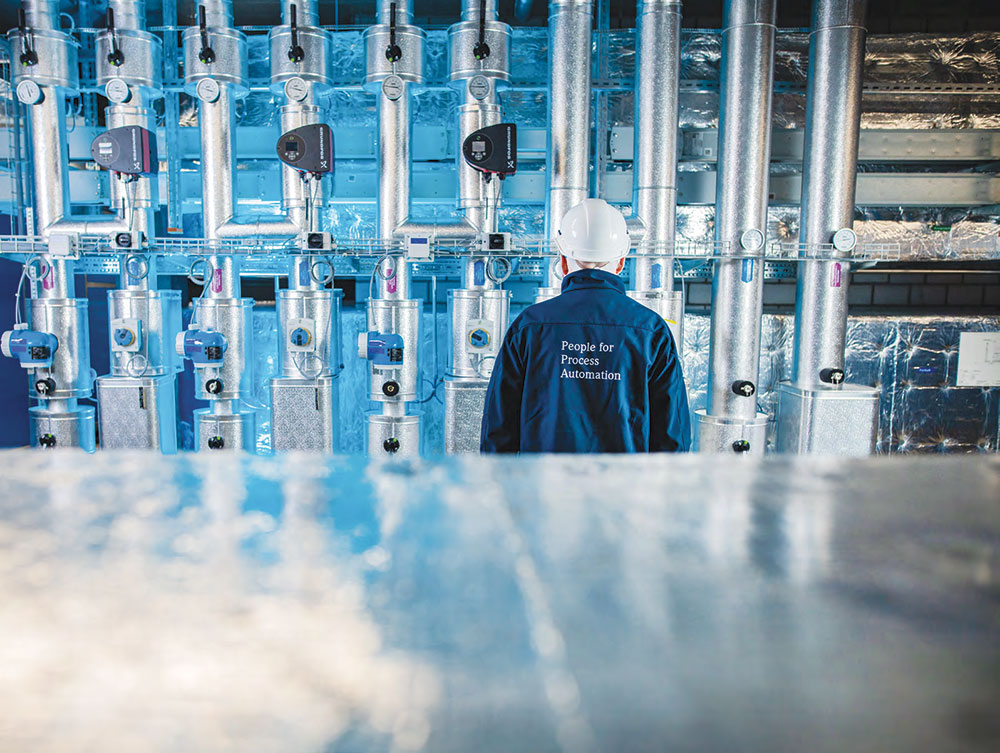
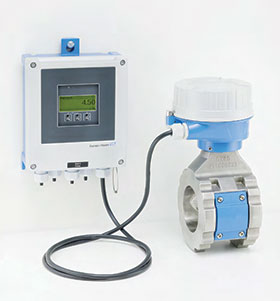
The Endress+Hauser inline measuring devices, the Proline Teqwave MW 300 and the Proline Teqwave MW 500, determine the total solids content of wastewater directly through microwave transmission. This is considerably less time consuming than the process of determining total solids content in a laboratory. The continuously available measured values and short response times mean that the process from primary sludge to dewatered sludge can now be optimised, and problematic operating conditions can be detected early.
One of the challenges wastewater plant managers face is controlling the ever-increasing operational costs. A key component of this is monitoring the total solids content in the different process steps within the wastewater plant. A continuously available total solids measurement makes it possible to optimise the separation of the solid and liquid components in the process. It also increases the operational compliance of the process.
Primary clarifier
Primary sludge settles on the bottom of the primary clarifier, and is pushed by a scraper into a collection chamber. It is then pumped into the sludge treatment facility. This usually happens on a time-based control, during which the current total solids content of the sludge mixture is unknown. As a result, the water portion may be significantly increased due to excessive pumping cycles, making the later phase separation difficult.
With the Teqwave MW continuously determining the total solids content, pump operations can be optimised to avoid excess water being pumped to the sludge treatment plant. When a defined threshold value is reached, the pump is switched off. This optimises pump performance and saves energy. The polished measuring tube reduces buildup and, thanks to Endress+Hauser’s Heartbeat Technology, the functional integrity of the device can be verified at all times. In turn, this means that the calibration intervals can be extended and the process availability increased.
Digester
Raw sludge coming from the primary clarifier and biological treatment reactor is concentrated into a thicker sludge product. To achieve this, flocculants are added to the process. This ensures that smaller particles are combined into larger flakes, which can be separated more easily from the liquid portion of the mixture. The flocculant is dosed according to experience values and regular laboratory analyses of the total solids content. In the digester, the stabilisation and reduction of the sludge quantity takes place.
Dewatering
The dewatering process is designed to draw as much water as possible from the thickened, but still fluid, sludge before disposal. It is important to reduce weight-based transport costs before disposal. Flocculants are introduced before sludge enters the centrifuge or belt press to improve the clarity of the centrate. At the same time, they increase capacity and significantly increase the total solids content.
Thanks to continuous inline measurement with the Teqwave MW, flocculants are no longer dosed based on the flow rate alone. The current total solids content is referenced to optimise the flocculant dosage in real time. This makes it possible to use around 20% less material in typical applications.
The measuring principle of microwave transmission
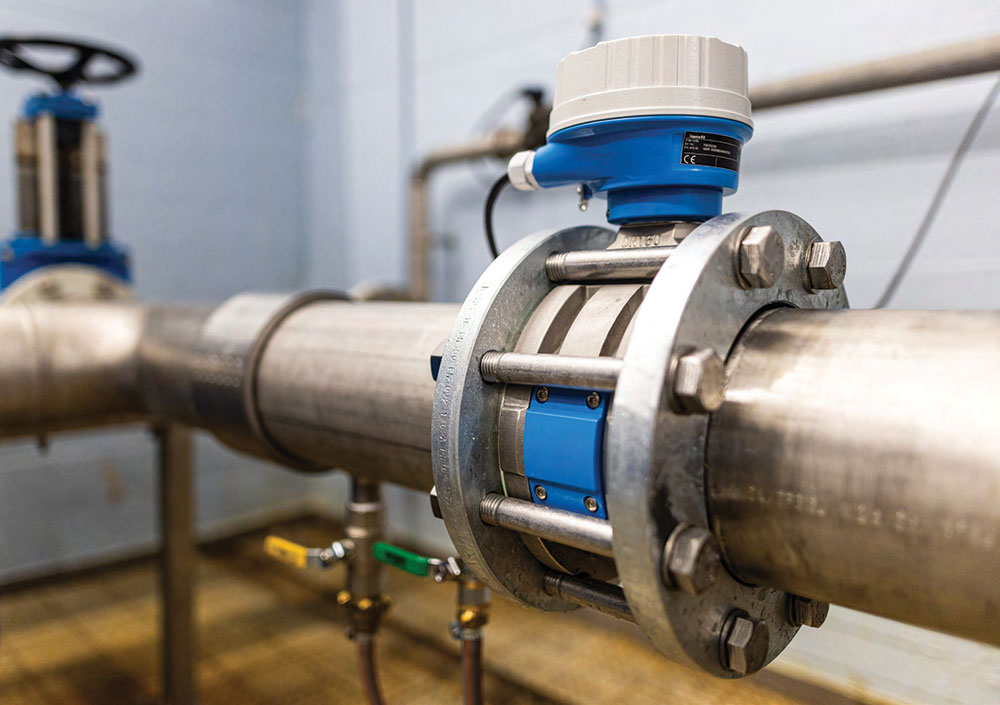
To determine the total solids content, the Teqwave MW uses the measuring principle of microwave transmission. Two antennas installed in the sensor emit microwaves, and in turn receive them from the opposite side. To compensate for temperature-dependent effects, the temperature of the fluid in the pipe is also measured.
When microwaves are sent through the fluid, the transit time and absorption are measured. The permittivity, i.e., the ability to be polarised by electric fields can be calculated from these values. The propagation speed of the waves is greater in fluids with a high total solids content compared to pure water. This is because the polarisation properties of its molecules give water a high permittivity, meaning the water molecules within wastewater sludge absorb the microwaves more strongly, and slow down their time of flight. On the other hand, the total solids typically present in sludge exhibit lower permittivity, meaning the time of flight is correspondingly shorter and the attenuation of the waves is less.
Using a mixing model stored in the device, the existing total solids content in the medium can be determined based on the differing permittivity.
The Proline Teqwave MW 300/500 is a unique and advanced product that assists plant operators to operate desludging pumps efficiently, and reduces the consumption of flocculant. This reduces excessive pumping and operational costs, and promotes energy savings through efficient flocculant dosing and less costly sludge disposal.
| Tel: | +27 11 262 8000 |
| Email: | info.za.sc@endress.com |
| www: | www.endress.com |
| Articles: | More information and articles about Endress+Hauser South Africa |






© Technews Publishing (Pty) Ltd | All Rights Reserved
 printer friendly version