Together, shipping, receiving and storage account for less than half of all warehousing activity costs. The lion’s share of expenses – a whopping 55% – lies in order picking. Breaking down the various activities associated with order picking, we find that over 60% of the time is spent walking, with writing, searching, and picking tasks comprising the other 40%.
Given the data, it’s safe to say that automating the walking portion of an order picking operation will have a strong positive impact on overall warehouse efficiency. Omron Logistics strategic account manager, Yaqing Sun, recently discussed some strategies for using autonomous mobile robots (AMRs) for this purpose at the Automate 2022 show.
Strategy 1: Transporting items to employees (‘goods to person’)
By having an AMR autonomously move goods to a warehouse associate, you can reduce the amount of time that associate spends walking, which in turn reduces fatigue and generally improves work satisfaction. In addition, it improves traceability by automating the QR code scanning process.
Some potential downsides of this method include high upfront investment costs, relatively long integration and/or installation time, and the likelihood of infrastructure changes to the facility. Still, logistics facilities by and large find that the productivity benefits heavily outweigh the initial costs of deployment.
Strategy 2: Transporting items between zones (‘person to goods’)
This strategy involves breaking the warehouse into separate order picking zones, each of which will have a dedicated employee. Since a single order might involve picking from more than one zone, an autonomous mobile robot will move between the zones, stopping whenever an employee needs to retrieve a particular item.
Although each employee must still do some walking, having AMRs traverse the long distances between zones significantly reduces walking times. The main downside of this method is that employees must still scan items manually, so traceability isn’t fully automated.
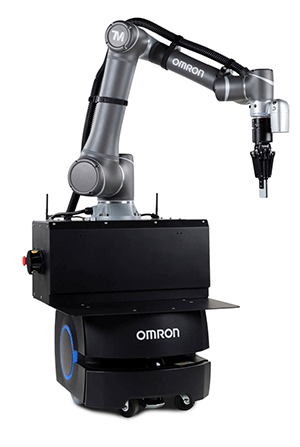
Strategy 3: Transporting items to a robot (‘goods to robot’)
This method has the dual advantages of high accuracy and low dependence on labour availability, making it a good option for companies struggling to hire personnel. Minor downsides include high investment costs and the possibility of lower throughput relative to manual picking.
Nonetheless, collaborative robotic (cobot) technology is advancing by leaps and bounds, and solutions that connect an autonomous mobile robot with a cobot are going to just get more and more efficient. Furthermore, both AMRs and cobots can work around the clock with minimal downtime.
Osterwalder launches multi-plate, fully electric powder press
Motion Control & Drives
Osterwalder Technology has launched the MPneo 480, a 480 kN fully electric multi-plate powder press with up to six cross-pressing modules. Designed for hard metals, ceramics and advanced engineered materials, the press supports complex geometries and offers optional
Read more...Ground helical racks for superior precision and durability
Motion Control & Drives
KHK USA has announced its ground helical rack series, engineered for smooth operation, high torque transmission and long-lasting performance in precision motion systems. The racks are designed for demanding environments such as machine tools, high-speed automation equipment and precision positioning systems.
Read more...SpinDrive launches Magma X100 active magnetic bearing controller
Motion Control & Drives
SpinDrive has launched the Magma X100, a new active magnetic bearing controller platform for applications up to 150 kW. The platform brings oil-free, frictionless bearing technology to mobile machinery, semiconductor equipment and other high-speed rotating equipment at a cost comparable to conventional bearing solutions.
Read more...Sealed split spherical roller bearings deliver rapid installation and reduced downtime SKF South Africa
Motion Control & Drives
SKF Cooper sealed split spherical roller bearings combine a split design with premium engineering to enable rapid installation and simplified maintenance, reducing mean time to repair by up to 70% and keeping operations running in sectors from mining to food and beverage.
Read more...Inclination sensors for motion control ifm - South Africa
Sensors & Transducers Motion Control & Drives
The JBC dynamic inclination sensor from ifm offers accurate angle measurement in the most demanding conditions, filtering out motion disturbances such as vibrations, shocks and vehicle dynamics to deliver reliable inclination values via IO-Link or programmable switch outputs.
Read more...Next-generation autonomous mobile robots from Omron Robotics Omron Electronics
Editor's Choice
The new LD-150 and LD-300 autonomous mobile robots from Omron Robotics offer higher payload capacity and advanced navigation in a compact footprint, with wireless inductive charging and fleet management integration to support high-throughput material transport in demanding production environments.
Read more...Inside the Giant Magellan Telescope with mechanical engineering at astronomical scale
Motion Control & Drives
Construction of the Giant Magellan Telescope, set to become the world’s largest Gregorian optical infrared telescope, is well underway. While its scientific mission is to transform astronomy, its performance depends heavily on advanced mechanical, hydraulic and pneumatic engineering.
Read more...Drives cut energy use by up to 30% amid rising costs
Motion Control & Drives
Rockwell Automation’s PowerFlex 755TS variable frequency drives are delivering energy reductions of 10 to 30% in Africa’s industrial operations, with adaptive control and predictive maintenance features that cut downtime by up to 50%.
Read more...Proportionate specification for hazardous locations
Motion Control & Drives
As automation spreads deeper into processing, handling and transport operations, motors are increasingly required to operate in spaces that sit on the edge of hazardous zones.
While every effort has been made to ensure the accuracy of the information contained herein, the publisher and its agents cannot be held responsible for any errors contained, or any loss incurred as a result. Articles published do not necessarily reflect the views of the publishers. The editor reserves the right to alter or cut copy. Articles submitted are deemed to have been cleared for publication. Advertisements and company contact details are published as provided by the advertiser. Technews Publishing (Pty) Ltd cannot be held responsible for the accuracy or veracity of supplied material.










 printer friendly version