



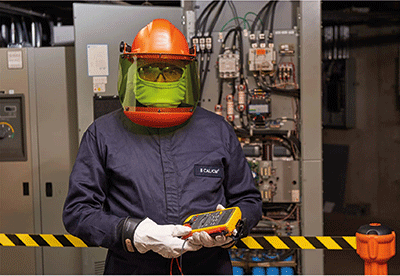
Most companies don't have a strong culture of safety, according to a Fluke survey. To build a strong culture of safety, you first need to create a climate of safety. A climate of safety allows for changing and adapting more quickly. It influences the culture of safety, which is harder to change because it is engrained into the overarching company culture. If you want to change a company’s culture of safety, you need to start with the climate of safety. Over the years, that strong climate will create a stronger culture.
Safety culture expert at Predictive Solutions, an Industrial Scientific company, Chuck Pettinger (Ph.D.) has seen three key changes help in creating a successful climate of safety that will grow into a successful culture of safety:
1. Communicate
Part of any successful business is how we communicate with one another. When looking at a climate of safety, communication can include things like goal-setting and incentive programmes.
Dr Pettinger suggests that, instead of tracking metrics based on accidents and injuries, an organisation should focus on the positive. Focusing on accidents and injuries “drives a lot of safety reporting ‘under the ground’, and it may unintentionally hurt the culture.” Instead, try focusing on tracking the quality of the safety inspections, or how many employees participate in a safety initiative. In general, people are more motivated when they are trying to improve something, rather than trying to avoid or reduce something (such as injuries).
Instead, focus on setting S.M.A.R.T. goals (Specific, Measurable, Achievable, Realistic and Timely), which are more useful and create a positive effect on the company’s climate of safety. Dr Pettinger says, “[The goal] should be an actionable, observable behaviour that you're reinforcing, versus, you know, ‘Do your best.’ So, make it specific. Make it achievable. Make it relevant to the people around you, and not just important to you. And visualise it, get people to appreciate it.”
It is also important to be aware of how you talk about certain processes. This can also impact how the climate is perceived throughout the company. Dr Pettinger gives an example of how the climate can negatively influence employees: “If you hear ‘We have to get this machine up and running,’ you know there's time sensitivity. There's a little bit of pressure, and no one's actually telling you, ‘Take shortcuts,’ but you're feeling that pressure from the climate, versus other cultures that say, ‘I don't care how long it takes. Take your time. Do it safe. Don't get hurt’.”
2. Make it personal
Creating a plan that makes safety about the individual helps keep it top-of-mind throughout the workday. Dr Pettinger has seen success in changing how shift startup meetings are conducted, and tailoring the training more.
Getting employees more involved in shift startup meetings has had a positive effect for many companies. Instead of just focusing on what needs to get done and where the previous shift left things, Dr Pettinger suggests taking the time during each meeting to discuss potential risks and how to mitigate them. “Elicit those responses from the people in your group. As a good manager, trying to get them to come up with the solution is the key,” Dr Pettinger said.
When it comes to training and teaching, there are multiple different ways of approach. A Fluke customer, Michael Brooks, has seen success with one-on-one training at his company, Great Southwestern Fire and Safety – taking the time to walk through the safety steps and ensure that the knowledge and experience one employee has is translated to the next.
According to Brooks, “What they've learned, they've been able to translate that to somebody else new. It's not the same people teaching and learning and growing all the time. We've worked really hard to try to keep this positive attitude amongst our workforce.” This has not only helped to keep the employees safe but has helped the company grow over the years.
3. Keep building
Many companies fall into what is called the ‘venomous cycle’. In this cycle, new initiatives start out strong, but eventually lose momentum, and after a while will be ignored completely. Then another new initiative is started and the cycle repeats. However, no real change is seen from these initiatives and both the climate and culture of safety remain the same.
Instead, companies need to find a way to get into the ‘virtuous cycle’. This is all about patience and perseverance. “Culture is something that's very hard to impact. It's something that takes three to five to ten years to change sometimes,” Dr Pettinger said.
Once a new initiative is started, set short-term goals so it feels more like progress is being made. Not only will individual employees feel like they’re able to make more of an impact, but management can also track what changes have started to happen. Once people see the value of the new process, it will become self-sustaining, ingrained, and help your organisation create a culture of safety.
| Tel: | +27 10 595 1824 |
| Email: | [email protected] |
| www: | www.comtest.co.za |
| Articles: | More information and articles about Comtest |






© Technews Publishing (Pty) Ltd | All Rights Reserved
 printer friendly version