Insect-sized flying robots with flapping wings
March 2022
Motion Control & Drives
A new drive system for flapping wing autonomous robots has been developed by a University of Bristol team, using a new method of electromechanical zipping that does away with the need for conventional motors and gears.
This new advance published in the journal Science Robotics* could pave the way for smaller, lighter and more effective micro flying robots for environmental monitoring, search and rescue and deployment in hazardous environments. Until now, typical micro flying robots have used motors, gears and other complex transmission systems to achieve the up-and-down motion of the wings. This has added complexity, weight and undesired dynamic effects.
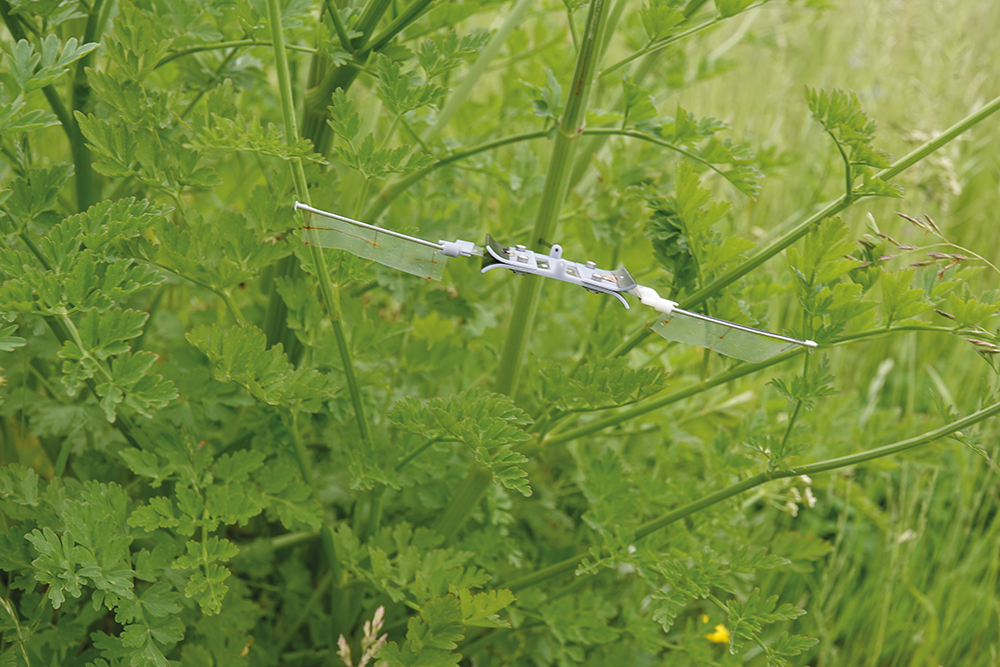
Taking inspiration from bees and other flying insects, researchers from Bristol’s Faculty of Engineering, led by professor of Robotics Jonathan Rossiter, have successfully demonstrated a direct-drive artificial muscle system, called the liquid-amplified zipping actuator (LAZA), that achieves wing motion using no rotating parts or gears.
The LAZA system greatly simplifies the flapping mechanism, enabling future miniaturisation of flapping robots down to the size of insects.
In the paper, the team shows how a pair of LAZA-powered flapping wings can provide more power compared with insect muscle of the same weight, enough to fly a robot across a room at 18 body lengths per second.
They also demonstrated how the LAZA can deliver consistent flapping over more than one million cycles, important for making flapping robots that can undertake long-haul flights.
The team expects the LAZA to be adopted as a fundamental building block for a range of autonomous insect-like flying robots.
Dr Tim Helps, lead author and developer of the LAZA system said: “With the LAZA, we apply electrostatic forces directly on the wing, rather than through a complex, inefficient transmission system. This leads to better performance and simpler design and will unlock a new class of low-cost, lightweight flapping micro-air vehicles for future applications, like autonomous inspection of off-shore wind turbines.”
Professor Rossiter added: “Making smaller and better performing flapping wing micro robots is a huge challenge. LAZA is an important step toward autonomous flying robots that could be as small as insects and perform environmentally-critical tasks such as plant pollination and exciting emerging roles such as finding people in collapsed buildings.”
*Paper: ‘Liquid-amplified zipping actuators for micro-air vehicles with transmission-free flapping’ by T. Helps, C. Romero, M. Taghavi, A. Conn and J. Rossiter in Science Robotics.
Further reading:
Mammoet completes major bridge replacement at Amsterdam Centraal Station
Motion Control & Drives
Mammoet completes the second of five major bridge replacements at Amsterdam Centraal Station, transporting steel deck sections by water to keep the station open throughout the works.
Read more...
ndustry expertise drives SEW-EURODRIVE’s Electra Mining Africa presence
Motion Control & Drives
SEW-EURODRIVE will showcase industry-specific drive technology, modernisation services and expanded aftermarket support at Electra Mining Africa 2026, with a focus on lifecycle support and operational optimisation.
Read more...
Next-generation motor management solution
Schneider Electric South Africa
Motion Control & Drives
Schneider Electric has launched its TeSys Tera motor management solution in the West African market, combining advanced motor protection, digital connectivity and real-time diagnostics for manufacturing, mining and water applications.
Read more...
Premium slewing rings from SKF
SKF South Africa
Motion Control & Drives
SKF’s slewing bearing portfolio spans standard and customised designs across a wide range of types and sizes, backed by advanced monitoring, remanufacturing services and application engineering expertise for demanding industrial applications.
Read more...
World’s first fully electric hydrogen fuel cell aircraft engine
Motion Control & Drives
Airbus and MTU Aero Engines are establishing a joint venture to industrialise hydrogen-electric propulsion systems for commercial aviation, combining liquid hydrogen expertise with fuel cell development to support the ZEROe programme’s 2035 target.
Read more...
Monopile handling innovations boost offshore wind farm
Motion Control & Drives
Mammoet’s XXL monopile transport system and new MTC 1600 terminal crane are helping offshore wind developers safely marshal and install ever larger monopile foundations, as demonstrated on Van Oord’s Baltic Power project.
Read more...
Automation without the mega factory
Yaskawa Southern Africa
Motion Control & Drives
Mid-sized South African manufacturers are turning to targeted, low-risk automation to solve specific bottlenecks rather than chasing full factory transformation, helped by retrofit-friendly robotics and advanced simulation software.
Read more...
Duplex worm gears for precision backlash adjustment
Motion Control & Drives
KHK USA has introduced duplex worm gears that allow precise backlash adjustment through simple axial movement of the worm shaft, eliminating the need for gearbox housing alterations during assembly or maintenance.
Read more...
Choosing the right level of protection in modern automation
Motion Control & Drives
Choosing the right ingress protection rating for a motor or drive is less about maximising the number, and more about understanding what the machine will actually face in operation.
Read more...
Osterwalder launches multi-plate, fully electric powder press
Motion Control & Drives
Osterwalder Technology has launched the MPneo 480, a 480 kN fully electric multi-plate powder press with up to six cross-pressing modules. Designed for hard metals, ceramics and advanced engineered materials, the press supports complex geometries and offers optional
Read more...










 printer friendly version