



Factories all over the world have systems tracking production through the plant. These systems track customer orders, works orders and production orders through the plant. Some plants have automated equipment that captures and retains product and production information, but these are often complemented by ‘manual’ manufacturing processes.
Most manufacturing companies have combinations of automated and manual processes. Rarely is automated equipment integrated into a framework where automated information is linked to manual information to provide an end-to-end tracking solution. For most companies, the tracking systems are manual, meaning that a piece of paper (sometimes quite complex) follows the products through the different manufacturing processes, collecting information as the job moves from one process to the next.
Limitations of manual systems
These systems are effective and therefore still in use, in that they provide accounting on actual jobs completed, along with the actual raw materials consumed, so that the ERP can be ‘backflushed’ to determine actual stock on hand. For the purposes of materials management, the systems work. They do, however, only provide a ‘real’ view of the plant on the day that the backflush is done. So, for some plants, orders or jobs disappear into the factory and are only seen again 10 to 20 days later when they are complete and all data is captured in the ERP system.
In a fast-moving environment where orders are completed every hour or two, this can be quite effective as data capture is done frequently, but where manufacturing processes span more than a day or two, the system introduces delays into the process and actual production performance and production rates are rarely known. Although more profound in slow-moving environments, the ability to measure and report on actual rate of production remains an issue due to the manual nature of production tracking.
In addition to the infrequent/intermittent capturing of production data, another problem companies face is that quality issues, production rate issues and material consumption issues only become apparent hours (if not days) after the fact, when the opportunity to react and implement corrective and preventive actions has long passed.
Digital systems
From a plant optimisation perspective, there is thus a definite benefit in implementing digital solutions to replace the manual ones, as they make information available in real-time, giving the opportunity to react swiftly and prevent issues from proliferating through the plant. An additional benefit brought by digitisation is the ability to determine product genealogy. In some industries this may not be a legal or regulated requirement, but others are looking at their second (and third) tier providers to have the ability to backward and forward track product genealogy. This is especially true for the more highly regulated industries such as pharmaceuticals, food and beverage and automobile manufacturing.
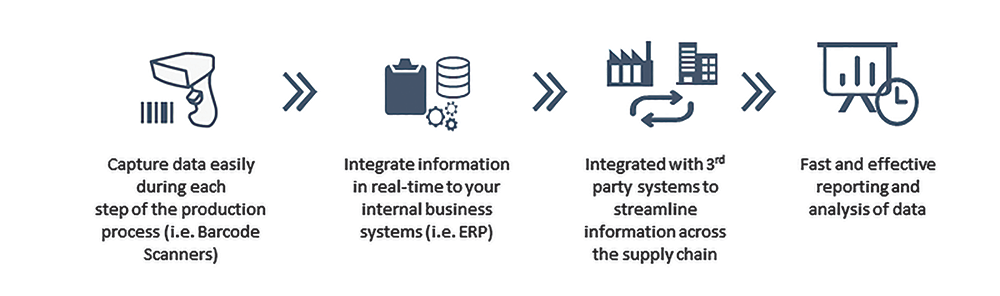
Many suppliers get away with clean supplier ‘audits’ etc., as retrieving manual records can be time consuming (so the sample size cannot be big), but many manufacturers are now starting to insist on digital systems in order to increase the sample size and cast a wider net during the audit process. Some companies do not directly define the need for digital systems, but they define an allowed response time (e.g., two hours from request) that cannot be met without a digital system. Manufacturers have also realised that without real-time information they cannot make real-time decisions.
Benefits of digital solutions
More mature companies that have implemented digital track and trace solutions found that in addition to the electronic audit records, they were also able to use the same tracking information to obtain and calculate actual rates of production, as opposed to ‘best demonstrated’ or ‘average over time’ production rates. They are also using the data to compare shifts, equipment, materials etc. to find the most effective and profitable combinations, which can then be planned and replicated in future.
Additional benefits found include:
• Real-time count of units produced, or volumes processed.
• Real-time view of order progress and whether production rates are on target or running behind.
• Calculate actual production rates versus the planned rates per product.
• Ability to compare information across shifts, teams, or lines, as well as the improvement over time.
• Automatically feed order completion information to the ERP system.
• Find the most effective and profitable batches, analyse the impacting factors and put in steps to replicate these processes in future.
Additional benefits to the rest of the company, outside of the production environment, included:
• Protection of brand reputation.
• Compliance to regulatory requirements.
• Improvement in inventory accuracy.
• Minimise recall time and costs.
Conclusion
Production tracking or shop floor data collection is thus a crucial requirement for successful management, not only of production processes, but also of stock and physical and human resources. Modern track and trace solutions are purpose-built to introduce as little disruption to the existing production process as possible, while also being flexible enough to cater for plants that range from fully manual to fully automated.
From what can be seen above, digital solutions can provide huge benefits to companies and many are in the process of investigating and evaluating them. Surprisingly, it is not only the ‘big players’ that are looking at track and trace solutions, but even small- and medium-sized companies are looking to these solutions to assist them in their continuous improvement initiatives.
Considering all the outlined benefits, it becomes obvious that implementing a production tracking system in a factory is certainly not a waste of time and considerable additional benefits can be derived from such systems.
| Tel: | +27 12 349 2919 |
| Email: | [email protected] |
| www: | www.iritron.co.za |
| Articles: | More information and articles about Iritron |






© Technews Publishing (Pty) Ltd | All Rights Reserved
 printer friendly version