


System Integration & Control Systems Design


Portion cutter for fish and poultry

November 2020 System Integration & Control Systems Design

Danish company Borncut A/S, located in Rønne, has developed what it believes to be the world’s fastest and most precise portion cutter for the food industry, based on specially developed software and the open control platform from Beckhoff. Fish or poultry is divided into exact portions in a flash – with knives that rotate at speeds of up to 200 km/h and can make over 2100 cuts per minute.

The Borncut Scancut 225 portion cutter can process up to 4 tons of fish in just one hour to produce almost any number of individual pieces, cut to the desired weight. Speed and precision are key competitive parameters in the food industry, since even a small increase in processing performance can result in significant annual cost savings. Gorm Sørensen, co-founder and CEO of Borncut, gives an example: “A processing challenge arises when foods such as fish and poultry are irregular in size and shape. If, for example, 10 tons of salmon are processed per day, a machine output optimised by only 0,5% can save around DKK 5000, which adds up to around DKK 1,25 million – or around 170 000 Euros – per year.”
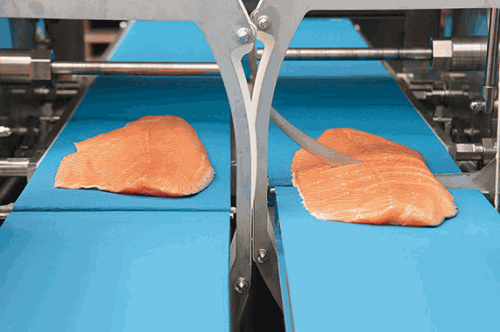
Image copyright Borncut, Denmark.

Fast EtherCAT communication increases machine performance

Peter Mikkelsen and Gorm Sørensen founded Borncut in 2016 with the aim of developing the most innovative portion cutter on the market. “With all due modesty, we have achieved our ambitious goal,” says Mikkelsen. “The tremendous machine speed is primarily due to the high performance of EtherCAT communication. This is because EtherCAT enables the control components in the machine, the PLC, servomotors, safety module, and our own high-speed camera, to communicate with each other very rapidly. This results in an extremely efficient process flow. At the same time, our machine requires minimum manual intervention since it uses network-compatible standard solutions.”

Borncut machines are available in single or dual lane versions, i.e., with one or two infeed belts. The corresponding setup can easily be changed via the CP27xx multi-touch panel PC. The machine can be adjusted exactly to the desired portion size using drag-and-drop functions. In addition, the machine data can be called up as required for comparison with other production data.

A special feature is the integrated high-speed camera that scans the food on the belt. The camera captures 250 frames per second and displays a 3D image on the panel PC. In this way, the end user can see exactly where the cuts are made. Mikkelsen elaborates: “The faster the volume of the fish or poultry can be calculated, the faster the food can pass through the machine. For example, in order to obtain only the best pieces, or to cut the fish into different sizes, the cutting blades can be conveniently adjusted using the drag-and-drop function, and the cuts can be accurately checked based on the 3D image.”

Reliable machine operation is crucial

Borncut places high demands on the control platform, especially with regard to operational reliability and service. This is because the machines are used for a wide range of different food production processes, and it is therefore important that they can reliably and quickly be adapted to new functions without equipment downtime. A standstill would have significant consequences for the end users, as the machines are often part of large processing lines with many operators. In addition, the food to be processed usually has a short shelf life at normal temperatures, and short delivery times are essential. Should a machine failure occur, it is crucial that the fault can be quickly located and rectified.

Sørensen concludes: “PC-based control from Beckhoff enables us to build efficient and reliable machines. The openness of the system makes it easy to integrate third-party components such as the high-speed camera, which gives us additional options. Another key factor is our good cooperation with Beckhoff, who took note of our requirements right from the start. Beckhoff staff were quickly available on site when the need arose and offer excellent service. The innovative solutions perfectly complement our own philosophy.”


Credit(s)


Share this article:
Share via emailShare via LinkedInPrint this page

Further reading:

Flotation system modernisation for a gold processing and mineral recovery plant.
Moore Process Controls System Integration & Control Systems Design
Moore Process Controls has successfully modernised a gold processing plant's flotation control system, replacing obsolete I/O hardware with Schneider Electric's latest M580 X80 platform.

Read more...
Project and industry
Schneider Electric South Africa System Integration & Control Systems Design
Transforming crushing plant operations through integrated automation.    Controlgear Instramac was engaged to deliver the electrical control and automation systems for a new crushing plant within the ...

Read more...
Project and industry
EXEL Electrical Engineering System Integration & Control Systems Design
EXEL EE was contracted to deliver the complete electrical, control and instrumentation scope for the upgrade of a gold mine's water treatment facilities in Tanzania.

Read more...
Turning system integrators into trusted technology partners
Schneider Electric South Africa IT in Manufacturing System Integration & Control Systems Design
Schneider Electric’s Alliance Partner Programme is repositioning system integrators from hardware suppliers into lifecycle-value partners. Oriel Soupen explains the competency framework, certification model and real-world results that are already helping African system integrators win higher-value, longer-term engagements.

Read more...
When digital twins move from concept to critical tool
IT in Manufacturing System Integration & Control Systems Design Maintenance, Test & Measurement, Calibration
Digital twins are moving out of the lab and onto the mine, the factory floor and the transport network where they predict failures before they happen. Amritesh Anand looks at where they earn their keep, the data and integration work behind them, and the security questions every organisation should ask before switching one on.

Read more...
Best practices for managing the MRO supply chain in Africa
RS South Africa System Integration & Control Systems Design
RS South Africa outlines how strong data governance and digital tools can turn maintenance, repair and operations procurement into a strategic advantage across Africa.

Read more...
Test bench for temperature calibrating power semiconductors
Beckhoff Automation Temperature Measurement
Precise temperature characteristics are essential for performing power cycling tests on power semiconductors. Infineon Technologies determines these characteristic curves on a test bench using PC-based control. As a result, calibration has become more precise and the efficiency of the entire test laboratory has increased significantly.

Read more...
XTS for highly efficient end-of-line packaging of beverage bottles
Beckhoff Automation Editor's Choice
Italian machine builder Clevertech used Beckhoff’s XTS linear transport system to help a Dutch distillery double its bottle packaging throughput to 225 bottles per minute while cutting format changeover times from 30 minutes to just seven.

Read more...
Containerised Solar Solution Accelerates Delivery of Riverside 3 MW Power Plant
Proconics System Integration & Control Systems Design
Proconics was engaged by NewFields to deliver the electrical integration solution for the Riverside 3 MW Solar Power Plant in Zimbabwe. The project required a compact, modular approach that could simplify deployment, minimise site works, and support rapid commissioning in a remote location.

Read more...
Modern Energy Metering Solution Enhances Reliability and Reporting for Major Power Utility
SAM Systems Automation & Management System Integration & Control Systems Design
This project involved the implementation of a modern energy metering system for a major power utility operating within the industrial automation and energy management sector. The objective was to improve the reliability, accessibility, and accuracy of energy data while simplifying infrastructure and reducing system complexity.

Read more...


While every effort has been made to ensure the accuracy of the information contained herein, the publisher and its agents cannot be held responsible for any errors contained, or any loss incurred as a result. Articles published do not necessarily reflect the views of the publishers. The editor reserves the right to alter or cut copy. Articles submitted are deemed to have been cleared for publication. Advertisements and company contact details are published as provided by the advertiser. Technews Publishing (Pty) Ltd cannot be held responsible for the accuracy or veracity of supplied material.


© Technews Publishing (Pty) Ltd | All Rights Reserved

