



The Eight Commandments to digitising your shop floor workforce bundle insights, examples and lessons learned from PwC’s experience in digital transformation in an operations and supply chain environment into eight practical ‘commandments’. Operations, production and supply chain leaders can apply this knowledge to digitising and connecting their workforce through wearable technologies.
Connectivity has moved beyond the use of mobile phones alone, with the emergence of a host of new technologies such as augmented and virtual reality. Connecting your workforce with smart technologies in an operational context has enormous benefits, for example, by interacting with a digital environment in a realistic way, quality, compliance, production and logistic efficiency can be increased, as can the self-learning and training opportunities that enable the workforce to adapt to its changing environment.
The Eight Commandments
1. Bring consumer reality into the realm of industry
In addition to being used by consumers, smart devices can also be used in operations on the shop floor. This naturally renders the industrial environment paperless, is easy to manage and gives staff a consistent and familiar user experience.
2. Select the right challenges
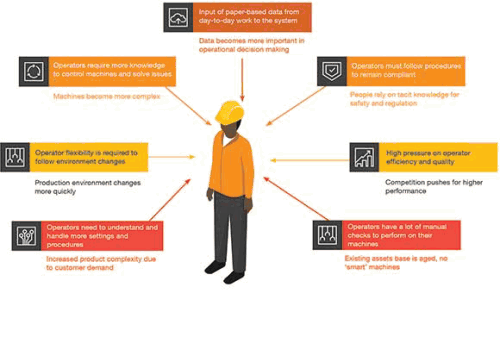
Your workforce is facing new challenges, from increased machinery and product complexity to changing safety regulations and circumstances. It’s crucial to consider these challenges and select the most important ones to address or overcome during your digital transformation.
As the need for digitally skilled people increases, so does the need for companies to invest in training programmes for digital concepts and capabilities and in finding new ways to attract talent. Your ‘workforce of the future’ will work with state-of-the-art technology, so the required skill set will shift accordingly. Creativity, adaptability, problem solving, leadership and innovation are the top skills for both blue and white-collar jobs.
3. Place your workforce at the centre
Industrial leaders see the biggest potential for digitisation on the shop floor. Companies need to think about how they can connect their workers with the equipment, information and processes they handle on a daily basis. There are various wearable devices and software options available that can help you achieve this.
For instance, if you give an operator a wearable with applications that contain digital and dynamic versions of their work instructions, they’d have access to all relevant processes and thus be able to complete the task at hand correctly the first time, faster and more effectively.
However, this connection is not limited to processes. There’s a growing number of resources available that can enable your company to connect the workforce with the assets and environment in which they operate. These provide workers with internal information from internal sources such as asset, ERP and other data, as well as external sources. The increasing generation of data and therefore information, by new assets and technologies, will only further increase the opportunity and urgency to connect your workforce with these sources of information.
Connecting your workforce by location alone already presents many opportunities for safety and quality assurance. For instance, the location information of an operator can allow or prohibit them to access specific areas or execute certain tasks. In case of a hazardous situation or emergency in an industrial environment, all internal employees and contractors can be traced and evacuated.
Also including additional static information in the connection, such as real-time performance data, manuals and routes, supports the workforce in its tasks and assures better compliance with safety, quality and operational procedures. For instance, providing the operator with a machine’s oil temperature may help them make a better and faster decision on specific preventive maintenance needs. Another example would be remote engineering support via communication by data exchange, call, or video.
Connecting your workforce with these various sources and utilising one or more connectivity levels across different applications can have a significant impact on your company’s overall performance.
4. Weigh your options smartly
There are many possibilities in using augmented reality and virtual reality, depending on the degree of reality augmentation you require and the mobility of the workforce. You need to consider the specific environment and application when choosing the optimal type of reality and associated hardware.
5. Let the voice of your workforce lead you through your transformation
To guide your workers through the digital transformation process successfully, it’s important to involve them from the very beginning. First, you need to learn how your workers operate within their environment before you consider a new and better solution.
This approach enables you not only to define a connected worker strategy and choose the right innovative technologies, but also to imagine the future of your connected workers. Getting out into the field to talk with and observe your operators performing real tasks on the work floor is the most powerful and valuable way to define the challenges and pain points that need to be addressed. It’s amazing what you can learn by spending time on the floor.
Implementing a connected worker strategy is a powerful component in a digital transformation process. By easily connecting your workers to their colleagues and giving them the correct information at the right time in the easiest possible way, you can make operational processes more efficient and productive than ever. Only by systematically involving your workers throughout the whole transformation process is it possible to implement real and valuable solutions on the work floor. Solutions that are easily accepted by your workers will ultimately become the new and natural ways of working.
6. Select the most promising operational area to start your journey
Connecting your workers with the use of smart wearables offers a wide range of opportunities. However, it also requires specific software and customisation for both workers and the organisation. Therefore, it’s important to assess the impact of the changes on the area of operations you’re considering and ensure the correct funnelling and selection procedures are in place.
The scope shouldn’t be limited to manufacturing and maintenance but should also include logistics: consider smart wearables for digitising procedures and switching to smart paperless warehouses. Connectivity allows team leads to monitor real-time performance, enabling them to proactively deal with potential problems or bottlenecks in day-to-day operations. It enables them to gather a great deal of data on daily activities and in turn, use that data to gain insights that can be applied to further robotics and automation initiatives.
7. Connecting your workforce is the means to an end: unlocking the data
Smart devices need a lot of data input and connections, but at the same time they’re tremendous generators of data. You should therefore consider your smart devices as important elements in the transition to a smart factory, where the data will be used for widespread analyses.
You need to consider which data is available or required for other smart factory opportunities and how this data can be used or generated in future. Smart devices aren’t standalone solutions and should be integrated into the broader digital system. The more tools, sensors and technologies can interact and exchange data, the higher the efficiency gains and therefore return on investment. As with many technologies, data analytics is both an enabler as well as an incentive for achieving the full potential of smart devices.
With the increasing availability of data from all types of sources, analytics platforms and dashboards are increasingly widespread and applied in domains such as commercial excellence, operations, logistics, energy and procurement. With smart glasses, the end user has hands-free access to these dashboards and their data insights. The smart device user can also receive tasks to be completed, triggered by analytics platforms or enterprise systems.
With the increasing use of analytics comes the need to connect and integrate as many data sources as possible. By using wearables as instruments during the execution of procedures, data registrations are not only stored digitally, but can also be fed into data analytics platforms. For instance, equipment parameters such as oil temperature and pressure can be included in a broader analytics platform that helps predict maintenance needs.
8. A small step for your workforce can be a big step in your digital transformation
Smart devices can be used for a wide range of applications. However, they shouldn’t be introduced as an isolated implementation, but launched as part of a bigger digital journey with the right vision, scope, communication and ecosystem of partners, suppliers and customers.
They can be highly beneficial in developing a larger digital programme in which business and technology viewpoints are combined with a hands-on experience perspective during short co-creation sessions. Cross-functional teams and stakeholders define business challenges while gaining technology insights, resulting in the identification of new opportunities and providing a clear view on the company’s current digital maturity.
As with every change and transformation, picking low-hanging fruit and showing tangible results and impact are key success factors. Therefore, it’s important to start with small pilots and scale quickly in terms of digital applications. The connected worker is a pilot case that can be implemented at relatively low cost and effort. Tackle a specific improvement opportunity, such as increasing efficiency and quality compliance, by digitising a standard operating procedure.
Conclusion
Your operators are facing numerous challenges, ranging from tightening safety regulations and ageing equipment to increased product complexity. This requires continuously evolving knowledge and skills from their side and therefore, support is needed. Support can be provided by connecting the workforce with their daily processes via manuals, digital procedures or human assistance.
The opportunities for applying digital procedures and assistance for your workforce are countless. However, it is risky to dive into the most obvious application without applying the Eight Commandments.






© Technews Publishing (Pty) Ltd | All Rights Reserved
 printer friendly version