



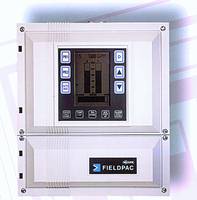
In the early days of process control, loop controllers had direct process inputs and pneumatic outputs and they were mounted close to the process. This provided the lowest installation cost and the greatest control loop integrity. However, this approach did not give operators an overview of the complete process unit.
To improve operator access, controllers were mounted in central operating panels which added to the expense of installation. With the introduction of electronic controllers, pneumatic tubing was replaced by wires. Today, the cost of wire runs is a major concern. Moore Fieldpac helps contain costs, particularly in retrofit installations where added functionality can be used to improve process operation without the added costs of new cable runs.
The Moore Fieldpac 348 combines reliable field proven technology with advanced digital communication technology to provide fieldbus benefits. Applications for the controller range from simple, single loop standalone stations to fully integrated distributed control architectures.
Wiring costs can add up quickly. Simple loops require a minimum of two wire runs to the control room (process and valve), with typical loops having as many as three or four wire runs. Reducing this number even by one can be a significant contribution in reducing costs.
This controller is designed to reduce installation costs. Moore Fieldpac puts a reliable digital controller in the field with communication back to the central control room over a single twisted pair. By reducing the number of wire pairs to one per loop, wiring costs can be reduced by up to 40%.
The controller also provides significant reductions in hardware costs by accepting direct process inputs, providing pneumatic outputs and offering additional analog and digital I/O. By providing loop components in a single package, hardware costs are reduced by up to 30%.
Minimises configuration, maintenance and training costs
The controller is designed to simplify and reduce configuration, maintenance and training costs, making good use of the company's field proven controller line, the patented XTC transmitter line with an MTBF of three million hours and reliable I/P and P/I converters. Moore Fieldpac is a reliable and tested process transmitter, controller and transducer all in one cost effective package.
The controller can be configured locally or via a PC. Locally, it can be configured entirely from the faceplate using the station’s front panel pushbuttons, or if desired, configuration software for a PC is available. To protect configurations, the main PC board includes a five-position lockout switch that locks out selected configuration areas. Further security is provided by user-definable passwords.
The modular construction facilitates easy maintenance and reduces spare part inventory. Moore Fieldpac's versatility allows it to be used in a variety of applications while providing the same intuitive operator display. Because it is a standalone device, it is easier for operators to understand and requires significantly less training.
Hazardous area classifications
The unit is available in two models. Moore claims that the Model 348S is the first intrinsically safe digital controller capable of advanced control techniques. The Model 348E offers more features while meeting the requirements of nonincendive locations.
The 348S offers options for a direct process pressure input, a temperature input or three pneumatic inputs and a pneumatic output. Because of the less stringent requirements for a nonincendive rating, the 348S offers additional options. The three standard analog inputs can be connected to transmitters powered by Moore Fieldpac and relay outputs are provided in place of the opto coupled discrete outputs.
In many plants, the only need for intrinsic safety is the wiring that runs between the process area and the central operating area. In this case the 348E can be used with a HART communication safety barrier.
Expandable system architecture
The controller can be used as a standalone device or integrated into many control system architectures. Utilising digital field communications, it returns process data to a central operating area over a single twisted pair. This cost-effective solution is made possible through the HART interface. As a de facto standard for field communications, HART incorporates proven technology and enjoys the largest installed base of any field communications protocol.
| Tel: | +27 11 466 1673/9 |
| Email: | [email protected] |
| www: | www.moore.co.za |
| Articles: | More information and articles about Moore Process Controls |






© Technews Publishing (Pty) Ltd | All Rights Reserved
 printer friendly version