SICK Automation has developed a sensor solution that operates on the basis of deep learning algorithms. Following the AppSpace eco-system that permits realisation of flexible solutions for automation applications, the deep learning sensor solution permits previously unimagined applications and contributes to driving Industry 4.0 forward.
Such deep learning technology is used in the industrial environment to specialise the functionality of sensors. In these applications, the sensor learns to process information and therefore obtains new functions. In addition, new processes are possible on the basis of adapted sensors. The sensor supplies, processes and analyses data using self-learning algorithms.
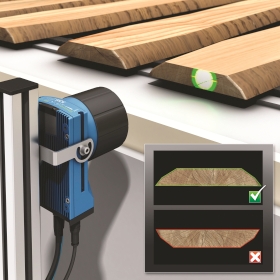
As an example, sensors are trained with a large number of images to give an answer to a specific question. On the basis of this training, the sensor can independently assign new unknown images to a result. “We are currently working with deep learning on a pilot project in the lumber industry,” explains Grant Joyce, sales and marketing manager, SICK Automation Southern Africa. “The basis of our solution is a camera with deep learning functionality.”
To ensure optimum use of the raw lumber material, sawmills must know about the conditions in the logs, such as knowing where the age rings and the core are in order to ensure good processing of the lumber. “To find out how the lumber can best be used, we taught the camera to identify these using deep learning, a task that could previously be performed only by humans,” adds Joyce.
This technology makes it possible to realise new, previously inconceivable applications that make processes more efficient and more productive. In the pilot project, SICK was able to increase material use, improve the quality of products and avoid unnecessary resource wastage. Additionally, sustainable use is possible not only with materials, but employees too as they no longer have to perform monotonous activities, freeing them up for more complex tasks.
“These developments in sensor technology provide the flexibility for production locations to adapt to individual tasks,” concludes Joyce.
Technology and education are critical to advancing safety in the mining sector
Sensors & Transducers
As mining operations across Africa continue to evolve in scale, complexity and automation, the role of advanced safety technologies has become increasingly important in protecting people, equipment and productivity.
Read more...Image processing cameras Vepac Electronics
Sensors & Transducers
The intelligent camera series from Vepac is an integrated camera module consisting of a camera and high speed processor. It offers a high-performance image sensing function at the edge device by embedding standard image processing software or the customer’s developed software.
Read more...OMRON launches non-contact safety door switch Omron Electronics
Sensors & Transducers
OMRON has unveiled its latest innovation in non-contact safety door switches, designed to enhance workplace safety and streamline machinery operations.
Read more...Conductivity sensing as a cornerstone of South Africa’s water smart industry ifm - South Africa
Editor's Choice Sensors & Transducers
South Africa’s engineers operate at the intersection of resource constraint and industrial ambition. Few parameters illustrate this balancing act as clearly as water quality. Whether in municipal treatment works, food and beverage plants or mining operations, the ability to measure water quality accurately and continuously has become non-negotiable.
Read more...Futureproofing pharma, one pixel at a time Omron Electronics
Sensors & Transducers
In pharmaceutical manufacturing, there’s no room for error. Omron’s FH-AI and FHV7-AI vision systems introduce AI-powered inspection that adapts to real-world variability, something conventional rule-based vision systems cannot easily achieve.
Read more...Distance sensor for confined spaces ifm - South Africa
Sensors & Transducers
The O6D100 from ifm has been designed as a powerful all-rounder for typical applications in object detection, distance measurement and positioning.
Read more...SICK earns Great Place To Work certification SICK Automation Southern Africa
News
Sensor specialist SICK South Africa has been awarded Great Place to Work certification recognising the positive working environment and strong workplace culture it has developed.
Read more...Long-range laser distance measuring sensor Vepac Electronics
Sensors & Transducers
The MS-100A is a long-range laser distance measuring sensor with a range of 150 to 1000 mm. This sensor excels in applications requiring extended measurement capabilities, such as quality control and logistics.
Read more...Listening for damage to wind turbines
Sensors & Transducers
The Fraunhofer Institute for Integrated Circuits, working in concert with the Fraunhofer Institute for Wind Energy Systems, has developed a solution that can be used to identify cracks and breakage inside wind turbine blades remotely at an early stage.
Read more...Verification using Heartbeat Technology is a breeze Endress+Hauser South Africa
Sensors & Transducers
Heartbeat Technology reflects Endress+Hauser’s long-term commitment to enhancing measurement reliability and efficiency across a growing product portfolio.
While every effort has been made to ensure the accuracy of the information contained herein, the publisher and its agents cannot be held responsible for any errors contained, or any loss incurred as a result. Articles published do not necessarily reflect the views of the publishers. The editor reserves the right to alter or cut copy. Articles submitted are deemed to have been cleared for publication. Advertisements and company contact details are published as provided by the advertiser. Technews Publishing (Pty) Ltd cannot be held responsible for the accuracy or veracity of supplied material.










 printer friendly version