



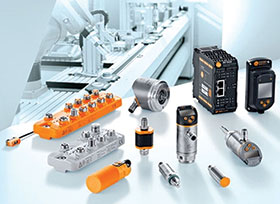
The implementation of Industry 4.0 is, among other things, about creating a digital silhouette of a plant, thus allowing for process optimisation. The essential information is provided by many sensors that are often already installed for machine control. Thanks to IO-Link, these sensors provide much more data than mere switching signals or analog values. Starrag Technology (Starrag) in Bielefeld is a company that produces machine tools and extensively equips them with IO-Link sensors from ifm electronic.
The FOGS-series portal machining centre from Starrag is a machine that has these features. It is used in mechanical engineering and in the aviation and automotive industries, for example, to manufacture body shell parts. These complex machine tools require sensors to monitor e.g. coolants and lubricants, hydraulics, and for machine temperature control. Tight tolerances are required for medium temperatures, pressure values and volumetric flow quantities to ensure that tools are used with optimum efficiency in fully automated production processes.
Sensors with a digital interface
IO-Link is a robust digital interface based on 24 V signal levels which, in addition to mere switching signals, enables bidirectional communication with the controller via the regular sensor cable. The sensors transmit digital measured values and diagnostic information via IO-Link to the IO-Link master, such as an IO module, gateway or a PLC equipped with IO-Link ports. Starrag Technology opts for fluid sensors from ifm electronic because of the extensive range of process sensors featuring IO-Link.
One of the greatest advantages of IO-Link is the possibility to transfer all necessary parameter data via the connection cable to the sensor. The parameter data (e.g. switch points, switching hysteresis and display colour) can be transferred from the controller either when the sensors are set up or later during operation, or to adjust them to a specific situation. If necessary, for example in case of small lot sizes, IO-Link makes it possible to store different parameter sets for different products separately, on the same sensor. All in all, one can say that IO-Link is a key technology for Industry 4.0 applications.
Error-free digital transmission of measured values
Up until now, analog sensor signals were digitised via A/D converters and scaled in the PLC, adding to inaccuracies of the actual measured value. IO-Link, however, provides the measured values from the sensor digitally to the controller. Transmission errors and conversion of analog signals are thus ruled out. The digitally transmitted measured values can be directly displayed in the control room. The transferred value is always identical with the measured value. There are no longer any deviations between the local display and the value that the PLC derives from the analog signal. Thanks to IO-Link, even interference with the analog signal, for example caused by electromagnetic fields, is a thing of the past.
Two measured values – one sensor
Modern process sensors from ifm often provide more than just one measured value. Dietmar Wallenstein, e-construction and commissioning department manager at Starrag explains: “Often, a sensor processes more than just one physical value. In addition to volumetric flow quantity or pressure, for example, it is also possible to read the medium temperature via the IO-Link interface. This saves money on hardware, wiring and mounting since, instead of two sensors you now only need one.”
Diagnostic data
Apart from the process data, the IO-Link sensor can also provide diagnostic data about the status of the device. For example: the level sensor detects critical deposits and signals them to the controller. Photoelectric sensors detect if a lens is soiled and signal it automatically. Pressure sensors store minimum pressure losses and maximum pressure peaks from the process and totalise the number of times those limit values are exceeded or not reached. This additional functionality supports the user decisively when it comes to condition-based maintenance as this extended information about condition minimises expensive downtime, while increasing process reliability.
Conclusion
Sensors offer a considerable additional value if they are equipped with IO-Link. Wallenstein summarises the advantages for Starrag: “Everyone is talking about Industry 4.0 and we at Starrag are not ignorant of this megatrend. When it comes to mechanical engineering, we think in particular about digital machine upgrading, which is why we opt for IO-Link. Thanks to low-cost robust interfaces, the sensors provide us with more information about the process that can then be more efficiently evaluated and optimised. This is one of the great advantages of IO-Link; it is a sensor feature contributing to the easy adoption of the principles of Industry 4.0.”
For more information contact ifm - South Africa, 086 143 6772, info.za@ifm.com, www.ifm.com
| Tel: | +27 12 450 0400 |
| Email: | info.za@ifm.com |
| www: | www.ifm.com/za |
| Articles: | More information and articles about ifm - South Africa |






© Technews Publishing (Pty) Ltd | All Rights Reserved
 printer friendly version