Optical water quality sensor
March 2002
Sensors & Transducers
Reverse osmosis processes are used to purify water in a variety of industries. It allows water to be recycled, thereby reducing costs associated with water purchases and environmental loading. In the reverse osmosis process, water flows through membrane filters. The final result is clear water that contains no salts, sugars, proteins or other larger solids.
This method has been applied in an eco project in a Finnish dairy. The project's goal is to reduce purchased raw water use by 30% in first phase and 70% in the second phase.
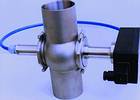
OPTEC-F analysers, which are online optical sensors, were selected as the best to control and monitor the reverse osmosis equipment. The optical sensor determines the quantity of solids in the rinse water before the membrane filters. If the concentration of solids gets too high OPTEC-F opens a valve and dilutes the rinse water to a level suitable for the filters.
An OPTEC-F sensor also monitors and controls the permeate that comes from the filter. The clear water then flows through disinfection units to the collection tanks.
"The optical measurement is excellent because there are no particles or conductive materials in such pure water," said Jarmo Juurinen, environmental engineer at the dairy, "the quality of water cannot be measured with pH or conductivity meters." Only the purest water is reused for different purposes at the plant, the sensor directs water having slightest trace if impurity into the sewer.
In another area the sensors are used to monitor the quality of raw water that is passed through the heat exchangers in a pasteuriser to collection tanks. The water flows directly to the water tanks and from there to normal use at the plant. The OPTEC-F detects and directs any contaminated water to the sewer and alerts the operator that a leak has occurred in the heat exchanger.
Seppo Floman, instrument technician at the dairy, is impressed with the sensitivity of the sensor: "OPTEC-F is very sensitive to even slightest changes in water purity - a drop of something and the sensor value changes instantly." OPTEC-F makes use of a light-scattering and absorption technique. It is used to monitor the concentration of a wide variety of liquids in the food, beverage, chemical, mineral and mining industries.
Herbert Karolius
Atlas Industrial Systems
016 986 2140
[email protected]
Further reading:
Inductive ring sensors monitor material flow in feeding technology
ifm - South Africa
Sensors & Transducers
ifm’s inductive ring sensors detect metallic parts such as screws and nuts as they pass through tubes at speeds up to 35 m/s, enabling precise counting, flow control and blockage detection, with sensitivity and output functions configurable via IO-Link.
Read more...
Reliable 1D and 2D code reading made simple
SICK Automation Southern Africa
Sensors & Transducers
SICK’s new sensingCam SEC200 image-based code reader brings supermarket-checkout simplicity to logistics and industrial identification, reading 1D and 2D codes reliably with quick browser-based setup, rugged IP65 construction and CRA-compliant cybersecurity.
Read more...
Market opportunity for sensors in humanoid robots
Sensors & Transducers
A new IDTechEx report forecasts the market for sensors in humanoid robots will exceed $6,59 billion by 2037, driven by perception sensors, force/torque sensors, encoders and inertial measurement units across a growing range of commercial robot platforms.
Read more...
The wireless route to safer, more efficient mining operations
Emerson Automation Solutions
Editor's Choice Sensors & Transducers
Modern wireless level measurement technologies are helping mining operations improve process control, increase safety and reduce installation costs. Emerson’s Rosemount 3408 wireless non-contacting radar level transmitter uses 80 GHz frequency-modulated continuous wave radar with HART communication to reach remote assets where cabling is impractical.
Read more...
Telco sensors for harsh environments
Sensors & Transducers
Telco sensors are designed to operate where moisture, particulate contamination and surface fouling would disable conventional sensors, with a range including an adjustable five-metre infrared proximity sensor for harsh industrial environments.
Read more...
The data-driven path to sustainable manufacturing
ifm - South Africa
Editor's Choice Sensors & Transducers
Smart automation is closing the gap between operational efficiency and environmental responsibility, and the data to do it is already inside the plant. With ifm’s sensing and digitalisation technologies, manufacturers can turn machine intelligence into measurable sustainability gains.
Read more...
Expanding visibility in mining operations
Emerson Automation Solutions
Editor's Choice Sensors & Transducers
Advances in wireless communications, condition monitoring and sensing technologies are helping mining operators extend measurement into previously under-monitored areas, improving equipment reliability, process performance and water stewardship.
Read more...
Fiber-optic amplifiers for precise object detection
ifm - South Africa
Sensors & Transducers
The OCF fibre-optic amplifier detects even the smallest or most transparent objects in confined spaces, making proven fibre-optic technology easier and more user-friendly than before.
Read more...
The next era of measurement and instrumentation
Sensors & Transducers
Smart sensors and non-contact radar are reshaping industrial measurement, feeding connected platforms that predict failures before they happen.
Read more...
Distance sensor for confined spaces
ifm - South Africa
Sensors & Transducers
The O6D100 from ifm has been designed as a powerful all-rounder for typical applications in object detection, distance measurement and positioning.
Read more...










 printer friendly version