



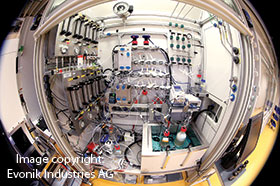
Evonik Industries and Siemens are planning to use electricity from renewable sources and bacteria to convert carbon dioxide into specialty chemicals. The two companies are working on electrolysis and fermentation processes in a joint research project called Rheticus. The first test plant is scheduled to go on stream by 2021 at the Evonik facility in Marl, Germany, which produces chemicals such as butanol and hexanol, both feedstocks for special plastics and food supplements, for example. The next stage could see a plant with a production capacity of up to 20 000 tonnes a year. There is also potential to manufacture other specialty chemicals or fuels. Some 20 scientists from the two companies are involved in the project.
“We are developing a platform that will allow us to produce chemical products in a more cost-effective and environmentally-friendly way than we do today,” explains Dr Günter Schmid, technical project responsible of Siemens Corporate Technology. “Using our platform, operators will in future be able to scale their plants to suit their needs.” The new technology combines multiple benefits. It not only enables chemicals to be produced sustainably, it also serves as an energy store which can respond to power fluctuations and help stabilise the grid. Rheticus is linked to the Kopernikus Initiative for the energy transition in Germany which is seeking new solutions to restructure the energy system. The Rheticus project will receive 2,8 million euros in funding from Germany’s Federal Ministry of Education and Research (BMBF).
“With the Rheticus platform, we want to demonstrate that artificial photosynthesis is feasible,” adds Dr Thomas Haas, who is responsible for the project in Evonik’s strategic research department, Creavis. Artificial photosynthesis is where CO2 and water are converted into chemicals using a combination of chemical and biological steps in a process similar to how leaves use chlorophyll and enzymes to synthesise glucose.
Siemens and Evonik are each contributing their own core competencies to this research collaboration. Siemens is providing the electrolysis technology, which is used in the first step to convert carbon dioxide and water into hydrogen and carbon monoxide (CO) using electricity. Evonik is contributing the fermentation process, converting gases containing CO into useful products by metabolic processes with the aid of special micro-organisms. In the Rheticus project, these two steps – electrolysis and fermentation – are scaled up from the laboratory and combined in a technical test facility.
“This research project shows how we are applying the Power-to-X idea,” says Dr Karl Eugen Hutmacher from the BMBF. “Using electricity to generate chemicals is an idea from the Power-to-X concept. As one of the four pillars of the Kopernikus Initiative, the idea is to help convert and store renewable, electrical energy efficiently. At the same time, the Rheticus platform also contributes to the reduction of carbon dioxide levels in the atmosphere, as it uses CO2 as a raw material. Three tonnes of carbon dioxide would be needed to produce one tonne of butanol, for example.
Evonik and Siemens see great future potential in the Rheticus platform. It will make it simple to scale plants to the desired size, allowing the chemical to adapt them flexibly to local conditions. In future, they could be installed anywhere where there is a source of CO2, power plant waste gas or biogas for instance.
“Its modular nature and flexibility in terms of location, raw material sources and products manufactured make the new platform attractive for the specialty chemicals industry in particular,” says Haas. “We are confident that other companies will use the platform and integrate it with their own modules to manufacture their chemical products,” concludes Schmid.
For more information contact Jennifer Naidoo, Siemens Digital Factory and Process Industries and Drives, +27 (0)11 652 2795, [email protected], www.siemens.co.za
| Tel: | +27 11 652 2000 |
| Email: | [email protected] |
| www: | www.siemens.co.za |
| Articles: | More information and articles about Siemens South Africa |






© Technews Publishing (Pty) Ltd | All Rights Reserved
 printer friendly version