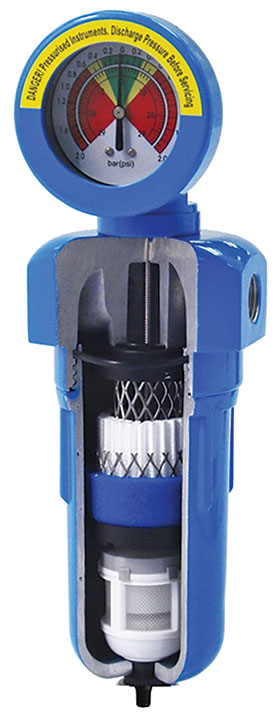
High quality inline filter casings and the elements they contain, are an essential part of compressed air treatment. They are the primary defence for removing condensed water, particles, oils and vapours along with other debris, before it clogs and disables your pneumatic system.
To get the best service life from your inline filtration system the following should be observed:
• Install a simple centrifugal water separator prior to the first stage of filtration. This will remove condensed water and oils in liquid form. This reduces the workload on the remaining filters. It’s essential that a reliable automatic drain is used. Condensates must be removed as they accumulate. A separator has no internal filter element to block up, its long-term operating cost is limited to auto drain maintenance.
• The second and third phase of filters are normally coalescing type filters with micron ratings of 1 micron and 1 mg/m3 down to the second filter at 0.1 micron and 0.01 mg/m3 oil removal. These filters are the real workhorses of the system. Using direct impact Brownian motion, these elements remove contaminants through an automatic drain in the base of the casing.
• The final phase of filtration can be oil vapour removal, this level of filtration can be optional or mandatory depending on what the c/air is being used for. By using an activated carbon filter oil vapours can be removed from a c/air system quite easily. The elements and casing should not be exposed to liquids, the air should be as dry as practically possible to ensure reasonable element life. Activated carbon filters must be preceded by two high end coalescing filters to ensure that oils and liquids are removed prior to the activated carbon elements. A/carbon elements are not designed for liquid and solids removal. They are there to prevent the last traces of hydrocarbons from infecting the airline. The elements will have half the service life of a coalescing filter.
• Filters should be sized for air flow, we normally recommend to have a 20% overdesign on maximum air flow to ensure good (long) service life intervals. Filters should be fitted with a differential pressure gauge and changed when the pressure drop exceeds the specified limit. It must be remembered that water in your airline will eventually evaporate, oils do not evaporate, they can lay in a compressed air piping system for years creating havoc with your c/air quality plans.
If you are in an industry that demands high air quality, consider having regular audits for dew point, particle and oil monitoring carried out at regular intervals. Or install this equipment in the system and permanently monitor your air quality for dew point, particle and oil carry over. This can assist in preventing a breakthrough of contaminated air into the c/air system.
In terms of local environmental legislation it is against the law to allow oils from any source to pollute ground water. Use a simple and effective condensate separation system to prevent the pollution of our precious dams and rivers.
Smarter motor technology for high-performance industrial automation Adroit Technologies
Motion Control & Drives
Adroit Technologies is bringing Mitsubishi Electric’s EM-A series permanent magnet motors to Africa, offering servo-like speed and position control at a lower cost by combining patented sensorless control with the FR-E800 inverter to eliminate encoders while achieving IE5 efficiency.
Read more...A smarter approach to simplifying motion architecture
Motion Control & Drives
n motion system design, the wiring and drive placement between motor and drive are often decided by default, yet they shape a machine’s cost, footprint and adaptability. Kollmorgen sets out how single-cable and decentralised architectures simplify the cabinet.
Read more...Robotic case packer achieves 99% uptime Rockwell Automation
Motion Control & Drives
DCC Automation designed a new robotic case packer for a nutrition supplement manufacturer using delta robots and a unified Rockwell Automation control platform, cutting changeover time from 45 minutes to 5 minutes, and achieving 99 to 99,5% uptime against the previous 10% per-shift downtime.
Read more...igus puts 3D-printed wear materials to the test igus
Motion Control & Drives
A new igus white paper compares its tribological iglidur 3D-printing materials directly with conventional POM, reporting lower wear, more stable friction and up to ten times longer service life in gear testing for customised, low-volume and replacement components.
Read more...SEW-EURODRIVE’s expanded local engineering capability SEW-EURODRIVE
Editor's Choice Motion Control & Drives
At Electra Mining Africa, SEW-EURODRIVE demonstrated how its expanded local engineering capability, digital technologies and lifecycle support strategy help customers improve reliability, energy efficiency and total cost of ownership across the full life of their drive assets.
Read more...Latest Danfoss automation drive Bearing Man Group t/a BMG
Motion Control & Drives
BMG has launched the Danfoss iC7-Automation enclosed variable speed drive range in South Africa, backed by significant local stockholding of 400 V models up to 710 kW, approved warranty workshops, and DrivePro digital asset management support.
Read more...Severe-duty workhorses powering mining
Motion Control & Drives
Mining machines such as rock crushers, pumps and conveyors need motors that combine high torque with robust enclosures, seals and cooling. WEG Africa explains how severe-duty motors deliver more than a decade of reliable performance in harsh conditions while meeting modern energy-efficiency standards.
Read more...Looking beyond the spec sheet when choosing motion architecture
Motion Control & Drives
When machine builders focus only on torque, speed and price, engineering time, integration effort and long-term maintainability get overlooked. Kollmorgen explains how thinking at the system level, not the component level, leads to better motion architecture choices.
Read more...Economy drive system closes the drive gap in the entry-level segment Beckhoff Automation
Editor's Choice Motion Control & Drives
Beckhoff has launched an economy drive system pairing its new AX1000 servo drive and AM1000 servomotor with the AF1000 dual-axis variable frequency drive on a shared EtherCAT platform, targeting series machines and price-sensitive markets without sacrificing TwinCAT integration or functional safety.
While every effort has been made to ensure the accuracy of the information contained herein, the publisher and its agents cannot be held responsible for any errors contained, or any loss incurred as a result. Articles published do not necessarily reflect the views of the publishers. The editor reserves the right to alter or cut copy. Articles submitted are deemed to have been cleared for publication. Advertisements and company contact details are published as provided by the advertiser. Technews Publishing (Pty) Ltd cannot be held responsible for the accuracy or veracity of supplied material.










 printer friendly version