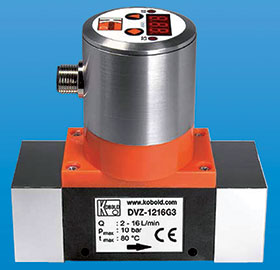
Kobold Instrumentation has introduced the compact vortex flowmeter Model DVZ, used for measuring and monitoring smaller and medium-sized flow of low viscosity, water-like liquids in pipes. This device has impressed in numerous applications due to its reliability and response time. It functions without any mechanical moving parts, using the vortex principle, where a sharp-edged object, the Karman vortex-generator, is installed within the flow duct, making it virtually maintenance-free. This is a considerable advantage over devices based on the variable area or impeller principle. Vortices are created behind the object whose frequency is proportional to the velocity of flow of the liquid. The flow volume can be determined with a high degree of accuracy by measuring the vortex frequency.
Unlike calorimetric flow measurement, its measuring principle works irrespective of the temperature and without time delay and can thus be used in time-critical applications. The measurement process is suitable for practically all liquids with a viscosity similar to water – irrespective of the pressure, temperature, density and electrical conductivity of the medium. Due to its specific operating principle, Kobold’s DVZ flowmeter is especially suitable for measuring aggressive, corrosive or saline solutions. It can also be used for ultrapure media.
The DVZ series covers measuring ranges up to 100 l/min with its different versions. The devices can optionally be equipped with a fixed or rotatable connection. Depending on the version, a switch output (1 A/30 VDC), a frequency output (open collector, PNP) or an analog output (4-20 mA) are also available. In addition, a programmable compact electronics system is available that includes a digital display, a switch output and an analog output. Dosing and metering electronics are currently being developed.
Hygienic ultrasonic flow sensor ifm - South Africa
Flow Measurement & Control
The SU Puresonic Hygienic ultrasonic sensor from ifm detects flows of conductive and non-conductive media with high precision.
Read more...VEGA pressure instrumentation supports resilient water network management VEGA Controls SA
Pressure Measurement & Control Flow Measurement & Control
As rapid urbanisation and climate pressures strain water networks across Africa, accurate real-time pressure monitoring has become a strategic necessity. VEGA’s pressure instrumentation helps utilities reduce losses, protect infrastructure and meet sustainability targets.
Read more...Field calibration made easy Instrotech
Maintenance, Test & Measurement, Calibration
Instrotech’s locally designed and manufactured Calog calibrator range feature a rugged IP54-rated housing, backlit display with data logging via SD card, and a lithium-ion battery with approximately eight hours of run time.
Read more...Groundwater level measurement using LoRa module Instrotech
Level Measurement & Control
Monitoring groundwater levels across large industrial sites is critical. Salzgitter Digital Solution was tasked with developing a fully automated and digital monitoring system using Long Range Wide Area Network technology.
Read more...Flow imaging microscopy for the early detection of harmful algal blooms Yokogawa South Africa
Flow Measurement & Control
Yokogawa’s advanced flow imaging microscopy technology, FlowCam is helping utilities move from reactive treatment to proactive prevention of harmful algal blooms in reservoirs, dams and freshwater sources.
Read more...Never waste a drop
Flow Measurement & Control
Manufacturers of pumps, valves and related equipment have an important role to play when systems for water are being designed or upgraded and should be included at every stage of a project to ensure that the work is carried out within the equipment’s capabilities.
Read more...Infrared solutions for glass manufacturing challenges Instrotech
Temperature Measurement
In the glass industry, infrared temperature monitoring is crucial for maintaining product quality and process efficiency. Instrotech has infrared sensors and cameras which provide non-contact temperature measurements, making them ideal for these high-temperature environments.
Read more...Ultrasonic flow meters ifm - South Africa
Flow Measurement & Control
The ultrasonic flow meter of the SU series from ifm - South Africa monitors liquid media such as water, glycol solutions or industrial oils. It detects the three process categories volumetric flow quantity, consumed quantity and medium temperature.
Read more...How utilities identify water losses in Northern Europe
Flow Measurement & Control
Norwegian leak detection specialist, Ovarro outlines how municipalities are responding to hidden water loss using acoustic monitoring and analysis tools that provide early indications of developing leaks.
While every effort has been made to ensure the accuracy of the information contained herein, the publisher and its agents cannot be held responsible for any errors contained, or any loss incurred as a result. Articles published do not necessarily reflect the views of the publishers. The editor reserves the right to alter or cut copy. Articles submitted are deemed to have been cleared for publication. Advertisements and company contact details are published as provided by the advertiser. Technews Publishing (Pty) Ltd cannot be held responsible for the accuracy or veracity of supplied material.










 printer friendly version