Product quality is a top concern for the food and beverage industry, as plants need to follow ever more stringent quality and regulatory requirements. Calibration is important as it ensures the quality and safety of the process. Food and beverage plants operate to certain international quality systems such as ISO 9001 and ISO 14001. ISO 9001 is a standard that ensures a manufacturing plant maintains an effective quality assurance system. ISO 14001 focuses on environmental management systems.
Calibration of plant assets on a regular basis can assist food and beverage plants comply with these international standards. The risk of not calibrating on a regular basis can lead to a manufacturing plant sending inferior products to their customers. Calibration on a regular basis can help reduce wastage as there is a higher accuracy in the manufacturing process.
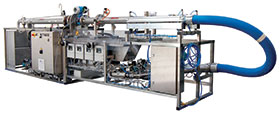
Endress+Hauser provides a complete calibration solution whatever the parameter or manufacturer. All calibration equipment is calibrated, traceable to the ISO 17025 standard. This guarantees best performance, minimal investment and low risk. On-site calibrations are conducted by highly skilled and trained technicians and calibration facilities are accredited to ISO 17025. The flow calibration rig is amongst the most modern and precise in the world. Calibration services can include calibration with (or without) adjustment and repair or replacement of faulty equipment where relevant. All Endress+Hauser calibrations include clear and concise calibration certificates. A comprehensive database of Standard Operating Procedures (SOPs) ensures a standardised and professional service is maintained around the world.
If required Endress+Hauser can facilitate complete calibration management, providing tools and support that ensure total compliance to all quality system and maintenance requirements.
Endress+Hauser has an international service network of qualified staff and certified equipment capable of meeting the most demanding of calibration requirements.
Infrared thermometers for electrical, industrial and HVAC applications Comtest
Maintenance, Test & Measurement, Calibration
: Comtest, distributor of Fluke test and measurement equipment, explains how handheld infrared thermometers are transforming maintenance in electrical, industrial and HVAC environments, with three measurement strategies and a wide range of practical applications.
Read more...Reverse-engineering legacy industrial gearbox parts
Maintenance, Test & Measurement, Calibration
WEG Africa’s turbine workshop uses 3D scanning technology to reverse-engineer components for legacy gearboxes, turbines and compressors, enabling equipment to run for decades after OEM support and spare parts have dried up.
Read more...Unlocking ICCP remote monitoring Omniflex Remote Monitoring Specialists
Maintenance, Test & Measurement, Calibration
Cathodic protection keeps buried and submerged pipelines safe from corrosion, but verifying it traditionally means costly, hazardous manual site visits. Omniflex explains how a retrofit module brings remote monitoring to ageing transformer rectifiers without replacing functional infrastructure.
Read more...Microdieseling – the explosions you never hear
Maintenance, Test & Measurement, Calibration
Microdieseling is a pressure-induced thermal degradation mechanism in which entrained air bubbles are compressed so rapidly that the surrounding oil ignites, producing soot, varnish and sludge. WearCheck explains how it happens, why the damage varies, and how oil analysis detects it.
Read more...Electrostatic spark discharge – when static strikes back Wearcheck
Maintenance, Test & Measurement, Calibration
WearCheck technical manager, Steven Lumley explains how static electricity accumulates in modern low-conductivity lubricants, why compact system designs and fine filtration make ESD more likely, and how to recognise the degradation it leaves behind.
Read more...High-speed cameras for crash testing Horne Technologies
Maintenance, Test & Measurement, Calibration
Vision Research has expanded its Phantom C-series with two cameras optimised for crash and safety testing, offering 4 and 8 megapixel sensors rated to 170G, up to 1180 frames per second, and Phantom Academy application training planned for South Africa next year.
Read more...SKF extends remanufacturing expertise to bearing clearance modification SKF South Africa
Maintenance, Test & Measurement, Calibration
Using its clearance modification expertise, SKF helped a mining equipment OEM salvage spherical roller bearing inventory that would otherwise have been scrapped, confirming a new capability within its remanufacturing services and avoiding redundant procurement.
Read more...When maintenance-system compliance starts replacing plant reliability Wearcheck
Maintenance, Test & Measurement, Calibration
WearCheck ARC division manager, Annemie Willer argues that the greatest threat to effective maintenance is no longer a lack of technology, but the gradual replacement of technical judgement by CMMS compliance, leaving no one owning the machine.
Read more...Nitration: the acid you didn’t see coming Wearcheck
Maintenance, Test & Measurement, Calibration
Nitration is as destructive as oxidation in many engines but far less understood. WearCheck technical manager, Steven Lumley explains how nitrogen oxide gases degrade lubricants, why the process is difficult to detect, and what oil analysis can reveal before damage occurs.
While every effort has been made to ensure the accuracy of the information contained herein, the publisher and its agents cannot be held responsible for any errors contained, or any loss incurred as a result. Articles published do not necessarily reflect the views of the publishers. The editor reserves the right to alter or cut copy. Articles submitted are deemed to have been cleared for publication. Advertisements and company contact details are published as provided by the advertiser. Technews Publishing (Pty) Ltd cannot be held responsible for the accuracy or veracity of supplied material.









 printer friendly version