



Initially control and sequencing in big manufacturing concerns was mainly composed of relays, cam timers, dedicated closed-loop controllers and drum sequencers. Depending on the complexity of the production line, these components could number in the thousands. This means that the process for upgrading or changing procedures at these facilities was very time consuming and expensive, as technicians needed to isolate and individually rewire the specific relays to change their operational features.
With the invention of digital computers, the huge potential for application in industrial processes was clear. Early computers required specialist programmers and stringent environmental control for temperature and power quality, and so applications were initially limited. The potential was enough to overcome the shortcomings of the requirements however, and through technological innovation this soon led to the development of the first PLC, specifically designed to operate in these industrial environments and to make the automation of these industrial processes much easier.
These PLCs were widely used, especially in the control of machinery on assembly lines across many industries. Due to their ability to accept and return multiple digital or analog inputs, and their resistance to temperature, vibration, impact and electrical noise, their application was limited only by the imagination of the technicians installing them. Perhaps the only limitation that could be found was that the PLCs were not cost effective for use in smaller applications. This in itself led to further innovation.
PLRs (programmable logic relays) proved to be the answer to this limitation. This was done by taking the concept of a PLC and scaling it down to a more cost effective level. PLRs limited themselves to a smaller, set number of inputs and outputs. Additionally, PLRs limited the amount of programming that could be done and added a small LCD screen and buttons that allowed them to be programmed manually on the spot, as well as through a PC if required, increasing their accessibility. Through these changes the PLR could be designed to be more compact, without sacrificing any of the robustness of the PLC. Automation was now truly within the reach of anyone who wanted to use it.
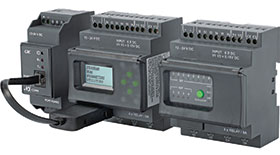
The Genie-NX smart relay
A perfect example of the embodiment of these functions in a PLR is the Genie-NX smart relay from AC/DC Dynamics. Designed to be small enough to fit on a DIN rail, the units can be programmed independently using keys on the base module, or through a PC using the G-Soft NX software. The unit has a backlit LCD display perfect for programming in places where there is not enough light. The backlight itself can be set to either be permanently on or off, or to come on only when the unit is being programmed.
Inputs and outputs on the Genie-NX units can be extended up to 48 I/O (32 digital, with up to 12 analog 0-10 V inputs, and 16 digital outputs). The units can accept up to 250 lines of ladder programming and come with a wide range of programmable functions including timers, retentive selective five digit up/down counters with scaling, time switches, compare counters, hour meters, soft text messages, retentive selective auxiliary relays, and analog comparators with scaling.
With a program transfer feature, the units allow programs to be transferred or copied to other devices with the help of a memory card. This means that programming multiple units, or replacing existing units, is as easy as pressing a button.
Taking the innovation even further, the GENIE-NX units allow for connection to a module (NX-Comm) which allows communication through a Modbus network. This facilitates communication of the unit over a two wire half duplex RS-485 link. This is a step into the future for PLRs. Essentially it allows the unit to transfer information with other PLRs or PLCs, meaning that through the use of clever design in automation, it is possible to reduce the cost of an installation through the reduction of PLCs required.
All these features make the unit perfect for applications in printing and packaging machines, production equipment in textile and plastic industries, conveyor systems, and distributed control systems. Additionally the excellent pricing of the units allows them to be used in the automation of barriers, lighting, compressors, pumps and air conditioning systems.
For more information contact Farrel Sher, AC/DC Dynamics, +27 (0)10 202 3300, [email protected], www.acdc.co.za






© Technews Publishing (Pty) Ltd | All Rights Reserved
 printer friendly version