



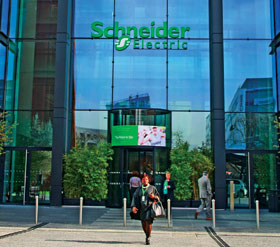
Energy management specialist, Schneider Electric, is the sole sponsor of the prestigious Paris Marathon and for the second year running invited editors from all over the world to a coinciding press day, where the company’s latest innovations were showcased and the media was given an insight into its strategic direction. A highlight for Motion Control’s editor was the way that Schneider is embracing the arrival of the Internet of Things (IoT).
In the face of the three megatrends currently engulfing the world – digitisation, industrialisation and urbanisation – Schneider is paying a great deal of attention to IoT, which is making a significant contribution to its strategic direction. Chief technology officer, Pascal Brosset, defines IoT as “a set of technologies that allow us to do everything we do more simply and efficiently”. The goal is to produce more with less.
For example Schneider manufactures huge numbers of thermostats every year and came up with a smart thermostat connected to the Internet that learns behaviour and self-regulates. Round about the same time Google bought a little company called Nest Labs, which develops sensor-driven thermostats that can program themselves and communicate with smartphones. “We are now being challenged at the very heart of our business from a complete outsider. We would have laughed two years ago if anyone had said that Google was a competitor,” he says. “In essence Google is buying data and selling comfort. We have learnt from this, and IoT will be a complete revolution for us in everything we do.”
Meanwhile devices are getting smarter while communication bandwidth and data storage are getting cheaper, and all this has led to the creation of totally new business models. Schneider has risen to the challenge. For example, its latest PLC is designed so that by default it can run large, complex installations over an Internet connection. “For €2.50 we can put a system on a chip with the same power as a high range PC two years ago. We now have connectivity in every product,” continues Brosset.
Until recently, the world did not have the technology to deal with huge quantities of data. The challenge as Schneider sees it, is to capitalise on this new data. “The implication for us is the ‘servicisation’ of our industry, where the customer expects more and more. We don’t just sell a product – the customer also wants all the services to keep it safe and reliable,” he explains. He quotes the example of aeroplane engines. These are not owned by the airline but by GE or Rolls Royce. They constantly monitor it in flight, pumping data into the cloud. Engineers maintain the engine and the airline pays by miles flown. If the engine doesn’t work and the plane doesn’t fly, the airline doesn’t pay. The business model has been turned on its head.
Brosset says that Schneider is in transition from selling products to selling products and services and will eventually move to services only. “This is good because it gets us closer to our customers by helping them get better performance out of their product. It has very positive and profound implications for us,” he explains. In fact every time Schneider develops a product, simple or complex, it also develops accompanying services such as health monitoring and preventative maintenance. The chip in every PLC is connected to the Internet and stores data. Even the smallest product has big intelligence.
He gives another example, Schneider’s Altivar drives, which are a growing part of the company’s business. “Drives used to be totally passive. Our new drives can monitor their own health and tell the customer when they are about to fail. The drive also has intelligence that can measure the way the engine behaves. Not only can we predict when the drive is going to fail, but also when the engine will fail,” he continues. He adds that the company is moving from selling a product, to selling a service, to optimising an entire installation. Schneider expects to reach the stage where customers won’t buy a drive that’s not connected.
Schneider believes that IoT is creating a step change in its ability to make the world more energy efficient and will revolutionise its business. “Our customers run complex systems and have invested huge amounts of money. Our challenge is to add value and make them smarter. We believe that if we deliver this concept to our customers as an evolution they will embark on this journey with us,” Brosset concludes.
For more information contact Ntombi Mhangwani, Schneider Electric SA, +27 (0)11 254 6400, ntombi.mhangwani@schneider-electric.com, www.schneider-electric.com
| Tel: | +27 11 254 6400 |
| Email: | za-ccc@se.com |
| www: | www.se.com/za/en/ |
| Articles: | More information and articles about Schneider Electric South Africa |






© Technews Publishing (Pty) Ltd | All Rights Reserved
 printer friendly version