


Maintenance, Test & Measurement, Calibration


Too many cooks in the 2,4 GHz kitchen?

Technews Industry Guide - Wireless 2014 Maintenance, Test & Measurement, Calibration Industrial Wireless

Microwave ovens are not the only things cooking in the 2,4 GHz spectrum. RF signals coming from WiFi devices, Bluetooth devices, ZigBee devices, cordless phones, wireless game pads, toys, PC peripherals, wireless audio devices and more make the 2,4 GHz frequency band a very crowded kitchen. Designing devices to function in this spectrum raises many challenges. A Bluetooth device, for example, not only has to fight for detection against WiFi and ZigBee, but it also presents issues such as high-power consumption and requests for higher data throughput. Figure 1 shows the 2.4 GHz spectrum with only Bluetooth, ZigBee, and WiFi channels.
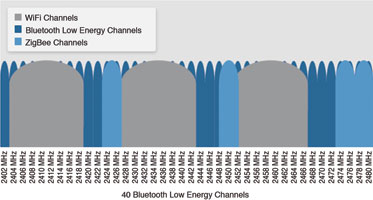
Figure 1. WLAN, BLE, and ZigBee all occupy the 2,4 GHz spectrum.

Bluetooth Low Energy

Consider the history of Bluetooth and its fight for recognition in this spectrum. Since its inception, the standard has tried to avoid interference from other signals using the following tactics:

* 2003 – Bluetooth 1.2 with adaptive frequency hopping (AFH) is released so Bluetooth channels can avoid interference from other standards in the 2,4 GHz band.

* 2004 – Bluetooth with enhanced data rates (EDR) is released and achieves 2,1 Mbit/s data rates.

* 2007 – Bluetooth 2.1 + EDR is released and allows secure simple pairing. One billion Bluetooth chips are shipped.

* 2009 – Bluetooth HS (3.0) is released and results in 24 Mbit/s, making it usable for higher data streaming. This release also opens the use of 802.11b/g radios for higher speed data.

With the most recent version of Bluetooth, Bluetooth Low Energy (BLE), 4.0, Wibree, as it was originally called, devices are expected to consume a fraction of the power that classic Bluetooth products consume. Because BLE chips spend most of their time asleep, BLE devices should last more than a year on a button cell battery without recharging. Even sending data takes only a few milliseconds – compared to the hundreds of milliseconds taken by classic Bluetooth.

BLE uses low duty cycles and is optimised to operate in small bursts so the devices consume less power. It offers the following advantages over classic Bluetooth:

* More intelligent controllers that can keep the devices asleep for longer time periods.

* Ultralow-duty cycles that can be adjusted down to 0,1 percent (compared to 1 percent in classic Bluetooth).

* Multivendor interoperability.

* Low cost and small size.

Channels for coexistence in the 2,4 GHz spectrum

Another important change is that BLE uses just 40 channels, while classic Bluetooth uses 79. Each BLE channel is 2 MHz wide compared to 1 MHz for classic. As you can imagine, Bluetooth needs to be able to differentiate its signals from others in the same band. Three of the 40 channels are located exactly between the WLAN channels, which allow easier device discovery and connection. Bluetooth devices use these channels, also known as ‘advertising channels’, to broadcast their presence and search for other Bluetooth devices. This enables Bluetooth signals to coexist with WLAN signals.

Software-based test instruments

NI offers toolkits for Bluetooth, WLAN, and even cellular standards that can be used with any NI RF vector signal analyser (VSA), vector signal generator (VSG), or vector signal transceiver (VST). The flexibility to use or upgrade hardware irrespective of the software environment is a valuable asset to test engineers who deal with the changing requirements of these RF protocols. Furthermore, engineers can upgrade test equipment to accommodate higher bandwidths, frequency ranges, or performance while maintaining their software stack. Figure 2 shows the NI PXIe-5644R VST being used with the NI Bluetooth Toolkit, which has an API that works with LabVIEW, NI LabWindows/CVI, NI Measurement Studio, and Microsoft Visual Studio.
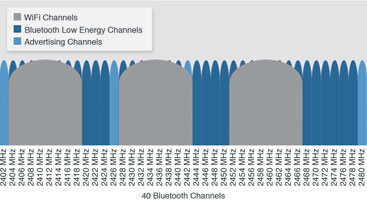
Figure 2. Advertising channels allow Bluetooth devices to connect to each other even in the presence of WLAN signals.

NI not only provides software for testing standards in the 2,4 GHz spectrum, the company also provides optimised hardware for detecting low-power RF signals in the presence of higher power saturating signals. With the software-defined nature of NI’s solution, users can test devices as well as tweak tests to see how devices react to real-world signals.




Share this article:
Share via emailShare via LinkedInPrint this page

Further reading:

OEM-standard repairs for industrial gear units
Maintenance, Test & Measurement, Calibration
BMG, the official OEM for Hansen gearboxes, is authorised to repair Hansen industrial gear units in strict accordance with the manufacturer’s documented procedures, preserving the design tolerances and operational reliability required in demanding industrial environments.

Read more...
The smart choice for test and measurement solutions
RS South Africa Maintenance, Test & Measurement, Calibration
As the demand for precision and efficiency continues to grow across industries, RS PRO, the own brand of RS, provides a complete portfolio of test and measurement equipment engineered to meet the highest standards of performance, safety and value.

Read more...
New frequency counter with 10 digits of resolution
Comtest Maintenance, Test & Measurement, Calibration
B&K Precisio has a new series of universal frequency counters designed for a wide range of frequency measurement applications.

Read more...
Verification using Heartbeat Technology is a breeze
Maintenance, Test & Measurement, Calibration
Heartbeat Technology reflects Endress+Hauser’s long-term commitment to enhancing measurement reliability and efficiency across a growing product portfolio.

Read more...
A South African legacy in telemetry
Interlynx-SA Editor's Choice Industrial Wireless
Telemetry is becoming a vital component of industrial strategy, allowing companies to harness real-time data to optimise processes and reduce waste. One company leading this technological shift is Interlynx.

Read more...
Clog-resistant nozzle for powerful stationary tank cleaning
Maintenance, Test & Measurement, Calibration
As EXAIR and BETE continue to build on a strong partnership, EXAIR has recently added a selection of BETE products to the site, including the innovative BETE HydroClaw tank and vessel cleaning nozzle.

Read more...
Clog-resistant nozzle for powerful
Maintenance, Test & Measurement, Calibration
As EXAIR and BETE continue to build on a strong partnership, EXAIR has recently added a selection of BETE products to the site, including the innovative BETE HydroClaw tank and vessel cleaning nozzle.

Read more...
Why your next oscilloscope should
Comtest Maintenance, Test & Measurement, Calibration
The PC-based USB oscilloscope is a cutting-edge, adaptable alternative to traditional benchtop oscilloscopes that’s redefining test and measurement.

Read more...
Advanced telemetry solutions
Interlynx-SA Editor's Choice Industrial Wireless
Namibia is one of the driest countries in sub-Saharan Africa, with an average annual rainfall below 250 mm. To address this challenge, the Namibia Water Corporation has employed one of southern Africa’s most powerful and well-proven telemetry solutions, designed and manufactured by SSE/Interlynx-SA.

Read more...
Automated test and measurement
Comtest Maintenance, Test & Measurement, Calibration
Comtest, in partnership with global brands, provides customised solutions with integrated hardware and software for efficient testing and data collection.

Read more...


While every effort has been made to ensure the accuracy of the information contained herein, the publisher and its agents cannot be held responsible for any errors contained, or any loss incurred as a result. Articles published do not necessarily reflect the views of the publishers. The editor reserves the right to alter or cut copy. Articles submitted are deemed to have been cleared for publication. Advertisements and company contact details are published as provided by the advertiser. Technews Publishing (Pty) Ltd cannot be held responsible for the accuracy or veracity of supplied material.


© Technews Publishing (Pty) Ltd | All Rights Reserved