



ABB’s Diaflex coated sensor diaphragm technology
Coal fired power plants need to measure various pressures associated with the coal pulverising mills. The red dots in Figure 1 show the typical locations for these measurements for a Raymond Bowl type mill:
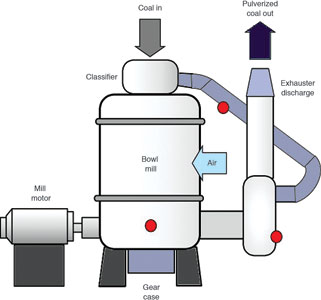
1. The pulverising mill section.
2. The ductwork from the classifier carrying coal fines to the exhauster.
3. The exhauster: the fan and ductwork carrying pulverised coal and fines to the boiler burners.
A certain ‘sweet spot’ of pressure indicates smooth and proper operation of the mill, as well as the exhauster ductwork. If the pressure drops, the mill could be plugged or the fuel supply cut short; higher than normal pressure may indicate plugging of downstream coal ducts leading to the furnace. Incorrect pressures often lead to flame instability, productivity losses and pollution.
Plant maintenance operations often have to deal with problems associated with the long impulse lines that run to the pressure transmitters. The lines may plug as often as once a week, or even once a shift in some cases. A small air purge in the sensing line may be present to provide positive pressure to keep the coal out of the line, but wet coal following a rainstorm, for example, invariably leads to plugged lines. In the worst cases, maintenance technicians will have to drill out these plugged impulse lines.
Ideally, pressure would be sensed directly with the transmitter mounted on the mill, exhauster or ductwork. This arrangement eliminates the need for long, narrow impulse lines, but the pressure sensing diaphragm must withstand the abrasive effects of the pulverised coal travelling at high velocity.
The ABB solution: Diaflex coated sensor diaphragm
This application calls for a transmitter with a direct mount seal and nonstandard pressure diaphragm that can withstand severe abrasion. ABB’s 2600T direct mount seal pressure transmitters are available with diaphragms protected by a patented Diaflex coating of nano-structured material with hardness similar to diamond.
Diaflex consists of a quaternary coating based on titanium and silicon of the nitrides class. Using a process of physical vapour deposition, ABB coats the transmitter’s 316L stainless steel diaphragm seal to a thickness ranging from 3 to 5 µm. This deposition technique and thickness provide the necessary flexing sensitivity to measure pressure, while protecting the diaphragm from the abrasive effects of fast-moving coal particles. ABB’s all-welded remote seal technology adds superior performance and reliability.
The physical characteristics of Diaflex remain stable between -100 and 700°C, but the transmitter’s maximum working process temperatures are limited by the fill fluid. Diaflex coated diaphragms have proved their durability in this application and have resulted in significant savings in maintenance hours and more efficient burner management.
For more information contact Jacolize Goosen, ABB South Africa, +27 (0)10 202 5000, jacolize.goosen@za.abb.com, www.abb.com/za
| Tel: | +27 10 202 5000 |
| Email: | contact.center@za.abb.com |
| www: | www.abb.com/za |
| Articles: | More information and articles about ABB South Africa |






© Technews Publishing (Pty) Ltd | All Rights Reserved
 printer friendly version