New belt rip detection system
October 2012
Sensors & Transducers
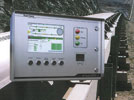
Becker Electronics has enhanced its BRS 1 belt rip detection system with the launch of the newly developed BRS 2. “This system is designed to increase the productivity of conveyor belts by detecting belt rips as soon as they occur,” says Tiaan Tromp, Becker Mining South Africa. “The BRS 2 system, which is used to detect longitudinal rips on steel cable and fibre conveyor belts, prevents further damage to the belt by stopping the drives in the event of a rip.”
Inductive loops, which are selected according to belt width and rubber type, are encapsulated in a rubber flap and embedded into the belt. The BRS 2 detects these inductive loops and defines and numbers them, creating its own image of the belt and its loops in real-time.
At installation, the system carries out an identification run and the processor of the belt rip detection system unit stores the necessary data. Parameters include the succession of loops in the belt, belt speed and start up time of conveyors. Stored values are protected against power loss and can be entered or changed when necessary.
When the belt is in operation, these loops pass over the transmitter and receiver which are positioned opposite each other on either side of the belt. An electro-magnetic signal is transmitted via the inductance loop from the transmitter into the receiver. Because this system has recorded the distance between successive loops and belt velocity, it can automatically calculate the time intervals between each loop.
The belt rip sensor that is embedded in the belt operates like a bridge between transmitter and receiver of the scanner sensor interface (BRS/SI). If a belt is ripped, the BRS/SI cannot measure any analogue values from the destroyed loop. Apart from the detection of belt rips, this system is designed for monitoring belt speed, the detection of belt slip and also for belt sequence control.
Access and monitoring of the system is simple, either locally via the TFT screen, five shortcut buttons, a mouse pad and virtual keypad, or remotely via TCP/IP or Modbus.
This advanced belt rip detection system is designed for use in diverse industries, including manufacturing, food and beverage conveying, packaging and mining applications.
For more information contact Tiaan Tromp, Becker Mining South Africa, +27 (0)11 801 5900, [email protected], www.za.becker-mining.com
Further reading:
Telco sensors in conveyor belt monitoring
Sensors & Transducers
Gail Norton Instrumentation Agencies has developed a low-maintenance conveyor belt monitoring unit built on robust Telco infrared sensors, detecting belt tear and misalignment reliably in harsh coal mining environments.
Read more...
Inductive ring sensors monitor material flow in feeding technology
ifm - South Africa
Sensors & Transducers
ifm’s inductive ring sensors detect metallic parts such as screws and nuts as they pass through tubes at speeds up to 35 m/s, enabling precise counting, flow control and blockage detection, with sensitivity and output functions configurable via IO-Link.
Read more...
Reliable 1D and 2D code reading made simple
SICK Automation Southern Africa
Sensors & Transducers
SICK’s new sensingCam SEC200 image-based code reader brings supermarket-checkout simplicity to logistics and industrial identification, reading 1D and 2D codes reliably with quick browser-based setup, rugged IP65 construction and CRA-compliant cybersecurity.
Read more...
Market opportunity for sensors in humanoid robots
Sensors & Transducers
A new IDTechEx report forecasts the market for sensors in humanoid robots will exceed $6,59 billion by 2037, driven by perception sensors, force/torque sensors, encoders and inertial measurement units across a growing range of commercial robot platforms.
Read more...
The wireless route to safer, more efficient mining operations
Emerson Automation Solutions
Editor's Choice Sensors & Transducers
Modern wireless level measurement technologies are helping mining operations improve process control, increase safety and reduce installation costs. Emerson’s Rosemount 3408 wireless non-contacting radar level transmitter uses 80 GHz frequency-modulated continuous wave radar with HART communication to reach remote assets where cabling is impractical.
Read more...
Telco sensors for harsh environments
Sensors & Transducers
Telco sensors are designed to operate where moisture, particulate contamination and surface fouling would disable conventional sensors, with a range including an adjustable five-metre infrared proximity sensor for harsh industrial environments.
Read more...
The data-driven path to sustainable manufacturing
ifm - South Africa
Editor's Choice Sensors & Transducers
Smart automation is closing the gap between operational efficiency and environmental responsibility, and the data to do it is already inside the plant. With ifm’s sensing and digitalisation technologies, manufacturers can turn machine intelligence into measurable sustainability gains.
Read more...
Expanding visibility in mining operations
Emerson Automation Solutions
Editor's Choice Sensors & Transducers
Advances in wireless communications, condition monitoring and sensing technologies are helping mining operators extend measurement into previously under-monitored areas, improving equipment reliability, process performance and water stewardship.
Read more...
Fiber-optic amplifiers for precise object detection
ifm - South Africa
Sensors & Transducers
The OCF fibre-optic amplifier detects even the smallest or most transparent objects in confined spaces, making proven fibre-optic technology easier and more user-friendly than before.
Read more...
The next era of measurement and instrumentation
Sensors & Transducers
Smart sensors and non-contact radar are reshaping industrial measurement, feeding connected platforms that predict failures before they happen.
Read more...










 printer friendly version