Gas and dual fuel fired igniters
May 2012
Maintenance, Test & Measurement, Calibration
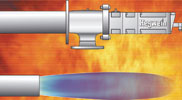
Hegwein’s gas and dual fuel fired igniters have a compact design with an integrated ignition transformer and flame monitor/burner control. Their built in flame ionisation electrode is ideally located and no high voltage cable is required on site. With guaranteed electromagnetic compatibility, the instruments have a rugged, low maintenance design and are available in sizes ranging from 100 kW to 3,6 mW.
Dual fuel igniters for extra light fuel oil (diesel) can also handle either propane/butane or natural gas. All types have an extremely tight and long pilot flame, eliminating the need for an automatic retraction system. Class 1, 2 or 3 igniters are also available according to NFPA. The igniters have a smoke free flame and custom tube lengths are offered in 10 mm increments.
Various types are offered. The ZAEL0 oil fired igniters for diesel have a maximum heat release of 100 kW and are designed for ignition of medium sized oil burners in industrial furnaces and boilers. The ZAZL2 dual fuel igniters for diesel or gas have a maximum heat release of 1000 kW in oil mode and 400 kW in gas mode and are used for the ignition of large oil or heavy fuel oil fired burners in utility boilers. The ZAZL3 dual fuel igniters for diesel or gas have a 1000 kW maximum heat release for both oil and gas mode and are designed for ignition of large oil or heavy fuel oil fired burners in utility boilers.
ZAVEX oil fired igniters for hazardous areas have a maximum heat release of 100/300/1000 kW and are suited for operation in ATEX zone 1 applications. The ZXAEL0 models with a maximum heat release of 100-3600 kW are suited for ATEX zone 2 applications.
Hegwein manufactures every igniter in a sophisticated modular assembly system and subjects every subcomponent to a 100% function test. The most important feature to consider when planning for an igniter is the required heat release from the pilot flame. In Europe, it is customary to supply 2 to 8% of the startup capacity of the corresponding main burner. In contrast, those plants falling under the jurisdiction of the NFPA typically require a higher heat release.
For more information contact Colwyn Savings, OEN Enterprises, +27 (0)11 675 4447, [email protected], www.oenenterprises.co.za
Further reading:
Infrared thermometers for electrical, industrial and HVAC applications
Comtest
Maintenance, Test & Measurement, Calibration
: Comtest, distributor of Fluke test and measurement equipment, explains how handheld infrared thermometers are transforming maintenance in electrical, industrial and HVAC environments, with three measurement strategies and a wide range of practical applications.
Read more...
Reverse-engineering legacy industrial gearbox parts
Maintenance, Test & Measurement, Calibration
WEG Africa’s turbine workshop uses 3D scanning technology to reverse-engineer components for legacy gearboxes, turbines and compressors, enabling equipment to run for decades after OEM support and spare parts have dried up.
Read more...
Unlocking ICCP remote monitoring
Omniflex Remote Monitoring Specialists
Maintenance, Test & Measurement, Calibration
Cathodic protection keeps buried and submerged pipelines safe from corrosion, but verifying it traditionally means costly, hazardous manual site visits. Omniflex explains how a retrofit module brings remote monitoring to ageing transformer rectifiers without replacing functional infrastructure.
Read more...
Microdieseling – the explosions you never hear
Maintenance, Test & Measurement, Calibration
Microdieseling is a pressure-induced thermal degradation mechanism in which entrained air bubbles are compressed so rapidly that the surrounding oil ignites, producing soot, varnish and sludge. WearCheck explains how it happens, why the damage varies, and how oil analysis detects it.
Read more...
Electrostatic spark discharge – when static strikes back
Wearcheck
Maintenance, Test & Measurement, Calibration
WearCheck technical manager, Steven Lumley explains how static electricity accumulates in modern low-conductivity lubricants, why compact system designs and fine filtration make ESD more likely, and how to recognise the degradation it leaves behind.
Read more...
High-speed cameras for crash testing
Horne Technologies
Maintenance, Test & Measurement, Calibration
Vision Research has expanded its Phantom C-series with two cameras optimised for crash and safety testing, offering 4 and 8 megapixel sensors rated to 170G, up to 1180 frames per second, and Phantom Academy application training planned for South Africa next year.
Read more...
SKF extends remanufacturing expertise to bearing clearance modification
SKF South Africa
Maintenance, Test & Measurement, Calibration
Using its clearance modification expertise, SKF helped a mining equipment OEM salvage spherical roller bearing inventory that would otherwise have been scrapped, confirming a new capability within its remanufacturing services and avoiding redundant procurement.
Read more...
When maintenance-system compliance starts replacing plant reliability
Wearcheck
Maintenance, Test & Measurement, Calibration
WearCheck ARC division manager, Annemie Willer argues that the greatest threat to effective maintenance is no longer a lack of technology, but the gradual replacement of technical judgement by CMMS compliance, leaving no one owning the machine.
Read more...
Automatic lubrication systems drive mobile mine machine reliability and uptime
SKF South Africa
Maintenance, Test & Measurement, Calibration
SKF’s Lincoln P203 progressive lubrication systems are improving reliability and uptime on mobile machines at a Zambian gold mine, with installation of 45 units completing by October 2026.
Read more...
Nitration: the acid you didn’t see coming
Wearcheck
Maintenance, Test & Measurement, Calibration
Nitration is as destructive as oxidation in many engines but far less understood. WearCheck technical manager, Steven Lumley explains how nitrogen oxide gases degrade lubricants, why the process is difficult to detect, and what oil analysis can reveal before damage occurs.
Read more...










 printer friendly version