


Flow Measurement & Control


Magnetic flowmeters with ceramic lining from Yokogawa

February 2012 Flow Measurement & Control

Yokogawa application note.

Ceramic lined magnetic flowmeters have seen increased use in biotechnology industries in recent years, the characteristics of the liner making it highly desirable in sanitary applications. Ceramic liners can tolerate higher temperatures and pressures than most other liner materials; other liners can also release plasticisers and drying agents into the product in a process referred to as leaching. Ceramic liners are much less likely to contaminate the process by leaching. One particular concern when using ceramic liners is thermal shock and the damage that can be done when inferior designs are subjected to large, rapid swings in temperature.

Application

Yeast is used in industrial processes such as the production of antibiotics, penicillin and other medicines, as well as in the fermentation of beer and alcoholic beverages. If the lines are not properly sterile, yeast fungus can infect the process and ruin the batch. Cleaning and sterilisation between batches is an absolute necessity and is often accomplished through the use of hot water or steam.

CIP (clean in place) and SIP (sterilise in place) applications can subject meters to drastic temperature fluctuations in short periods of time, which can lead to a variety of failures in meters with inferior design and materials of construction. Electrode seals can fail due to differing expansion rates of the liner and electrodes and inferior liner materials can crack and fail causing leakage and loss of measurement.

Solution

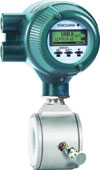
Yokogawa’s ceramic liner can offer customers superior resistance to thermal shock and thus failures that occur due to liner cracking. Yokogawa’s extremely pure (99,9%) Al2O3 liner material increases the host meter’s resistance to thermal shock considerably. Another major advantage of the Admag ceramic design is the electrode construction, all sizes utilise a platinum-alumina cermet electrode. The electrode is a mixture of platinum and alumina powders sintered into the liner during the manufacturing process, resulting in an electrode that is an integral part of the liner. This method of construction has several major advantages over solid electrode designs: the primary benefit is the elimination of two potential leak paths and, since the electrodes are an integral part of the liner, there is no seal to fail as with meters using solid electrodes.

Another advantage of the construction is that the electrode and the liner have the same thermal expansion rates. Differing expansion rates can lead to improper sealing around the electrode and, over time, can contribute to stress cracks at the electrode/liner seal. Both can lead to premature failure of the meter due to leakage.

A major biotechnology manufacturer recently conducted a yearlong test to evaluate the effects of thermal shock from CIP cleaning on magnetic meters with ceramic liners. Yokogawa’s Admag AXF series completed the test with no problems, while other meters showed blistering and cracking. Some even had to be withdrawn before the tests were completed.

Summary

Yokogawa’s use of cermet electrodes and 99,9% pure Al2O3 liner material allows the Admag to provide reliable service where other devices may fail due to leakage around the electrode or thermal cracking of the liner. This offers longer service life with less down time, reduced maintenance and lower overall operating cost.

For more information contact Johan van der Westhuizen, Yokogawa SA, +27 (0)11 831 6300, [email protected], www.yokogawa.com/za


Credit(s)


Share this article:
Share via emailShare via LinkedInPrint this page

Further reading:

Reducing fluid control and automation complexity in pharma process development
Flow Measurement & Control
Designing and building pharmaceutical processes or skids demands close coordination between mechanical, electrical, instrumentation and automation engineering teams.

Read more...
Flow imaging microscopy for the early detection of harmful algal blooms
Flow Measurement & Control
Yokogawa’s advanced flow imaging microscopy technology, FlowCam is helping utilities move from reactive treatment to proactive prevention of harmful algal blooms in reservoirs, dams and freshwater sources.

Read more...
Yokogawa’s free chlorine analyser is gold standard for water treatment utilities
Yokogawa South Africa Analytical Instrumentation & Environmental Monitoring
One of the key factors in ensuring safe drinking water is the accurate monitoring of free chlorine residuals. This is where advanced online analysers, such as Yokogawa’s FC800 free chlorine analyser, are becoming increasingly valuable for water treatment operators and municipal utilities.

Read more...
Never waste a drop
Flow Measurement & Control
Manufacturers of pumps, valves and related equipment have an important role to play when systems for water are being designed or upgraded and should be included at every stage of a project to ensure that the work is carried out within the equipment’s capabilities.

Read more...
Ultrasonic flow meters
ifm - South Africa Flow Measurement & Control
The ultrasonic flow meter of the SU series from ifm - South Africa monitors liquid media such as water, glycol solutions or industrial oils. It detects the three process categories volumetric flow quantity, consumed quantity and medium temperature.

Read more...
How utilities identify water losses in Northern Europe
Flow Measurement & Control
Norwegian leak detection specialist, Ovarro outlines how municipalities are responding to hidden water loss using acoustic monitoring and analysis tools that provide early indications of developing leaks.

Read more...
Senix sensors provide flood warnings
Instrotech Flow Measurement & Control
To create the world’s most sophisticated flood monitoring and forecasting system, the US State of Iowa’s Flood Centre (IFC) uses more than 200 Senix ToughSonic 30 and ToughSonic 50 ultrasonic sensors to measure water levels in streams across the state.

Read more...
Mastering inline LNG flow monitoring
Flow Measurement & Control
[Sponsored] As global demand for cleaner, more flexible energy sources continues to rise, liquefied natural gas (LNG) stands at the forefront of the energy transition. Engineered for excellence in cryogenic environments, the Anton Paar L-Cor 8000 flowmeter redefines inline LNG flow monitoring.

Read more...
Magnetic-inductive flowmeter with effective compact electronics and IO-link
Instrotech Flow Measurement & Control
KOBOLD has combined two of its proven components, the successful type MIK magnetic-inductive flow meter and the popular U-PACE compact electronics, creating an exciting new compact flow instrument at the best price.

Read more...
Dosing chlorine gas safely and sustainably
Flow Measurement & Control
Chlorine gas is central to a range of industrial processes but is highly dangerous. The solution is the deployment of a system solution for chlorination from Lutz-Jesco.

Read more...


While every effort has been made to ensure the accuracy of the information contained herein, the publisher and its agents cannot be held responsible for any errors contained, or any loss incurred as a result. Articles published do not necessarily reflect the views of the publishers. The editor reserves the right to alter or cut copy. Articles submitted are deemed to have been cleared for publication. Advertisements and company contact details are published as provided by the advertiser. Technews Publishing (Pty) Ltd cannot be held responsible for the accuracy or veracity of supplied material.


© Technews Publishing (Pty) Ltd | All Rights Reserved

