



What solutions are available?
The movement of materials for mining, paper milling, food production and the like, is of critical importance to any operation: the key decision being transport reliability versus the capital and operational cost of the transportation system.
The decision revolves around whether trucking or conveyor systems should be used. Simply put, conveyor systems are the ideal solution to transport manageable sized material from one processing point to another, such as an underground mining operation to a processing refinery or from a silo to a packing plant. The reliance on manpower is minimised and reliability is maximised with the use of conveyor systems, provided protection measures are taken to reduce the chance of mechanical or electrical failure.
A key protection area for consideration is how to handle the issue of a conveyor belt system fire. What questions need to be asked? What areas need consideration? What solutions are available? Are they practical solutions? The area of conveyor belt fire protection is a specialised niche area, where knowledge can be vague or hard to come by.
The essential philosophy behind conveyor belt fire protection revolves around the preservation of the conveyor belt system structure. A fire can weaken the metal structure, in some cases, to the point of collapse. Hence this thinking places the cross-hairs right on the need for very early detection that will result in the successful extinguishing of fire, while at the same time cooling the affected structure.
Detection methods have evolved since the days of 1940s thermocouple hoods. Fire Detection companies have tried to adapt detection devices that were designed for less rugged applications and sought in the past to use them on conveyor belt systems. The uses of spark and ember detectors have been popular in the past, but have largely proved ineffectual. The problem with these types largely revolve around the potential of false alarms, namely from reflective light or solar emissions. Also the monitored bandwidth that would result in an alarm is quite narrow, and early stage combustion cannot always be detected.
Importantly, the sources of conveyor belt fires result from two areas, either static heat build-up from friction caused by belt movement, over a jammed idler for example, or moving fire on the belt itself. For early detection of static type fires, linear heat detection cable (LHDC) has proven to be reliable when correctly installed (ideally at a height of 1–1,5 m above the belt). Tests have shown that LHDC responded within two minutes to a coal fire sized at 0,1 square metres.
LHDC can also be placed between the belt and return belt if practical. The primary advantage is that it is easily configurable, either into zoned areas along a conveyor that can signal the belt to stop and switch on a water-spray system, or it can be integrated into a sprinkler system that uses temperature threshold bulbs to operate.
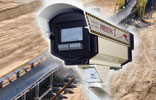
Another primary consideration is how to detect a moving fire as early as possible. The simple answer is to delve back into those physics books and relate infrared emissions to the thermal properties of masses; namely, black body radiation where infrared emissions of a much wider spectrum (compared to spark and ember detectors) can be detected when an object begins to increase in temperature. Such devices offer the capability to detect hot burning objects on a conveyor belt system well before they begin to glow. In some cases, they can detect such objects when buried. These types of detectors have demonstrated astounding results in offering a reliable yet highly sensitive response to the early stages of combustion that can occur on a conveyor belt system.
Combined together, linear heat detection cable and thermal energy black body fire detectors offer the most comprehensive solution to detecting fires on conveyor belt systems. If installed properly, they can be integrated into a water extinguishing system, either a sprinkler bulb or a water-spray type.
It is only recently that fire engineers are beginning to understand the best approaches to conveyor belt fires and how to put such fires out. Factory Mutual has put together a design matrix in its FM Global Property Loss Prevention Datasheets FM7-11 to help select the appropriate type of water system for conveyor belts. These are excellent guidelines for mitigating against damage caused by fire and are, in fact, freely available online.
By following the simple steps in FM7-11 in conjunction with the latest approaches in fire detection, companies can limit the losses caused by conveyor belt fires. No doubt with some gentle negotiation, one could earn a rebate from the underwriters!
For more information contact Samantha Wright, Alien Systems & Technologies, +27 (0)11 949 1157, sam@astafrica.com, www.astafrica.com
| Tel: | +27 11 949 1157 |
| Email: | sales@astafrica.com |
| www: | www.astafrica.com |
| Articles: | More information and articles about Alien Systems & Technologies |






© Technews Publishing (Pty) Ltd | All Rights Reserved
 printer friendly version