



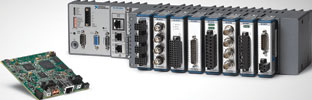
NI expands the advanced control and monitoring platform with higher performance and smaller form factor targets.
National Instruments has announced an expansion to its growing NI reconfigurable I/O (RIO) platform with the addition of the highest performance and first multicore NI CompactRIO systems and smallest NI single-board RIO devices. The new NI cRIO-908x systems feature an Intel Core i7 dual-core processor for increased processing power, Xilinx Spartan-6 field-programmable gate arrays (FPGAs) and the option of a Windows Embedded Standard 7 (WES7) OS configuration for monitoring and control applications that require exceptional performance and the ruggedness of CompactRIO. For high-volume and OEM applications, the new NI sbRIO-9605/06 devices are sized from less than 102 x 96 mm and offer greater customisation and I/O support than previous versions.
With the Intel Core i7 dual-core 1,33 GHz processor and up to a Xilinx Spartan-6 LX150 FPGA, the cRIO-908x systems deliver the highest processing power of any CompactRIO product and are ideal for performing complex signal processing and control within applications such as rapid control prototyping, advanced motion control and machine vision. The controllers can be configured with a WES7 OS, which gives engineers access to a broad ecosystem of Windows-based software and integrated graphics, or a real-time OS for reliable, deterministic performance. The systems provide a variety of high performance peripheral connectivity including two Gigabit Ethernet ports, a MXI Express port, four USB ports, RS232 and RS485 serial ports and a new CPU eXpansion Module (CXM) that makes it possible to add custom connectivity and expansion to CompactRIO using industry standard protocols.
“By combining the power of the Intel Core i7 processor and the productivity of National Instruments integrated CompactRIO hardware and LabVIEW software, we are giving engineers a high-performance solution to solve their advanced control and monitoring problems,” said Michelle Tinsley, general manager of the Intel embedded computing division.
The new NI Single-Board RIO devices provide a small and cost-optimised form factor for the NI RIO platform and are ideal for embedded monitoring and control applications in industries such as energy and medical. The devices feature a 400 MHz processor and Xilinx Spartan-6 FPGA to provide reliability and performance at a low price point for OEMs. The devices also offer built-in peripherals such as RS232, CAN, USB and Ethernet. Additionally, the new devices feature a high-density and high-bandwidth connecter that gives engineers direct access to the FPGA and processor as well as the ability to add peripherals for further customisation.
“NREL is working directly with National Instruments to develop advanced power electronics inverter control hardware based on reconfigurable FPGA technology for renewable, electric vehicle and smart grid systems,” says Dr. Bill Kramer, who manages research and development for Energy Systems Integration Technologies at The National Renewable Energy Laboratory. “With the new high bandwidth connector on these NI Single-Board RIO devices and LabVIEW programming tools, we now can take our simulations and advanced algorithms from prototype to high-volume, deployable targets more quickly than ever.”
An integral part of the NI graphical system design approach, NI RIO technology combines NI LabVIEW system design software with commercial off-the-shelf hardware to simplify development and shorten time to market when designing advanced control, monitoring and test systems. NI RIO hardware, which includes CompactRIO, NI Single-Board RIO, R Series boards and PXI-based NI FlexRIO, features an architecture with powerful floating-point processors, reconfigurable FPGAs and modular I/O. All NI RIO hardware components are programmed with LabVIEW to give engineers the ability to create custom timing, signal processing and control for I/O without requiring expertise in low-level hardware description languages or board-level design.






© Technews Publishing (Pty) Ltd | All Rights Reserved
 printer friendly version