


Motion Control & Drives


Electric aircraft cuts CO2 emissions

August 2011 Motion Control & Drives

Siemens supplies integrated drive train for the first series hybrid electric aircraft in the world.

Siemens AG, Diamond Aircraft and EADS presented the world’s first aircraft with a serial hybrid electric drive system at the Paris Air Show Le Bourget 2011. The aircraft was built by the three partners to test the hybrid electric drive concept. In the future, the technology will cut fuel consumption and emissions by 25%, compared to today’s most efficient aircraft drives. The Siemens Drive Technologies Division supplied the drive train comprising motor, converter and control electronics and utilised the drives and engineering expertise already gained in industrial areas.

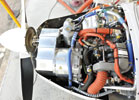
Air traffic accounts for some 2,2% of CO2 emissions worldwide. For this reason, aircraft must become more efficient. One possible solution – which Siemens and its partners Diamond Aircraft and EADS are testing in the DA36 E-Star motor glider – is to electrify the drive system. The motor glider, which is based on Diamond Aircraft’s HK36 Super Dimona, is the only aircraft of its kind in the world. It is the first to use a serial hybrid electric drive, which has been utilised to date only in cars, as an integrated drive train. The plane’s propeller is powered by a 70 kW electric motor from Siemens. Electricity is supplied by a small Wankel engine from Austro Engine with a generator that functions solely as a power source. A Siemens converter supplies the electric motor with power from the battery and the generator. Fuel consumption is very low since the combustion engine always runs with a constant low output of 30 kW. A battery system from EADS provides the increased power required during takeoff and climb. The accumulator is recharged during the cruising phase.

“The serial hybrid electric drive concept makes possible a quiet electric takeoff and a considerable reduction in fuel consumption and emission,” says Christian Dries, the owner of Diamond Aircraft. “It also enables aircraft to cover the required long distances.”

In comparison to the most efficient state-of-the-art technologies now available, the electric drive can save up to 25% of fuel and emissions. The technology is to be tested initially on small aeroplanes, but in the long term this drive will also be used in larger aircraft.

The Siemens Drive Technologies Division supplied a low-voltage motor, a frequency converter and the control electronics. Siemens utilises the expertise gained in the implementation of the integrated electric drive train in other areas, for example, as main propulsion engine for cruise ships. Ralf-Michael Franke, CEO of the Siemens Drive Technologies Division states: “This example enables us to demonstrate our competence in the entire drive train. We combine our comprehensive drives portfolio with engineering and industry know-how and adapt the components to the specific application. In this way, we can supply our customers with the ideal drive train which will enable them to efficiently drive a ship and a hybrid bus or fly an aircraft.”

The next development step will be to optimise the integrated drive train further. Siemens scientists are currently working on a new electric motor that is expected to be five times lighter than conventional drives. In two years, another aircraft is expected to be equipped with an ultra-light electric drive. The electric motor glider successfully completed its first flight at the Wiener Neustadt airfield in Vienna early in June just prior to the Paris Air Show where demonstration flights were conducted daily.

For more information contact Keshin Govender, Siemens Southern Africa, +27 (0)11 652 2412, [email protected], www.siemens.co.za


Credit(s)


Share this article:
Share via emailShare via LinkedInPrint this page

Further reading:

Solving common automation challenges with Festo’s servo drive and servo motor solutions
Festo South Africa Motion Control & Drives
Automation projects face challenges that include limited installation space, the need for precise and repeatable linear motion, rising cycle-speed demands, and seamless integration with existing control architectures. Festo’s servo portfolio directly addresses these issues with compact, modular drive and motor solutions designed for specific applications.

Read more...
Inside the Giant Magellan Telescope with mechanical engineering at astronomical scale
Motion Control & Drives
Construction of the Giant Magellan Telescope, set to become the world’s largest Gregorian optical infrared telescope, is well underway. While its scientific mission is to transform astronomy, its performance depends heavily on advanced mechanical, hydraulic and pneumatic engineering.

Read more...
Filtration as a reliability driver in motion control systems
Parker Hannifin - Sales Company South Africa Motion Control & Drives
This article highlights the importance of filtration in motion control systems, how contamination affects performance, and what fleet managers, operators and maintenance teams in southern Africa can do to reduce downtime, avoidable wear and costly repairs, aided by Baldwin Filters.

Read more...
Supporting construction of next-gen floating offshore wind turbines
Motion Control & Drives
While windy locations naturally make ideal spots for offshore wind farms, they bring challenges when it comes to assembling wind turbines, particularly in ports. Mammoet was approached by Euroports to support with the marshalling and assembly of the components that make up the three turbines at Port-la-Nouvelle in France.

Read more...
Rollers excel where profits balance on a knife edge
igus Motion Control & Drives
Polymer component specialist manufacturer, igus has developed a range of lubrication-free long-life knife edge rollers designed to improve the transfer of products between conveyor belts in high-speed production environments.

Read more...
Bringing physical AI to the factory floor by deploying humanoids in industrial operations
Siemens South Africa Motion Control & Drives
Siemens and Humanoid have marked a landmark milestone in the journey to bring physical AI from vision to industrial reality. Humanoid’s humanoid robothas been successfully tested in operations at Siemens’ electronics factory in Germany, performing autonomous logistics tasks.

Read more...
Next-generation oil-free motor systems with active magnetic bearings
WEG Africa Motion Control & Drives
WEG and SpinDrive are collaborating to integrate SpinDrive’s AMBs and built-in IoT condition monitoring into WEG’s market-leading electric motor offering, creating an oil-free, maintenance-free drive solution.

Read more...
Rising demand for advanced coolant technology
Motion Control & Drives
As modern engines become smaller, more powerful and increasingly complex, coolant technology has undergone a fundamental transformation.

Read more...
Addressing cost, supply and disease pressures in Africa’s feed industry
Motion Control & Drives
Feed producers across Africa are operating in an increasingly complex and volatile environment. The pressures are forcing producers to rethink how they operate, balancing cost control, production efficiency and the need for greater flexibility in an unpredictable market.

Read more...
Rapid headframe replacement for Canada’s biggest potash mine
Motion Control & Drives
Mammoet has supported Ledcor with the construction of BHP’s new Jansen potash mine.

Read more...


While every effort has been made to ensure the accuracy of the information contained herein, the publisher and its agents cannot be held responsible for any errors contained, or any loss incurred as a result. Articles published do not necessarily reflect the views of the publishers. The editor reserves the right to alter or cut copy. Articles submitted are deemed to have been cleared for publication. Advertisements and company contact details are published as provided by the advertiser. Technews Publishing (Pty) Ltd cannot be held responsible for the accuracy or veracity of supplied material.


© Technews Publishing (Pty) Ltd | All Rights Reserved

