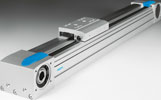
Festo recently launched the EGC electric drive range that it says defines a new performance paradigm for the motion control industry and features a radically new profile design. Not only do the new axes perform better than previous generation counterparts, they also cost less. During its extensive R&D programme aimed at improving the performance and service life of its electro-mechanical drives, Festo looked to Italian maestro Leonardo da Vinci’s Cupola arch for inspiration.
“The main body of every EGC axis is constructed from extruded aluminium, with a unique computer optimised cross sectional shape incorporating an internal arch-like structure. This feature provides the drives’ unprecedented rigidity and load bearing capabilities with very low mass,” explains Festo product manager, Ernst Smith.
Feed forces as high as 3000 N and speeds of up to 5 m/s, as well as new levels of acceleration and torque resistance, make them ideal for use in gantry-type materials handling, supplying and transporting systems.
The moving carriage is fitted with the latest high performance caged ball bearings and the fully sealed bearing cassette has grease pockets for optimal lubrication. Festo also offers a number of optional guide scrapers and grease feed adapters for use with centralised lubrication systems. The top face of the aluminium carriage is fitted with helicoils and centring holes to facilitate fast and accurate load mounting.
A choice of toothed belt or ballscrew drive mechanisms – with numerous variants in both categories – makes it easy to choose an actuator optimally matched to application needs. “Unlike most competitive products, the axes’ stainless steel guide rail is mounted externally, allowing the moving carriage to accommodate large cantilever and offset loads that apply very high moments of torque to the carriage,” says Smith.
The toothed belt version of the EGC axis is available with a choice of 50, 70, 80, 120 and 185 mm wide profiles, and the three largest models can be supplied with standard stroke lengths of up to 8,5 m. Different models within this range are capable of generating feed forces as high as 2500 N and of handling speeds up to 5 m/s and acceleration rates up to 50 m/s².
Another advantage of the EGC-toothed belt versions’ external guide arrangement is that it needs smaller belt pulleys, often removing the need for a gearbox. The unique cover opening and securing mechanism enable belt replacing without dismantling the axis, speeding up maintenance and lowering service costs.
“The ballscrew version of the EGC axes is particularly useful in short cycle time applications that demand high feed forces and very accurate and repeatable positioning. The spindle is designed for low noise, and the body of the axis is fitted with a non-metallic, clip-in cover band to guard against the ingress of contaminants,” concludes Smith.
The new EGC axes are easy to install. A hollow drive pinion, plus a new design of elastomer motor coupling featuring an expanding shaft, ensures simple, backlash-free connection.
Smarter motor technology for high-performance industrial automation Adroit Technologies
Motion Control & Drives
Adroit Technologies is bringing Mitsubishi Electric’s EM-A series permanent magnet motors to Africa, offering servo-like speed and position control at a lower cost by combining patented sensorless control with the FR-E800 inverter to eliminate encoders while achieving IE5 efficiency.
Read more...A smarter approach to simplifying motion architecture
Motion Control & Drives
n motion system design, the wiring and drive placement between motor and drive are often decided by default, yet they shape a machine’s cost, footprint and adaptability. Kollmorgen sets out how single-cable and decentralised architectures simplify the cabinet.
Read more...Robotic case packer achieves 99% uptime Rockwell Automation
Motion Control & Drives
DCC Automation designed a new robotic case packer for a nutrition supplement manufacturer using delta robots and a unified Rockwell Automation control platform, cutting changeover time from 45 minutes to 5 minutes, and achieving 99 to 99,5% uptime against the previous 10% per-shift downtime.
Read more...igus puts 3D-printed wear materials to the test igus
Motion Control & Drives
A new igus white paper compares its tribological iglidur 3D-printing materials directly with conventional POM, reporting lower wear, more stable friction and up to ten times longer service life in gear testing for customised, low-volume and replacement components.
Read more...SEW-EURODRIVE’s expanded local engineering capability SEW-EURODRIVE
Editor's Choice Motion Control & Drives
At Electra Mining Africa, SEW-EURODRIVE demonstrated how its expanded local engineering capability, digital technologies and lifecycle support strategy help customers improve reliability, energy efficiency and total cost of ownership across the full life of their drive assets.
Read more...Latest Danfoss automation drive Bearing Man Group t/a BMG
Motion Control & Drives
BMG has launched the Danfoss iC7-Automation enclosed variable speed drive range in South Africa, backed by significant local stockholding of 400 V models up to 710 kW, approved warranty workshops, and DrivePro digital asset management support.
Read more...Severe-duty workhorses powering mining
Motion Control & Drives
Mining machines such as rock crushers, pumps and conveyors need motors that combine high torque with robust enclosures, seals and cooling. WEG Africa explains how severe-duty motors deliver more than a decade of reliable performance in harsh conditions while meeting modern energy-efficiency standards.
Read more...Looking beyond the spec sheet when choosing motion architecture
Motion Control & Drives
When machine builders focus only on torque, speed and price, engineering time, integration effort and long-term maintainability get overlooked. Kollmorgen explains how thinking at the system level, not the component level, leads to better motion architecture choices.
Read more...Economy drive system closes the drive gap in the entry-level segment Beckhoff Automation
Editor's Choice Motion Control & Drives
Beckhoff has launched an economy drive system pairing its new AX1000 servo drive and AM1000 servomotor with the AF1000 dual-axis variable frequency drive on a shared EtherCAT platform, targeting series machines and price-sensitive markets without sacrificing TwinCAT integration or functional safety.
While every effort has been made to ensure the accuracy of the information contained herein, the publisher and its agents cannot be held responsible for any errors contained, or any loss incurred as a result. Articles published do not necessarily reflect the views of the publishers. The editor reserves the right to alter or cut copy. Articles submitted are deemed to have been cleared for publication. Advertisements and company contact details are published as provided by the advertiser. Technews Publishing (Pty) Ltd cannot be held responsible for the accuracy or veracity of supplied material.










 printer friendly version