Bottle filling made easy
August 2010
PLCs, DCSs & Controllers
CBI-electric: low voltage has the solutions from Mitsubishi Electric.
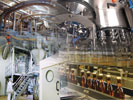
At first glance, a filling application involving the transportation of a liquid product into a solid vessel may seem simple. However what few people realise is the high accuracy and feed rates required for such high-precision and high-speed applications. The complex requirements of transporting the vessels, usually in the form of bottles, inserting the filling nozzle and controlling the flow rate of the liquid product, requires a highly capable function controller to handle the speed of the process. Finding the right automation solution to meet these requirements is a challenge for most engineers that CBI solves by providing a Mitsubishi solution that is simple and cost effective.
Advanced control using electronic camming
Ensuring that the control of the filling nozzle is synchronised with the rotational conveyor and flow controller is the challenge for most bottle filling applications. The controller has to ensure that the liquid is fed accurately into the bottle opening. The flow rate and the nozzle height also have to be precisely controlled so as to eliminate the risk of frothing and overflow of the liquid. By using Mitsubishi Electric’s motion controller CPU (based on the Q series automation platform), cam profile can be controlled intelligently with a software camming system that replaces hardware-based methods. The system is very flexible; when the bottle type has to be changed, the cam profile software can be simply exchanged eliminating the need for a system overhaul.
Linking high-speed networks
In addition to the motion controller, the actual transfer and conveyor aspect of the application can be controlled using Mitsubishi Electric’s intelligent and energy saving inverters FR-A700 via the open device level network CC-Link, centralised on the Q series controller. The fast rate bottle feed into the machine can be controlled by the Q series together with CC-Link network offering high-speed transmission of 10 Mbps with program execution in milliseconds. The Q series also enable connectivity to higher level systems via its Ethernet option module allowing real-time production data to be fed into ERP and MES systems. This continuous monitoring allows factory managers to report on actual bottling performance in real time without having to rely on statistical data. The high-speed servo drives are controlled directly by the motion controller on the Q series platform via high-speed SSCNET III, fibre-optic network. The network achieves speeds of up to 50 Mbps ensuring high speed and high accuracy. The cam profiles can be easily switched using the GOT1000 human machine interface touch screen, providing a user friendly interface to the bottle filling machine.
For more information contact CBI-electric: low voltage, +27 (0)11 977 0770, [email protected], www.cbi-electric.com
Further reading:
Network-capable remote relay system with flexible channel assignment
Phoenix Contact
PLCs, DCSs & Controllers
Phoenix Contact has launched a modular PLC-Interface Ethernet Gateway remote relay system with up to 56 configurable I/O channels, multi-protocol support including Profinet Class C and S2 redundancy, and compatibility with established controller software for straightforward network integration.
Read more...
Seven checks before replacing an obsolete industrial control component
PLCs, DCSs & Controllers
An obsolete control component rarely fails in isolation. Before ordering an exact spare, manufacturer successor or engineered alternative, maintenance and procurement teams should work through seven checks to define the problem properly and avoid a costly mismatch.
Read more...
Loop signature Part 2-6
PLCs, DCSs & Controllers
This instalment of the Loop Signature series introduces frequency plot theory as a foundation for understanding process dynamics, explaining Bode plots, dynamic gain, phase lag and their relationship to control loop tuning.
Read more...
The rise of software-defined brownfield automation
Schneider Electric South Africa
PLCs, DCSs & Controllers
Schneider Electric’s EcoStruxure Automation Expert is enabling brownfield operators to modernise incrementally, decoupling control logic from hardware to bridge legacy equipment and future-ready operations without disrupting production.
Read more...
Upgrading alarm systems for critical industries
Omniflex Remote Monitoring Specialists
PLCs, DCSs & Controllers
Omniflex’s OMNI16R alarm annunciator platform provides a direct replacement for legacy CSA systems such as MPAS 90 and SA9100, enabling operators in oil and gas, nuclear and power generation to modernise alarm infrastructure without sacrificing the clarity required for safe operations.
Read more...
How DCS can step off the hardware obsolescence treadmill
Schneider Electric South Africa
PLCs, DCSs & Controllers
Schneider Electric argues that virtualising DCS environments breaks the cycle of hardware obsolescence, giving plant operators a smarter path to lifecycle modernisation without production disruption.
Read more...
Loop signature Part 2-6
PLCs, DCSs & Controllers
The Loop Signature series turns to frequency plot theory, explaining Bode open-loop plots and how dynamic gain, phase lag and crossover frequency can be extracted from test data to inform more accurate control loop tuning.
Read more...
PC-based control in surgery
Beckhoff Automation
Editor's Choice PLCs, DCSs & Controllers
Researchers at the University of Basel are using Beckhoff PC-based control technology to develop a miniature laser robot for minimally invasive bone surgery.
Read more...
IIoT controller for the field and control cabinet
ifm - South Africa
PLCs, DCSs & Controllers
The IIoT controller from ifm is a powerful, communicative and flexible PLC solution in machine and plant digitalisation.
Read more...
How the DCS can step off the hardware obsolescence treadmill
Schneider Electric South Africa
PLCs, DCSs & Controllers
Ageing servers and unsupported operating systems are quietly eroding the stability of process plants that rely on distributed control systems. Kobus Vermeulen of Schneider Electric explains how virtualising the DCS environment can break the hardware obsolescence cycle without disrupting operations.
Read more...










 printer friendly version