When IT security is considered holistically, it becomes obvious that it extends far beyond logical, technical and organisational security.
Apart from the common firewalls, virus scanners and storage concepts, effective protection of IT structures against physical risks is immensely important. Irrespective of the required protection class – from basic protection to high-availability with minimised failure tolerances – IT security based on individual requirements is necessary. This requires adaptable, individual and scalable solutions which respond to the corporate structures and not vice versa.
Economic IT security solutions are therefore always modular, so that they can be flexible and adaptable to the local and spatial circumstances. They are scalable so that they can grow with the business, and above all, they are comprehensive so that precisely the right protection is available if a relevant risk should occur. Thus it is important to be aware of the diverse risks in advance as this is the only way for a customised security solution to be planned and implemented to match demand.
IT needs new approaches
Modern IT safes are used to accommodate the security requirements for decentralised or functionally separated IT systems and data. This new class of security system is capable of encasing a 19 inch rack (or even several) so that a secure mini data centre is formed. The advantages are obvious: The IT safe provides the same protection classes as a data centre, but because of its smaller size and modularity it is quick and cost effective to install and maintain. A new location can be selected just as easily – dismantling and re-installation is a matter of only a few hours. Energy efficient infrastructures are deployed in such an IT safe.
Example: Airconditioning
Cooling systems can be built smaller, lighter and therefore less expensively for a cabinet than a room. In addition, the air ducting in an IT safe can be solved more elegantly as an air volume of only 2,5 cubic metres has to be supplied. Therefore, hot spots in the racks or pressure losses like those experienced in the raised airconditioning flooring of a data centre cannot arise. The energy hungry systems for the uninterruptible power supply (UPS) can also be optimally dimensioned and therefore cost effectively designed because the power consumption of the IT safe is clearly defined. Thus there are no oversized or undersized UPS systems which can cause a real headache for data centre planners in other areas. In addition, the resulting smaller UPS units can be replaced or increased at a lower cost.
Most important of all is the security gained for the company. The server racks are no longer located in the cloakroom or in the corridor, accessible to all, but in an all-round secure housing with the relevant protection classes against fire, water, smoke, gas, dust, unauthorised access or vandalism.
The modular IT centre
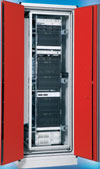
The Rittal Modular Safe LMS 9.3 provides users with a modular, extendable, mini-IT centre which combines an optimum reduction of exposure to physical and intrusion hazards.
The system provides comprehensive protection for computer and telecommunication systems, and therefore ‘multifunctional security’. The design facilitates transportation of extensive systems into cellars or upper storeys of buildings, and installation whilst IT systems are in operation.
The modular, extendable Rittal safe offers an appropriate level of protection for IT and communications systems at decentralised sites. In addition to the core fireproofing function, the safety cell of the Modular Safe offers genuine added value in a range of other risk areas.
Even in autonomous systems, human insight is important Schneider Electric South Africa
IT in Manufacturing
As AI, IIoT and digital twins reshape industrial operations, Schneider Electric’s Kobus Vermeulen and Bafana Msibi argue that the operator’s role is shifting from controlling equipment to interpreting intelligence, validating AI recommendations and making decisions that improve
Read more...AI-based quality inspection scales across P&G operations Siemens South Africa
IT in Manufacturing
Siemens and Procter & Gamble are expanding an AI-based visual inspection system across P&G’s manufacturing operations worldwide, inspecting products in real time at full line speed, and reducing scrap rates by 10 to 20% depending on the product.
Read more...How sustainability unlocks real business impact Rockwell Automation
IT in Manufacturing
Sustainability has moved from a compliance obligation to a strategic driver of resilience and value for manufacturers. Rockwell Automation explains how its Triple A framework and connected-data approach help producers cut energy, water and waste while improving productivity.
Read more...Mining’s AI future will depend on people as well as technology
IT in Manufacturing
South Africa’s mining industry is embracing digitalisation and AI, but AvenirHoldings chief executive officer, Tshidi Mndzebele says the real test is whether the people behind the industry are equipped to move forward with it, and outlines five things mining needs to get right.
Read more...How BIC overcame operational silos to integrate technology and people Rockwell Automation
IT in Manufacturing
Manufacturing giant BIC deployed Plex MES from Rockwell Automation at its Bizerte plant in Tunisia, replacing fragmented, partly in-house software with a single cloud-based execution system that broke operational silos and improved shop-floor visibility.
Read more...AI in industry is an early warning system, not a guarantee Schneider Electric South Africa
IT in Manufacturing
Schneider Electric’s Paul Steyn argues that AI in industrial maintenance is only as good as the infrastructure and people behind it, and explains the three layers a facility needs before predictive maintenance can deliver on its promise.
Read more...SA’s mining industry must put people at the heart of its digital future
IT in Manufacturing
South Africa’s mining industry employs around 470 000 people while its digital transition accelerates. Avenir’s chief executive officer, Tshidi Mndzebele argues that technology should enable and upskill the workforce rather than replace it, setting out five ways mining can make technology work for its people.
Read more...Quality control supports efficient tissue production Valmet South Africa
IT in Manufacturing
Valmet’s advanced quality control technology is helping tissue producers improve product consistency while reducing energy and raw material consumption. Its latest installation at KORO Paper in Vietnam combines real-time measurement, process optimisation and non-contact, nuclear-free quality control.
Read more...Patented algorithm maximises operator efficiency Rockwell Automation
IT in Manufacturing
Rockwell Automation piloted a patented anomaly detection algorithm and FactoryTalk DataMosaix at its Twinsburg electronics plant, giving operators 30 to 60 days’ advance warning of stencil failure, improving fail rates by 22% and achieving a 200% return on investment.
Read more...Cybersecurity must become part of the next era of industrial automation Adroit Technologies
IT in Manufacturing
The EU’s Cyber Resilience Act is setting a global benchmark for connected products, making cybersecurity a core engineering requirement in industrial automation. Adroit Technologies and Mitsubishi Electric explain how building security into controllers, PLCs and drives from the outset helps South African manufacturers protect production and meet international expectations.
While every effort has been made to ensure the accuracy of the information contained herein, the publisher and its agents cannot be held responsible for any errors contained, or any loss incurred as a result. Articles published do not necessarily reflect the views of the publishers. The editor reserves the right to alter or cut copy. Articles submitted are deemed to have been cleared for publication. Advertisements and company contact details are published as provided by the advertiser. Technews Publishing (Pty) Ltd cannot be held responsible for the accuracy or veracity of supplied material.










 printer friendly version